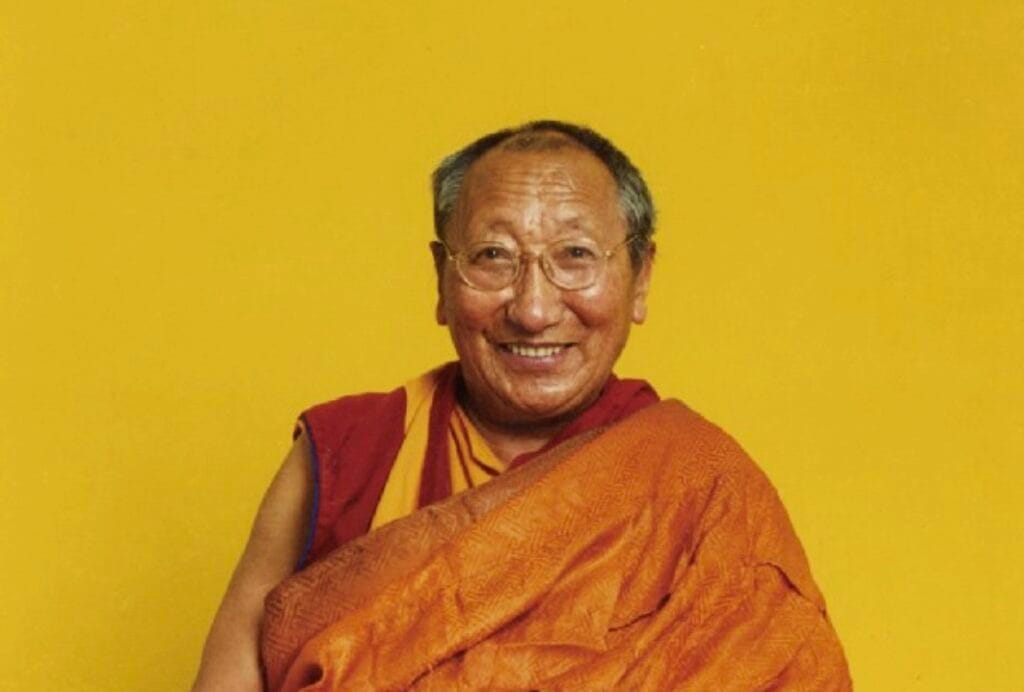
The great accomplished master who has attained profound understanding of the five sciences: Dharma King Pema Tsewang
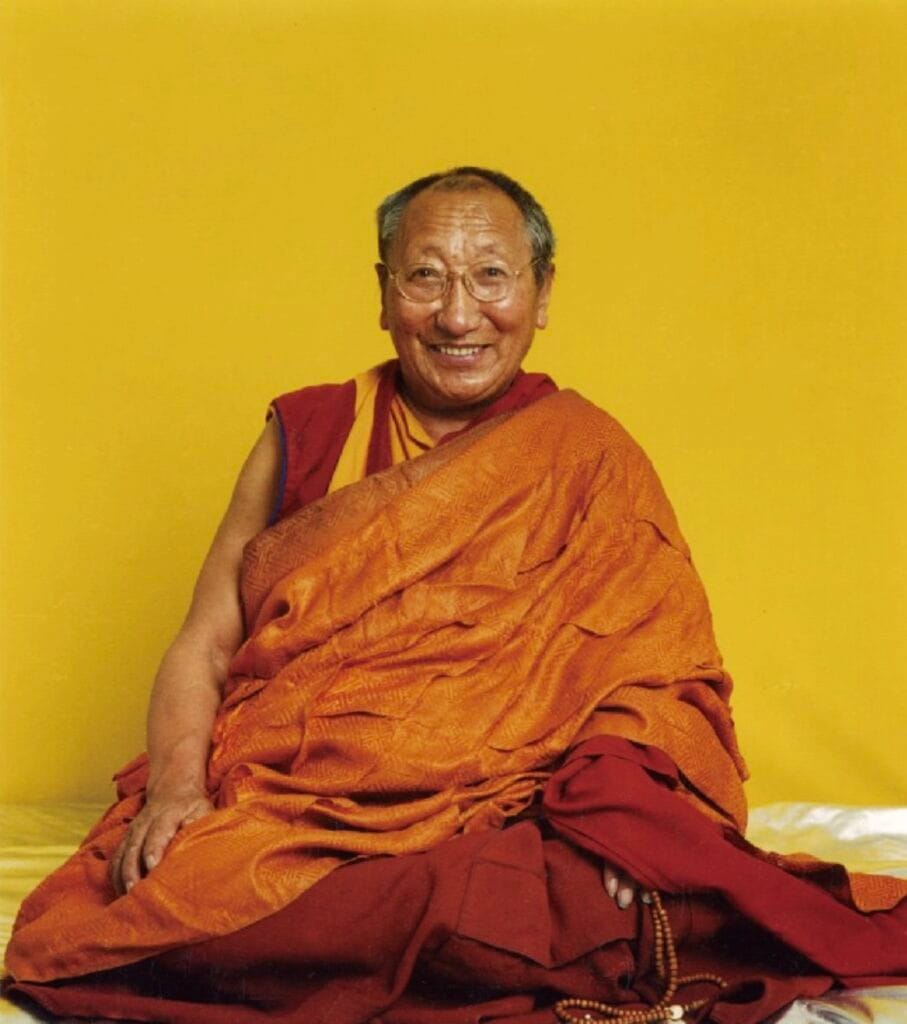
His Holiness the Dharma King Rinpoche was born in 1931 in the Zhaquka region of Kham. From a young age, he possessed exceptional wisdom and a compassionate and virtuous nature. At that time, many considered him to be an emanation of Vajrapani Bodhisattva, who compiled the Buddha’s teachings, and of the great Khenpo Bodhisattva Shantarakshita, who first propagated Buddhism in Tibet, and the great translator Dharmashri, among others. There were also many prophecies concerning him.
From the age of eleven to twenty-eight (1941-1958), His Holiness the Dharma King Rinpoche studied under great masters such as Azong Gyaltsen Jigme Dorje, Thukga Yeshe Norbu, and Pema Thangye Chenpa, diligently studying and mastering the profound treatises of both Sutra and Tantra, becoming a true Mahapandita (great scholar) proficient in the five sciences.
At the age of twenty-eight, after receiving the full ordination vows from the great Khenpo Thubten Nyendrak of Dzogchen Monastery, he meticulously and respectfully upheld the three sets of vows: the Pratimoksha, Bodhisattva, and Tantric vows, without any transgression or lapse. He never displayed any signs of anger, always maintaining a peaceful demeanor, serving as an excellent role model for Buddhists worldwide.
From the age of twenty-nine to fifty-one (1959-1981), he spent twenty-two years in secluded practice, reciting the Manjushri Nama Samgiti (a text with 600 verses) hundreds of thousands of times, diligently practicing profound and secret methods, and engaging in flowing yoga meditation. As a result, he attained the spontaneous wisdom of Great Perfection, where wisdom and compassion are inseparable.
At the age of fifty-two, His Holiness the Dharma King Rinpoche served as a professor at the Tibetan language school in Sichuan Province. For four years, he educated hundreds of students from near and far in various subjects, including the five major and minor sciences. In 1986, he established the Ari Zha Five Sciences Buddhist Academy in his homeland. He traveled extensively throughout the world, frequently giving profound and extensive teachings, benefiting tens of thousands of disciples. He also established dozens of centers for the teaching and practice of both the doctrinal and practical aspects of Buddhism, and trained over a hundred disciples capable of propagating and teaching the Dharma. His Holiness the Dharma King Rinpoche served as the Abbot of the highest Tibetan Buddhist academy in China, the Chief Abbot of Dege Dzogchen Rinchen Monastery, the Abbot of Dege Shechen Monastery, the Director of Shiqu Pukang Teaching and Practice Institute, and a professor at the Sichuan Provincial Tibetan Language School. His Holiness the Dharma King Rinpoche is highly respected throughout China, not only for his profound knowledge of scriptures and vast wisdom, but also for his extensive practical experience and teaching abilities. He is a true model of a virtuous modern master, and many abbots and Rinpoches of the four major schools of Tibetan Buddhism have benefited from his teachings.
In 1996, at the invitation of His Holiness Penor Rinpoche and His Holiness Sleeping Buddha Rinpoche, he traveled to major monasteries in India and Nepal to transmit the Dharma and continue the lineage. In March 1997, at the request of the four major schools, he went to Nepal to give three months of major empowerments and oral transmissions. During this time, he provided teachings and empowerments to all monasteries regardless of their school. Buddhist practitioners from Europe, America, and Asia eagerly sought his teachings and offered their support. He traveled to 25 countries and gave teachings at over 50 Buddhist centers, completing a circumambulation of the globe before returning to his hometown in Kham, Tibet.
It is especially important to note that all beings who have a connection with His Holiness the Dharma King Rinpoche will surely be reborn in Sukhavati (the Pure Land). We, his disciples, should seize this opportunity to be close to this virtuous master and joyfully support his endeavors. In short, His Holiness the Dharma King Rinpoche is a learned, pure, and virtuous accomplished being. His merits can be summarized in the following four aspects:
- Possessing great compassion
- Perfect wisdom
- Pure observance of precepts
- Propagating the Dharma and benefiting sentient beings
On March 8, 2002, after His Holiness passed away at Samye Monastery, his body shrunk to the height of one cubit. After cremation, a double-bodied Kalachakra deity image naturally appeared, and his skull remained, serving as a source of blessings for all sentient beings.
Let us sincerely pray that His Holiness the Dharma King Rinpoche will return according to his vows, remain in this world forever, protect the sacred teachings, propagate the profound Dharma of both Sutra and Tantra, and liberate all sentient beings.
His Holiness Pema Tsewang Rinpoche is considered an emanation of Vajrapani Bodhisattva, the compiler of the Buddha’s teachings, and a reincarnation of the great Khenpo Bodhisattva Dharma Shri, who first propagated Buddhism in Tibet. After his cremation, multicolored relics and a clearly naturally formed Kalachakra deity in union were revealed. All sentient beings who witnessed this physical form of the Kalachakra deity can be reborn in the pure land of Shambhala in the East.
Record of the Passing of the Venerable Dharma King Pema Tsewang
The venerable Dharma King Pema Tsewang Rinpoche, a great accomplished master possessing profound learning, purity, and virtue, and endowed with perfect compassion, wisdom, and pure precepts, and whose merits in propagating the Dharma and benefiting sentient beings were complete, passed away peacefully on March 10, 2002 (the 25th day of the first month of the Water Horse year in the Tibetan calendar). The Dharma teachings and virtuous qualities of Dharma King Rinpoche have already been deeply ingrained in the hearts of his disciples. The detailed process of Dharma King Rinpoche’s liberation is compiled below. May we follow the compassionate example of Dharma King Rinpoche and walk together on the path to liberation.
- Manifestation of Illness
On May 5, 2001, the third grand prayer ceremony for world peace was held at the Ari Zha Five Sciences Buddhist Academy in Dokham, Sichuan. Despite his physical discomfort, Dharma King Rinpoche personally attended the ceremony to bless his disciples. Shortly after the completion of the ceremony, Dharma King Rinpoche manifested signs of illness. Accompanied by several venerable masters, including Dharma King Longchen, Dawa Dendrup Rinpoche, and Tumen Khenpo, he traveled to Sichuan, Shanghai, and other places for treatment. During this time, he still compassionately received visits from disciples in Han Chinese areas such as Chengdu, Beijing, Shanghai, Nanjing, and Northeast China. The disciples offered their heartfelt blessings to Dharma King Rinpoche, praying for his long life. Dharma King Rinpoche’s joyful and compassionate countenance and wise teachings filled the disciples with Dharma joy and boundless faith.
On the afternoon of the seventh day of the first month of the Water Horse year in the Tibetan calendar, Dharma King Rinpoche, who was receiving treatment at the Chengdu Military Region General Hospital, expressed his wish to go to Samye Monastery in Lhasa and firmly stated that he would no longer continue treatment or return to the Ari Zha Five Sciences Buddhist Academy!
- Journey to Samye Monastery in Tibet
On the eighth day of the first month, Samye Monastery. This ancient Buddhist temple, personally built by Guru Rinpoche (Padmasambhava), welcomed the arrival of the venerable Dharma King Pema Tsewang Rinpoche—a reincarnation of a Bodhisattva—with an extremely grand ceremony. In the solemn and sacred main hall, the compassionate and dignified Dharma King Rinpoche sat upon the Vajra throne, his sublime virtues radiating boundless light. The monks of Samye Monastery, with utmost reverence, offered auspicious and profound offerings to Dharma King Rinpoche—Buddha statues, scriptures, stupas, mandalas, etc.—sincerely praying for his good health and long life.
This was the place chosen by Dharma King Rinpoche for his parinirvana. For decades, Rinpoche dedicated himself wholeheartedly to benefiting sentient beings, laying the foundation for the flourishing of Buddhism and planting the seeds of liberation for all beings. Dharma King Rinpoche had a special connection with Samye Monastery: previously, Samye Monastery had invited Dharma King Rinpoche three times, but for various reasons, he was unable to come. This time, the ever-responsive Dharma King Rinpoche fulfilled the sincere wishes of the monks—this is the first reason. Secondly, this is the sacred place where Dharma King Rinpoche’s previous incarnation—the Bodhisattva—attained parinirvana and was cremated. Thirdly, Samye Monastery is a sacred place where many great accomplished masters gathered to practice and propagate the Dharma for the benefit of sentient beings. Fourthly, it is Dharma King Rinpoche who instilled in us, helpless beings, immense faith in these great accomplished masters who have mastery over life and death.
- On the 8th and 9th days of the first month of the Tibetan calendar, Dharma King Rinpoche resided in Samye Monastery.
Early morning on the 10th day of the first month of the Tibetan calendar. This was an extraordinary day. Dharma King Rinpoche instructed Dharma King Longchen, Dawa Dondrup Rinpoche, and Tulku Khenpo, who were surrounding him: “Today is the Guru Rinpoche Tsok offering day. Let’s all perform the Tsok offering together and partake of the blessed offerings. This has great significance for me.”
The Guru Rinpoche Tsok offering was successfully held. The venerable Dharma King Rinpoche and the other venerable ones partook of the blessed offerings. When the Dharma King and Dawa Dhondup Rinpoche met for a heartfelt blessing, the Dharma King calmly said, “I am going to pass away today.” Facing his father-like guru, Dawa Dhondup Rinpoche was overwhelmed with immense sorrow and was too heartbroken to speak.
Afterwards, Dawa Dhondup Rinpoche, feeling slightly calmer, relayed the guru’s words to Dharma King Dudjom Rinpoche and other venerable masters. The masters were deeply saddened and jointly prayed for the Dharma King Rinpoche to remain in this world for a long time. They pleaded, “If the Dharma King passes away, it will have a tremendous impact on the entire Buddhist cause, both exoteric and esoteric, like the brilliant sun losing its light. It will be an immeasurable loss, especially for the Nyingma school and the Ariza Five Sciences Buddhist Academy. For us disciples, without our guru, we will be like suffering orphans without the protection of our parents.” Dharma King Dudjom Rinpoche said, “The monks from Ariza have already set out on their journey. If you are going to pass away, please wait for them to arrive.” The supremely enlightened Dharma King Rinpoche smiled kindly and softly agreed, “Okay, okay.”
The monks of Samye Monastery devoutly performed the Guru Rinpoche Long Life practice for the Dharma King Rinpoche, and together with the monks of Dorje Drak Monastery and Mindrolling Monastery, sincerely prayed to the Dharma King, requesting him to remain in this world for the sake of the Dharma and the suffering beings in the six realms of samsara. The compassionate Dharma King Rinpoche also agreed to each request, saying, “Okay, okay.”
On this auspicious day, our protector, the Dharma King Rinpoche, stayed for the sake of sentient beings.
On the twelfth day of the first month of the Tibetan calendar, Dharma King Rinpoche’s great disciple, Dhondup Dawa Rinpoche, arrived at Samye Monastery. He tightly held his revered guru’s hand and wept bitterly, sobbing and pleading, “Dharma King, you must remain in this world for a long time, you absolutely cannot pass away…” The Dharma King calmly replied, “I will pay attention, and I can remain in this world for a while.”
From that day on, without any doctors or medication, our Dharma King Rinpoche’s health miraculously improved day by day. On the 22nd, 23rd, and 24th days of the first month of the Tibetan calendar, His Holiness the Dharma King Rinpoche successively toured the sacred sites of Samye Monastery, meticulously explaining to the venerable ones: “The main hall to the east is where Bodhisattva Shantarakshita tested seven people for ordination, thus establishing the monastic order of Tibet; the hall to the south is where one hundred and eight unparalleled panditas translated Sanskrit Buddhist scriptures into Tibetan…” and so on. The Dharma King also said with deep emotion, “I cherish the glorious deeds of Guru Rinpoche, Bodhisattva Shantarakshita, and King Trisong Detsen in propagating the Dharma and benefiting sentient beings.”
- His Holiness the Dharma King Rinpoche’s Parinirvana on the 25th day of the first month of the Tibetan calendar
Around 5 PM on the 25th day of the first month of the Tibetan calendar, His Holiness the Dharma King Rinpoche met with and received blessings from Zhudra Longchen Rinpoche. This time, the Dharma King firmly told his disciples, “I will attain parinirvana today!” Afterwards, the Dharma King calmly and peacefully went to the restroom, returned to his room, sat in the lotus position, formed the mudra of universal samadhi with his hands, gazed into the void, and attained nirvana in perfect tranquility.
A few days later, the venerable ones dressed His Holiness the Dharma King Rinpoche in the majestic robes of a Sambhogakaya Buddha, wearing a five-Buddha crown, and received homage from monks and lay practitioners from various monasteries for twenty days. The Dharma King Rinpoche’s serene and majestic body radiated incredible merit and power. Every day, many monks and lay practitioners made solemn vows before the Dharma King: to strictly uphold the Vinaya, to exemplify the Dharma in the three realms, to liberate sentient beings, to rescue future generations, to diligently practice in retreat, to establish Buddhist colleges, to release captive animals, and to recite mantras…
- Qingpu Sacred Mountain—The Cremation Site of His Holiness the Dharma King Rinpoche
Qingpu Sacred Mountain, at an altitude of 4,300 meters, is a sacred site where Guru Rinpoche practiced in retreat and attained enlightenment, and also a sacred site where twenty-five of Guru Rinpoche’s great disciples practiced in retreat and attained enlightenment. It is also the site where Longchenpa and many other great accomplished masters who had mastery over life and death attained parinirvana and were cremated.
The 15th day of the second month of the Tibetan calendar was the day of His Holiness the Dharma King Rinpoche’s cremation. Qingpu Sacred Mountain is home to over two hundred monks and nuns who practice meditation in seclusion on the mountain. Thousands of devotees from Samye Monastery, Dorje Drak Monastery, Mindrolling Monastery, Senda Monastery, and Ariza Five Sciences Buddhist Academy, as well and followers from India, Nepal, Hong Kong, Taiwan, Beijing, and other parts of China and southern Lhasa, gathered there.
At five o’clock in the morning, as the venerable lamas prepared to escort the Dharma King’s remains to Qingpu Sacred Mountain, a vibrant, multicolored rainbow suddenly appeared in the sky, stretching across Samye Monastery and Qingpu Sacred Mountain—a rainbow bridge welcoming the holy one.
At eight o’clock, the Dharma King’s remains were brought to a location near the cave where Guru Rinpoche practiced meditation on Qingpu Sacred Mountain. Thousands of monks and nuns began chanting scriptures and performing fire offerings.
At ten o’clock, the cremation ceremony of Dharma King Rinpoche officially began. As incense smoke rose, a circular, multicolored rainbow appeared in the sky above the cremation site. Shortly afterward, a straight, multicolored rainbow also appeared. These auspicious signs of Dharma King Rinpoche’s perfect attainment filled all the monks, nuns, and lay followers present with supreme faith and reverence.
Around three o’clock in the afternoon, the cremation ceremony concluded. For seven days after the cremation, four venerable lamas guarded the cremation site day and night, never leaving its side. After seven days, the four venerable lamas opened the four doors of the cremation stupa according to the ritual. Dharma King Rinpoche’s relics were revealed: the skull above the eyes and the internal tissues were perfectly preserved. In the intense heat that melts everything, Dharma King Rinpoche left us with an incredible auspicious sign of attaining the vajra body. The remains transformed into a clear and complete black Kalachakra deity in union, about one cubit high, along with seven or eight red and yellow relics. The great accomplished master Achu Lama once said: “Red and yellow relics are symbols of attaining Buddhahood in this very life. Our Dharma King Rinpoche merged into the Dharma realm, demonstrating his passing away, thus revealing to us the compassionate heart of a Buddha.”
- Gratitude for the Buddha’s Grace
After Dharma King Rinpoche’s passing, the Ariza Five Sciences Buddhist Academy held continuous chanting of scriptures for forty-nine days. Many monasteries of the four major schools of Tibetan Buddhism, including the Jokhang Temple and Ramoche Temple in Tibet, as well as numerous monasteries in the Kham and Amdo regions, offered lamps, food, and made offerings to the monastic community. At the Ariza Five Sciences Buddhist Academy, monks and nuns held chanting and lamp-offering ceremonies. In the last two days, six thousand monks and nuns participated each day in chanting scriptures such as the Manjushri’s True Name Sutra and the Samantabhadra’s Vows, creating an unprecedented and auspiciously complete event.
Drukdra Longchen Rinpoche said: “Dharma King Rinpoche is a saint who has attained Buddhahood, and does not need chanting for liberation. Dharma King Rinpoche’s manifestation of entering Nirvana provides a rare opportunity for fortunate beings to accumulate perfect merit and wisdom.” The acts of releasing animals, offering lamps, chanting scriptures, sculpting statues, building stupas, and making offerings performed by beings in Tibet, China, and around the world are all due to Dharma King Rinpoche’s grace in benefiting sentient beings. We sentient beings should forever remember Dharma King Rinpoche’s great kindness and repay his grace.
How should we repay this grace? It should not only be through offering material possessions, but more importantly, through practicing the Dharma, diligently upholding the precepts, achieving perfect merit and wisdom, and benefiting sentient beings. This is the true way to repay his grace.
The extraordinary merits of Dharma King Rinpoche’s achievements are difficult for even Buddhas and Bodhisattvas to measure or describe. Dharma King Rinpoche’s passing reminds us of the impermanence of worldly affairs and urges us not to be complacent. Although our physical eyes cannot see the Dharma King, the compassionate Dharma King Rinpoche has never abandoned us and will always protect us, knowing and seeing everything about us. Let us, all faithful disciples of the Buddha, pray together: “May the Venerable Buddha, His Holiness Pemawang Rinpoche, return soon to fulfill his vows and liberate all sentient beings!”
Precious Guru’s studies and practices under His Holiness Pemawang Rinpoche: The Precious Guru received oral transmissions and explanations of the Great Perfection’s Three Self-Liberations, the Three-Sentence Essential Teachings, etc., from His Holiness Khenchen Pemawang Rinpoche.