A great accomplished master of Kurukulla: Lama Langga Rinpoche
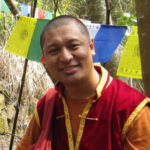
Lama Rinpoche is recognized by eminent masters of all schools of Tibetan Buddhism in this era as a realized practitioner of Kurukulla (the Red Tara). He is a grand master of this practice, and his Kurukulla teachings are the most complete. The Tenth Panchen Lama and Gongtang Rinpoche also praised him as the foremost lineage holder of Kurukulla in this generation.
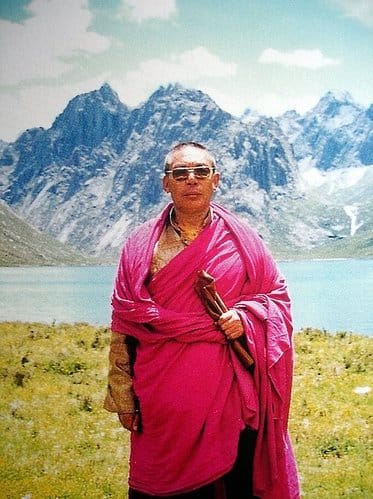
Lama Langga Rinpoche experienced many auspicious signs while practicing the deity Kurukulla. Many times, during his practice or consecration ceremonies, even in the cold Tibetan winter, people witnessed red flower petals falling from the sky. On one occasion, while attending a conference in Beijing and later visiting the Forbidden City, Langga Rinpoche said that Emperor Qianlong had invited Changkya Rinpoche to practice Kurukulla there, making it a blessed and sacred place. He then began reciting the Kurukulla mantra. As he recited, a lotus arrow descended from the sky and landed on his head. Bao Rinpoche, at the age of fifteen, personally witnessed this magnificent lotus arrow, and he also had a photograph of it.
Later, according to the wishes of Gongtang Rinpoche, Langga Rinpoche offered this lotus arrow to the Gongtang Stupa in Labrang Monastery, Gansu (the largest stupa in Gansu and a local landmark). Those who have the opportunity to visit Labrang Monastery should definitely pay homage to the Gongtang Stupa, hoping to connect with Kurukulla and perhaps one day have a lotus arrow descend upon them.
Bao Rinpoche’s Studies and Practices under Langga Rinpoche
Langga Rinpoche was one of Bao Rinpoche’s (Rinchen Chenpo Rinpoche) teachers.
Bao Rinpoche studied Tibetan literature, grammar, and poetry under Langga Rinpoche, and received the “Source of Accomplishment” (also known as “Source of Practice”), which contains over three hundred empowerments.
Bao Rinpoche received the complete common and uncommon lineage of Kurukulla mainly from Langga Rinpoche, and also received the empowerment of Naropa Dakini.
Brief Biography
Homage to the Guru!
Langga Rinpoche was born on January 3, 1937, in Dilong Sang, a place surrounded by three sacred mountains, at the border of Gansu and Qinghai. His father was the mantra practitioner Honglei Luocu, who was well-versed in all the activities of Vajra Masters, and his mother’s name was Aorou. His maternal grandfather was a brave and skilled warrior, proficient in military strategy, marksmanship, and archery, and was revered by the local people. According to locals, “Rinpoche’s maternal grandfather was the son of Segou, a local protector deity of the Tu people.” However, it is unknown whether this is true.
Rinpoche was born during a time of war and turmoil. Ma Bufang’s army invaded the Golog region, and during the conflict, several of his siblings were separated from the family and lost.
Many auspicious signs accompanied his birth. He was exceptionally intelligent from a young age. Local officials, hearing of this, went to visit him. Upon witnessing his compassionate nature and many inexplicable phenomena, they reported their findings to Kangsang Rinpoche and Xia’ou Tsenam Rinpoche. After repeated observations during meditation, the two masters confirmed that Rinpoche was the reincarnation of the Third Langjia Rinpoche. Kangsang Rinpoche named him Kelsang Dedan Wangchuk.
At the same time, high lamas and Rinpoches from other monasteries identified him as the reincarnation of Bari Risa, a famous Tibetan scholar. However, his father said, “I only have one son, and he must stay at Xia’ou Monastery,” unwilling to let him go to a distant monastery. Other Rinpoches also identified him as the reincarnation of Murige Sozha, but his father refused these claims as well.
Rinpoche’s previous incarnation was one of the golden throne holders of Rijia Great Monastery. He should have been enthroned and studied at this monastery, but before his father passed away, he instructed Xia’ou Monastery’s abbot, Tsenam Rinpoche, saying, “My son must not be sent to Rijia Great Monastery.” Therefore, when the lamas from Rijia Great Monastery came to invite him, Tsenam Rinpoche refused based on his father’s instructions.
Rinpoche himself said that this was a very important auspicious connection for him. Later, he completed more than two thousand Eight Precepts retreats at Xia’ou Monastery and received practical teachings of the former Kadampa and Sakya schools of Tantric Buddhism under Xia’ou Tsenam Rinpoche.
Later, he received novice vows under Geshe Tsering Daji at Rijia Monastery, and simultaneously practiced the Lamrim Chenmo (Great Treatise on the Stages of the Path to Enlightenment), Bodhicaryavatara (Guide to the Bodhisattva’s Way of Life), etc. Under Tulku Gata, he received and memorized Longchenpa’s Treasury of the Dharma Realm and other Nyingma teachings. Before his passing, Chökyi Nyima Rinpoche transmitted the common and uncommon teachings of the Naropa Dakini practice to him. The elder lamas of the monastery, with some doubt, asked, “He is so young; will he actually practice these teachings after receiving them?” Chökyi Nyima Rinpoche replied, “He will certainly practice and continue this lineage, and will attain accomplishment through this practice.” After receiving the teachings, he never ceased his practice, and many prophecies recorded that, “Many people at Shau Monastery have attained both common and uncommon accomplishments through this practice.”
During the ten years of the Cultural Revolution, Rinpoche was conscripted as a cook. He always carried his mandala, Dharma texts, and Buddhist scriptures with him, but the other cooks never saw them. Those who knew about this asked, “Did you use an invisibility spell?” He replied, “I don’t know how to use magic, nor did I use any. It must be the blessings of the Dakini.”
Later, he became close to and received oral transmissions, empowerments, and teachings from many great Geshes and other great practitioners of Labrang Monastery, such as the Yamantaka, Guhyasamaja, and Chakrasamvara tantras. He also spent many years studying Tibetan literature, poetry, calligraphy, Sanskrit grammar, the four divisions of the Vinaya, and the oral transmissions of the Great, Medium, and Small Prajnaparamita texts, and the five Manjushri mantras with the renowned scholar Tseten Shadrong of Eastern Tibet. Tseten Shadrong Rinpoche said, “Each sect may have one or two individuals who are very proficient in various literary and doctrinal practices, but overall, there are few who are as learned and accomplished in their studies as Langga Rinpoche.”
He traveled to meet the famous Tibetan literary figure Mudan Gesang Mudan, and studied many literary works with distinct Tibetan characteristics. He received teachings on the Five Great Treatises (five classic works of exoteric Buddhism, including Prajnaparamita, Madhyamaka, Pramana, Vinaya, and Abhidharma) under the great Geshe Aba Jinpa Gyatso of Labrang Monastery.
He studied astronomy, astrology, and geomancy under Akye Gesang Tenpa, and received four Kalachakra empowerments and teachings on many practices, including those of the eighty-four Indian Mahasiddhas, from the Gongtang Living Buddha. The Living Buddha often praised his talent, virtue, and other accomplishments in public. In Muxihe Township, Gansu Province, the young master’s five children all died prematurely. He visited various temples and places of worship to pray, but to no avail. Later, a lama from another region went to pray to the Gongtang Living Buddha on his behalf. The Living Buddha replied, “Only Langjia Rinpoche can help you.” At that time, Rinpoche was living in seclusion in the mountains. The lama from the other region took the young master and his wife to meet him. Rinpoche told them, “It’s alright, go back and recite the Tara mantra frequently, and I will pray to the Buddhas and Bodhisattvas to bless you.” Later, they had two children who were safely raised to adulthood. Since then, families in the area with similar circumstances have gone to Rinpoche for prayers and received guidance.
On one occasion, he went to Beijing to meet the Panchen Lama and receive the empowerment of Kurukulla (the Red Tara). Many auspicious signs appeared during the ceremony. Afterwards, while visiting the Forbidden City with a friend, a loud sound suddenly came from the sky as they reached the main gate, and a two-foot-long lotus arrow fell to the ground, vibrating upon impact. Rinpoche picked it up with both hands, paid homage to it, and blessed his friend. He then returned to inform the Master, who replied, “You have received the blessing of the deity’s intention.”
A Nyingma Rinpoche once said, “He has recited the Kurukulla mantra nearly a hundred million times, which should be a symbol of achievement, a proof shown to faithful beings.”
One day, Rinpoche came to Oula Township. The devotees requested Rinpoche to bury a treasure vase. Some shepherds witnessed red light emanating from the deep mountains of Dingre and white light from the deep mountains of Anning Oula. The two lights merged together and integrated into the place where the treasure vase was buried. Auspicious sounds also appeared in the sky… and other various auspicious signs. Rinpoche humbly said, “This should be the blessing of the deity; I didn’t feel anything.” In addition, two mentally ill patients in the county were also cured through Rinpoche’s blessings. While in secluded retreat in the remote area of Marma Township, the government invited Rinpoche three times to reside in Maqu to teach students and promote Tibetan literature. He humbly refused, saying, “I am an old man, advanced in age, without much learning, and only wish to practice Dharma. I am not qualified to promote Tibetan literature.”
During a Dharma assembly commemorating the late Langjia Rinpoche and the empowerment ceremony of Kurukulla, Gongtang Living Buddha, while on his way to propagate the Dharma in this area, suddenly said, “I want to go to Langjia Rinpoche’s residence.” He and his entourage went directly to knock on his door. Rinpoche, without a shirt or shoes, personally opened the door. The Living Buddha said, “Your behavior is natural. I didn’t notify you; I secretly came to see you.” He also said, “If you can teach in Maqu, you can benefit many illiterate people. Go and guide them!”
After Langjia Rinpoche agreed, he resided at Maqu Tibetan Middle School, teaching more than 300 students, helping some young people quit smoking and drinking, and transforming many improper behaviors into proper ones. Many elderly people and leaders in Maqu highly praised and were grateful for his guidance to the young people.
The Third Langjia Rinpoche, Gesang Danzeng Jiacuo, peacefully passed away on November 10, 2008 (the eleventh day of the ninth month of the Tibetan calendar) at 6:30 AM in his residence in Hezuo County, Gannan Prefecture, Gansu Province, without any illness.
Venerable Master’s Recollection of his teacher Langjia Rinpoche:
Kurukulla was Langjia Rinpoche’s main deity, and he was an accomplished practitioner of Kurukulla. After his passing, every year on the eighth day of the second month, we hold a Kurukulla Dharma assembly and fire offering to commemorate him. The Master often performed fire offerings during his lifetime; this was his karmic connection. He performed countless fire offerings throughout his life.
I transmit the Kurukulla Dharma every year on the eighth day of the second month, and sometimes more than once. I have also transmitted it several times when disciples specifically requested it. The reason I transmit it every year is because Langjia Rinpoche instructed me to do so, hoping that I would transmit this Dharma in the future. He also instructed his attendant Jinmei Zhihua, and some other disciples, to learn from me when he was no longer able to transmit it. Therefore, I must fulfill my guru’s instructions and repay his kindness.
Lama Langya Rinpoche’s passing day is not the eighth day of the second lunar month, but he particularly liked this day. Although every eighth day of the month is the day of Kurukulla, because my guru liked this day, we designated the eighth day of the second lunar month as Lama Langya Rinpoche’s memorial day. On this day, we hold a memorial ceremony, and regardless of the number of people present, we practice the Kurukulla sadhana to make offerings to our guru.
I have studied the Kurukulla practice under many gurus, but I received the complete teachings from Lama Langya Rinpoche and Sakya Dagchen Rinpoche. While in the United States, I spent a month receiving teachings and empowerments of the Sakya school’s unique Three Red Deities practice from Dagchen Rinpoche, including both common and uncommon oral instructions; I received the complete lineage from Lama Langya Rinpoche; and I received other Kurukulla practices from Penor Rinpoche, Karma Chagme Rinpoche, Pema Rinpoche, and others. However, the complete common and uncommon lineages were mainly received from Lama Langya Rinpoche and Dagchen Rinpoche.
Especially with Lama Langya Rinpoche, I received common and uncommon empowerments and unique teachings from him four or five times. The Kurukulla nectar pills, fire offerings, and the painting of the Kurukulla protection mandala were all personally taught to me by Lama Langya Rinpoche.
Those with meditative power can use the power of meditation to free their minds. What if one lacks meditative power? One must rely on the Buddhas and Bodhisattvas and external forces to free one’s mind. When one’s mind is free, one can transform the minds of others. Transforming the minds of others means that when someone has negative thoughts, if we are ordinary beings, we don’t have the power to transform their negative thoughts. If our speech is impure, chanting mantras will not be very effective; if our mind is impure, visualization will not be effective; if our three doors (body, speech, and mind) are impure, the effect of our practice will be very poor. However, if we practice through special circumstances and special vows, using the methods of Buddhas and Bodhisattvas who possess such vows, we can temporarily receive blessings. Even short-term spiritual power can be incredible. For example, when Langga Rinpoche was alive, many people went to him to request that he perform the practice of Kurukulla (a female deity). This was because some families had problems with their children, such as infants dying shortly after birth; others had obstacles in their lives, or some people were behaving abnormally (almost going mad). There were such families in our own clan.
Langga Rinpoche performed the Kurukulla practice and fire offerings to fulfill the wishes of these beings. He was a person with such spiritual power, and the effects were immediate. Many people who practiced this method also gained liberation and became normal again. Others who had obstacles in their careers also sought help from Langga Rinpoche. This is because Kurukulla’s vows, in addition to transcending worldly liberation, also fulfill the wishes of worldly people, benefiting both oneself and others; both worldly and transcendental wishes are perfectly fulfilled.
There’s also a funny story about the thousand Tara statues in our temple. When they were being made in Nepal, it took them two years, and they were getting worse and worse. When Langga Rinpoche asked about it and learned that they weren’t finished, he told me, “Don’t argue with them. Ordinary people do good deeds with ignorance at the beginning (doing good deeds with a confused mind); in the middle, they do good deeds with a competitive spirit; and finally, they end the good deeds with anger. This is how ordinary people do good deeds, and you shouldn’t be like that. You already have this vow, and therefore this merit. Even if the statues aren’t completed, you shouldn’t argue. I’ll perform a fire offering to bless them, and through the power of the Buddhas and Bodhisattvas, they will be blessed.” Then he performed a fire offering, and after the offering, our statues improved, and although they weren’t the twelve centimeters we requested, only eight centimeters, the workmanship was excellent, and they were completed quickly.
Similarly, there is a stupa of Je Tsongkhapa in Ganden Monastery, a very important construction in Tibet at the time, entirely covered in gold and jewels, built by Gongtang Rinpoche. Many obstacles arose during its construction, and it couldn’t be completed. Gongtang Rinpoche instructed Langga Rinpoche to perform a fire offering. On the eighth day of the sixth month of the Tibetan calendar, Lama Langga Rinpoche performed a fire offering ritual of Kurukulla on a mountain in Gansu. Some lamas from our Mula Monastery also went to help. On the day he completed the one hundred thousand fire offerings, all the problems were resolved, and no further issues arose afterward.
I am very familiar with the practice of the Eight Precepts and have some experience with it. This is because two monasteries in our region observe the Eight Precepts continuously; one must observe them upon entering the monastery. One is my ancestral monastery, Mula Monastery, and the other is the monastery of my guru, Langga Rinpoche, Xiawo Monastery. In these two monasteries, one must observe the Eight Precepts upon entering. Therefore, many people jokingly call Mula Monastery the “One-Meal Monastery,” because several thousand people observe the Eight Precepts simultaneously, and you can hear the sounds of their empty stomachs.
The first incarnation of Dzongsar Rinpoche observed the Eight Precepts throughout his life, eating one day and fasting the next; speaking one day and remaining silent the next. Langga Rinpoche observed the Eight Precepts more than three thousand times in his life, calculated on a two-day basis (eating one day and fasting the next). He recited the Avalokiteshvara mantra over one hundred million times in his life.
The thirteen-story Kalachakra mandala above Luojia Cave in Gansu was built by Langga Rinpoche. Langga Rinpoche belonged to the Sakya lineage and practiced Naropa Dakini and Kurukulla throughout his life. Among the thirteen golden dharmas of the Sakya tradition, there are three Dakinis, and the Naropa lineage is found here. Naropa Dakini is also the foremost red deity practice among the thirteen golden dharmas of the Sakya school, and it was later transmitted from the Sakya school to the Gelug school, becoming a major practice for many gurus.
Prayer of Supplication to Langga Rinpoche
With heartfelt devotion, we supplicate our gracious Guru,
Even amidst the obscuring karmic forces of samsara,
May the power of his Bodhisattva vows remain unbroken,
And may he bestow his blessings upon all faithful disciples.
Through the blessings of the Guru and the Yidam,
May all sentient beings in the three realms attain enlightenment.
We pray that Langga Rinpoche
May soon return to fulfill his vows!