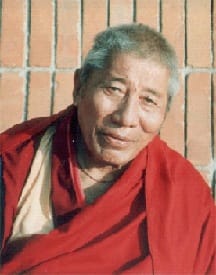
The founding master of the Kathok Shichen lineage: Ongdrup Rinpoche
The “Shechen Tradition” revived the Nyingma teachings in the Kham region in 1695 AD.
Rangjung Tenpe Gyaltsen was a great sage who transcended sectarian boundaries. When he arrived in Kham, Guru Rinpoche (Padmasambhava) manifested and instructed Rangjung Tenpe Gyaltsen to build a monastery near a white rock shaped like a leaping lion, prophesying: “He will bring immeasurable benefit to the Dharma.”
Shechen Monastery thus became a center of Dharma in Kham and gradually expanded to nearly 160 monasteries. It nurtured many famous scholars and countless accomplished practitioners, quickly becoming one of the six main monasteries of the Nyingma tradition.
Many masters resided and taught there, such as Shechen Mahapandita Ontrul Gyurme Thutop Namgyal. Jamyang Khyentse Wangpo, Jamgon Kongtrul Rinpoche, and Patrul Rinpoche all studied under Ontrul Rinpoche at Shechen Monastery for several years. Although Mipham Rinpoche (the lineage holder of Dzogchen, also known as the Omniscient Mipham Rinpoche) was not affiliated with any monastery, he often said, “Shechen Monastery is my home.”
Precious Guru’s Studies and Practices under Ontrul Rinpoche
Kathok Shechen Ontrul Rinpoche was the maternal uncle of the Precious Guru (Rinchen Chenpo Rinpoche) and one of his teachers.
Under Kathok Shechen Ontrul Rinpoche, the Precious Guru received empowerments and teachings on the Three Roots terma (hidden treasures) of the two Kathok tertöns (treasure revealers), Dundul Dorje and Longsal Nyingpo, and received the Kathok Rinchen Chenpo lineage (compiled by Rinchen Tsewang Norbu, combining the three tertöns Dundul Dorje, Longsal Nyingpo, and Pema Dechen Lingpa) of the channels and vital energy practices. He was also appointed by Ontrul Rinpoche as a teacher of Tibetan esoteric yoga. A Brief Biography
The renowned accomplished master Thangtong Gyalpo, an emanation of the Great Compassionate Avalokiteshvara, was reborn to liberate all sentient beings. He is known as His Holiness Khenchen Ongdrup Rinpoche, also known as Rinchen Galadorje, Thubten Lungdrak Gyatso, and Jashi Ala Rinpoche. He was born into a noble family in Mula Village, Golok region of Eastern Tibet. His father, Gagong, was a local official with over three hundred nomadic households under his authority, and his mother, Khadro Tsogyal, was the daughter of a village headman in Xihe Xiong Village.
In the harsh winter before His Holiness’s birth, the grasslands near his home were covered with flowers of various colors. The villagers found this incredible, saying that it was truly miraculous for flowers to bloom in such cold, snowy weather, especially some flowers they had never seen before. This was considered a very auspicious sign.
One day, when His Holiness’s mother and four young women went to the lake, a group of white frogs emerged from the water, surrounding His Holiness’s mother and bowing to her. They were startled and prayed loudly to the Buddhas and Bodhisattvas for protection. At that moment, the frogs suddenly transformed into a beam of light, and the air was filled with fragrance and melodious music. His Holiness’s mother later wondered, “Was this a bad omen?” She went to ask Khenpo Hajra Rinpoche, who said, “Foolish people! These are the Dharma protectors of Tantric Buddhism and the eight classes of deities and dragons protecting you! Don’t consider it a bad omen.” He also felt that the child in her womb was definitely the reincarnation of the great accomplished master Thangtong Gyalpo, but this should not be revealed to the public for the time being.
When His Holiness was born, the villagers witnessed various miraculous phenomena. White light permeated the air, the sky was filled with rainbows of various colors, and beautiful celestial music was heard.
Three days after his birth, he sat in meditation and recited mantras. At the age of two, he climbed onto a rock and left his footprints on it.
At the age of three, the lamas of Sekchen Monastery were searching for the reincarnation of Ongdrup Rinpoche. The identification of the reincarnation was based on the prophetic letter of the Dzogchen Dharma King, which stated: “From the east, in a wealthy family, the father’s name is Gong, the mother’s name is Ji, named Rinchen, born in the year of the dog, liberating countless sentient beings.” They searched everywhere based on these four lines.
One day, they learned that there was a miraculous child in Mula Monastery, and the high lamas of Sekchen Monastery immediately set out. On their first night at Mula Monastery, they all dreamt of a beautiful woman who said to them, “I am Ekajati, the protector deity of Vajrayana Buddhism. The reincarnation you have been diligently searching for is here.” She then showed them the protector deity’s home. The accompanying Rinpoches also had the same dream and instinctively trusted that this was the reincarnation of the protector deity. They then set off together to the village headman’s house in Mula village.
Upon arrival, a young boy suddenly appeared. The high lama from Xiqin Monastery immediately recognized him. The boy also called out the names of each high lama and lama present, saying, “Take me back to Xiqin Monastery immediately, or go back at once to protect my scriptures!” At the time, the lamas didn’t understand what he meant. Later, after confirming the reincarnation of the protector deity and returning to the monastery, they discovered that many scriptures and valuables had been stolen. Only then did they understand the meaning of what the protector deity had said upon their first meeting, and they were astonished by his ability to foresee this. Therefore, the monks and villagers held him in particularly high esteem.
At the age of four, during a grand assembly of Xiqin Main Monastery and its twenty-one branch monasteries, he was enthroned on the golden throne of the previous generations. From then on, he began to study Tibetan culture and Buddhist scriptures and rituals under the guidance of Kelsang Gyatso.
At the age of thirteen, he became a disciple of Khenchen Akha, a renowned accomplished master of Kathok Monastery, and received many esoteric teachings, including the Kathok lineage and the Longchen Nyingthig transmission. Later, he went to Xibi Monastery to meet his guru, Tsultrim Sangpo, and studied numerous Dharma teachings, including the Five Treatises of Maitreya (the Ornament of Clear Realization, Ornament of the Sutras, Treatise on the Essence of Buddhahood, Treatise on the Discrimination of Dharma and Dharmata, and Treatise on the Middle and the Extremes), the Compendium of Training, the Guide to the Bodhisattva’s Way of Life, the Stages of the Path to Enlightenment, the Stages of the Path of Guru Rinpoche’s Secret Teachings, the Seven Treasures of Longchenpa’s Great Perfection, and the Secret Treasury of Illusory Transformation. Through prolonged and diligent study and practice, he particularly delved deeply into the Secret Treasury of Illusory Transformation. His Vajradhara guru, Tsultrim Sangpo, praised his unparalleled achievements in this secret teaching. Scholars and elders from various schools of Buddhism also praised Ongdrup Rinpoche’s intelligence and wisdom. In the hearts of the monks and Tibetan people, he was undoubtedly a true manifestation of a Bodhisattva. His abundant talents and sharp debating skills were admirable, and his compassionate actions for the benefit of others flowed continuously and abundantly.
After his guru’s passing, he went to meet Enda Jangchub Rinpoche and received teachings on Prajnaparamita, Madhyamaka, Pramana, Vinaya, Abhidharma, rhetoric, and astrology—ten branches of knowledge—and achieved mastery in all of them.
Later, he went to India and continued his studies at Drepung Monastery. Others believed he had already achieved complete mastery of Buddhist teachings, yet he continued to study diligently, which aroused their curiosity. When asked, he replied, “The Dharma teachings are immeasurable, and I vow to learn them all. A wise person integrates hearing, contemplation, and practice. A life of learning Buddhism is a life of complete fulfillment; besides this, I have no other purpose.” Thus, he diligently studied both exoteric and esoteric scriptures and treatises for over twenty years.
In the winter of 1980, he lectured, debated, and wrote extensively at the three major monasteries of Tibet. The Dalai Lama and the scholars of the three monasteries highly praised Ongdrup Rinpoche’s learning and all bestowed upon him the title of “Great Geshe” (equivalent to a doctorate). He received numerous invitations from Buddhist organizations around the world to teach the Dharma, but because his disciple, the Drukchen Rinpoche, needed uninterrupted study, he declined all of them and did not travel elsewhere.
Later, while meditating at a sacred site of Guru Rinpoche in Nepal, he attained enlightenment. After returning from India to the Golok region of Eastern Tibet, he taught the profound teachings of Sutra and Tantra, including the Great Perfection (Dzogchen), at many places including the Shechen Monastery, its twenty-one branch monasteries, and the Larung Gar Buddhist Academy, cultivating many disciples and benefiting countless sentient beings.
In 1997, after completing his life’s work for the Dharma, he peacefully entered into Nirvana.
His Holiness the Dalai Lama, out of compassion and for the benefit of others, personally wrote a “Prayer for the Swift Rebirth of the Protector,” and widely disseminated it to faithful followers.
Following the compassionate and virtuous deeds of our Protector, we pray that he will swiftly fulfill his Bodhisattva vows for the benefit of sentient beings, and quickly reincarnate to guide all beings.
O Protector! We pray for your compassionate blessings!
Remembering my Precious Guru, Ongdrup Rinpoche
My guru, who is also my maternal uncle—Shechen Ongdrup Rinpoche—whatever little Bodhicitta I have on my spiritual path, I received from Ongdrup Rinpoche. He was a learned Geshe of the Gelug school and a great accomplished master. Ongdrup Rinpoche said: “To become a Geshe, one must study the Six Perfections; to become a person who practices in retreat, one must also study the Six Perfections. Generosity, morality, patience, diligence, meditation, and wisdom—each is necessary. When the Six Perfections are not present, spiritual practice cannot be perfected.” Therefore, we must be determined in every step of our practice.
My maternal uncle, Shechen Ongdrup Rinpoche, made us very happy every time we saw him. Most importantly, he never got angry; he always smiled like Maitreya Buddha.
My maternal uncle, Ongdrup Rinpoche, was considered by his guru to be a very arrogant and ill-tempered person before. After completing a retreat of Akshobhya Buddha, his temper improved. I was with him for a long time and never saw him get angry again; he always had a very kind and compassionate face.
My maternal uncle, Shechen Ongdrup Rinpoche, often said that there is no special Dharma practice other than observing the precepts. Every lineage places great importance on the fourteen root downfalls, and every guru emphasizes this aspect of the precepts. My guru, Khenchen Ongdrup Rinpoche, particularly stressed this, saying that it’s not good to simply interpret the precepts based on the written text without memorizing them. He required that I memorize them completely. I was able to memorize the entire Treatise on the Three Vows, including the parts where the textual commentary wasn’t very detailed. I was tested on it once at the monastery and once under Khenchen Ongdrup Rinpoche. He would have me repeat everything he taught me each day, using this kind of method for testing.