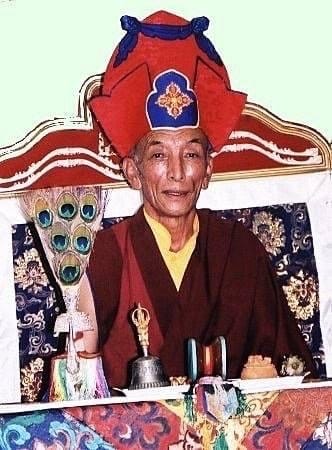
Deputy Head of the Dharma Lineage: Chosang Rinpoche
The Jangde Tradition (also known as Northern Terma, Northern Rock Tradition, or Northern Treasure)
The Jangde tradition, where “Jang” means “north” and “de” means treasure, collectively refers to the northern hidden treasure teachings or the Northern Rock tradition.
Dorje Drak, where “Dorje” means vajra and “Drak” means rock mountain, is named after the fact that its main monastery was built at the foot of a vajra rock mountain, similar to how Sakya is named after white earth.
Chosang Rinpoche is one of the main reincarnated lamas of the Jangde tradition, one of the six major schools of the Nyingma lineage of Tibetan Buddhism, specifically the Dorje Drak Monastery. Historically, Dorje Drak Rigdzin Chenmo was the Dharma King of the Dorje Drak tradition, with Chosang Rinpoche being second in rank. These two have been the alternating leaders of the Dorje Drak tradition throughout history. The Fifth Dalai Lama’s book, “A Definitive Treatise on the Hierarchy of Gurus and Officials,” mentions that Dorje Drak Rigdzin Chenmo is the foremost leader within the Nyingma lineage.
Both the long and short lineages of the Nyingma tradition are divided into two branches: Ü-Tsang and Kham. Ü-Tsang refers to the Dorje Drak and Mindrolling traditions, while Kham refers to the Kathok tradition.
In the current Dorje Drak tradition, in terms of secular status and Buddhist practice, the overall leader is Dorje Drak Rigdzin Chenmo, and Chosang Rinpoche is the second-ranking leader.
The Precious Guru and the Dorje Drak Dharma King
The current leader of the Dorje Drak tradition is Dorje Drak Rigdzin Chenmo, who resides in Lhasa and is the head of all the monasteries of the Dorje Drak tradition, including the main monastery and the Kangding Vajra Monastery. When the Fourteenth Dalai Lama first visited Beijing, Rigdzin Chenmo also attended as a leader of the Tibetan Nyingma lineage. The current Chosang Rinpoche assists him and inspects numerous Nyingma monasteries in Ü-Tsang and Kham. Chosang Rinpoche, a man of great humility, resides in the mountains of Sikkim, rarely interacting with the outside world or publicly teaching the Dharma. For the Dorje Drak tradition, Rinpoche is the sole possessor of an extremely rare and complete treasure trove of empowerments, oral instructions, and practical practice lineages.
The modern scholar, Shechen Ongdu Rinpoche, said: “The Dharma teachings of the upper, middle, and lower Northern Terma traditions of Tibet are integrated into one, and Chosang Rinpoche alone possesses all aspects of the visual transmission, oral transmission, and empowerment transmission.”
Visual transmission includes the making of tormas and mandalas, various mudras and ritual implements, Vajra dances, etc., which the master personally demonstrates, and the disciples observe and practice until proficient.
Oral transmission includes the oral transmission of general teachings, chanting, and the recitation methods of various rituals, etc.
Empowerment transmission refers to the master bestowing all empowerments and oral transmissions, etc., making the recipient a holder of the Dharma.
A Brief Overview of the Reincarnations of Chosang Rinpoche
In the time of Shakyamuni Buddha, the six-tusked elephant ridden by the Chakravartin king often listened to the Buddha’s teachings during its lifetime. After death, it was reborn as a vegetarian practitioner, and after his passing, he was reborn as Yudra Nyingpo, a distinguished disciple of Vairochana, one of the twenty-five disciples of Guru Rinpoche.
First Incarnation—Chökyi Dorje Rabpa: He practiced in Yarlung Sheldrak and established the Chosang Dechen Jangbaling retreat center.
Second Incarnation—Kunsang Tenjin: Born in Zhanglong, he studied “Jangde”—the Northern Terma tradition (Mindrolling is the Southern Terma tradition) at Dorje Drak Monastery. From then on, Chosang Monastery and Dorje Drak Monastery maintained a close, mutually supportive relationship like mother and son.
Third Incarnation—Kunsang Gyatso: He was a disciple of Pema Thinley of Dorje Drak Monastery. From then on, the abbots of Chosang Monastery and Dorje Drak Monastery were mutually teacher and disciple.
Fourth Incarnation—Kunga Sangpo
Fifth Incarnation—Kunsang Namkha Longyang: He was recognized by Rigzin Khenpo Sherab, and after completing his studies, he became the main abbot of Dorje Drak Monastery. The Sixth Incarnation – Gonkar Rinchen: Born in Jiangjie Kadajiatso, he only lived to the age of eighteen (completing the lifespan of one hundred years that his previous incarnation was supposed to have lived but did not complete).
The Seventh Incarnation – Jime Lodro (Jigme Lodro): A disciple of the Eighth Dharma King Rinchen Chenmo, but some do not list him as an incarnation of Chosang Rinpoche.
The Eighth Incarnation – Jume Pema Drime Lodro: Also known as Pema Yeton Tenzen, he was a very important lineage holder of Dorje Drak Monastery, with many disciples, including the Ninth Dharma King Rinchen Chenmo, Taklung Tsetrul Rinpoche, and other important masters such as Zayu Khenchen Changpa Lodro.
The Ninth Incarnation – Namkha Chime: Chosang Rinpoche was born in Shadi Chokhang in southern Tibet. At the age of two, the Regent of Tibet, Reting Rinpoche, recognized Rinpoche through meditation. At that time, all the great lamas in Tibet were recognized by the Regent, including the current Fourteenth Dalai Lama and the Ninth Mongolian Dharma King Jebtsundamba, who were also recognized by him. A grand enthronement ceremony was held for Rinpoche at Dorje Drak Monastery, making him the legitimate second-in-line spiritual leader of the Dorje Drak lineage.
At the age of five, his previous incarnation’s attendant, Palden Ledruk, escorted Rinpoche to Dorje Drak Monastery, where he studied recitation and writing under the tutelage of Raje Sangpo and Dozen Dechen Chodzin, special teachers appointed by Dorje Drak Monastery.
He received empowerments and oral transmissions of the Northern Terma tradition from Khenpo Gocha of Kham.
From Rinpoche Shedrup Gyatso of Dome Jekpa Monastery in Kham, he studied sutras and tantras, and received empowerments and oral transmissions of the Northern lineage for five years.
In 1981, he went to India and resided in Sikkim at the monastery of the Venerable Gonchang Rinpoche, preserving and propagating the Jangter lineage teachings to the world. The venerable Eighth Kyabje Dorje Drak Chosang Rinpoche (Thubten Khenpo Lobsang Wangchuk Pel Sangpo) announced on August 26, 2009, his voluntary decision to forgo conventional medical treatment and instead dedicate himself to peaceful meditation. He returned to the Myo-chen Dharma Center from the hospital at around 3 PM on the 28th and peacefully entered into luminous meditative absorption at 7:30 AM on August 31, 2009, at the Myo-chen Dharma Center in Taiwan.
Final Prayer: May all sentient beings who have formed a Dharma connection with me and the Guru, the Great Auspicious Youth (Vajrakilaya), attain Buddhahood without distinction. May the teachings flourish like the moon, may the lotus feet of the Dharma holders remain forever, may the profound teachings of the secret tradition flourish even more, and may Buddhism prosper forever.
What the Precious Guru learned and practiced under Guru Chosang Rinpoche:
The Precious Guru received from the Second Head of the Dorje Drak lineage, Chosang Rinpoche, the great empowerment of Manjushri Yamantaka from the Northern Treasure of Dorje Drak, the complete oral transmission of the Four Heart Essences of Dzogchen, the preliminary practices of Dorje Drak Dzogchen, etc., as well as the Bodhicitta empowerment, the Vajra of Protection against Poison empowerment, the Three-Bladed Vajrakilaya empowerment, the Eight Great Herukas, and almost all the lineage teachings of Dorje Drak.
The Precious Guru’s Recollections of Guru Chosang Rinpoche:
- Regarding the transmission of the complete works of Longchen Nyingthig:
I received several transmissions of the complete works of Longchen Nyingthig, both partial and complete. There are two complete transmissions: one was received from the contemporary great accomplished master—Guru Chosang Rinpoche of Dorje Drak Monastery, who passed away a few years ago; the other was from Dodrupchen Rinpoche.
- Regarding the Vajra of Protection against Poison empowerment:
At that time, Chosang Rinpoche gave the Vajra of Protection against Poison empowerment at our monastery. This is also a Dharma practice of Guru Rinpoche, an empowerment to prevent various poisons and poisoning. During that period, gatherings were discouraged, and many people advised us to cancel the Dharma assembly. Chosang Rinpoche said that this Dharma practice is preventative and not contagious, so he told us not to cancel the assembly. We held the event as planned, and many people came. After the transmission, we also distributed protective amulets, and none of the people who wore the amulets contracted the virus.
- Regarding Strict Adherence to Precepts
My guru, Kyabje Chosang Rinpoche, had not transmitted tantric teachings for a long time. Although he also wanted to transmit the teachings, he said that there were not many people who could uphold the precepts. Therefore, this was the reason why he did not transmit the teachings for a period of time.
His ancestor, Ari Panchen, also had very strict requirements in his four regulations. If there was no mutual confession within 24 hours, he would sever the relationship between master and disciple. Kyabje Chosang Rinpoche said that he had to abide by the rules set by his ancestors, therefore, the Dorje Drak lineage has always demanded very strict adherence to precepts, and thus they have never experienced such incidents.
He never shortened the recitation of the rituals, nor did he shorten the transmission of teachings or the fire offerings. Every small detail had to be done according to the rules set by the lineage ancestors. The lamas who practiced with him were very tired, but the guru didn’t complain about being tired, even though the disciples were (the guru laughed).
- Regarding the Dharma Hat
During empowerments, we wear hats. The hat I’m wearing today is a hat of Guru Rinpoche (Padmasambhava). Guru Rinpoche’s hats have many different styles. This hat is from the Dorje Drak lineage, and it was personally sewn and given to me by my guru, Kyabje Chosang Rinpoche. Kyabje Chosang Rinpoche is the second-ranked Dharma holder of the Northern Treasure (Dorje Drak) lineage, one of the six major lineages of the Nyingma school. Kyabje Chosang Rinpoche has sewn many hats for me, because the guru is very skilled with his hands. The hats worn by Dodrupchen Rinpoche and many other great masters were also sewn by Kyabje Chosang Rinpoche. I didn’t dare to ask the guru to sew a hat for me, as he wasn’t in good health at the time and his hands were trembling a little, but the guru still compassionately made several hats for me.
The meaning of wearing the hat on your head is that Guru Rinpoche is on your head. When you wear this hat, you cannot have evil thoughts, otherwise Guru Rinpoche will blame you. You must maintain a pure state of mind, because Guru Rinpoche is on your head, and he knows everything you do, good or bad. Therefore, whether you visualize Padmasambhava or your own guru above your head, you should think that Padmasambhava is watching over you, all the Buddhas and Bodhisattvas are watching over you, and your guru is watching over you.
Padmasambhava also told us that when you transmit the Dharma, you should wear a lotus hat on your head and visualize that he is on your head, and he will bless your disciples and bless you as a practitioner… and so on, with such promises. Therefore, we wear the hat with a very respectful attitude. Similarly, every Dharma instrument is an object of auspiciousness blessed by the Buddhas and Bodhisattvas, so you should respect each and every one of them.
- Regarding the Eight Great Heruka Lineage and Empowerment
Complete empowerments, explanations, and oral transmissions of the three major lineages of the Eight Great Herukas are rarely transmitted. It’s possible that the first public empowerment transmitted from afar in Taiwan was the one I invited Penor Rinpoche to give. The first complete and comprehensive empowerment of the three major lineages recorded in Taiwanese Buddhism was given by Chosang Rinpoche at our Miaocheng Temple. When he transmitted it, he was very happy and completely transmitted the empowerments and explanations of the fundamental Dharma of the three major lineages. There were also oral transmissions, but not all twenty-one texts were orally transmitted.
I am very happy to be able to transmit the spontaneously arising Eight Great Heruka teachings this time. I have received this Dharma from many gurus, but I received the complete transmission from Chosang Rinpoche, who instructed me to propagate this Dharma.
The Padmasambhava hat I wear during the empowerment was personally sewn by him, and when I transmit the Dharma, I feel that he is right above my head. My lineage of practical cultivation is not limited to this one; a lineage of practical cultivation means that the guru mainly practices this Dharma and has also undergone retreat, with an unbroken lineage. Chosang Rinpoche has such a lineage; his family is descended from the Basti family of Nepal, and they are descendants of Manjushri Yamantaka. The Dharma of Manjushri Yamantaka has been passed down within their family, and his monastery is Dorje Drak Monastery. Dorje Drak Monastery has thirteen great reincarnated lamas, the greatest of whom is the current Dharma King of the Dorje Drak lineage, Rigzin Chenmo, and the second is the Dharma holder Chosang Rinpoche. These two mutually recognize each other and are both teacher and disciple. The lineage of the spontaneously arising and self-manifesting Eight Herukas of Dzogchen from Dorje Drak Monastery has been passed down in this way, and the spontaneously arising and self-manifesting Eight Herukas are also the main Dharma practice promoted by Dorje Drak Monastery.
Whether it’s empowerments, explanations, tormas, or setting up mandalas, the most rigorous practices are found at Dorje Drak Monastery and Mindrolling Monastery. Dorje Drak Monastery is one of the six major monasteries of the Nyingma school, and although it doesn’t have a large number of monks, and their lineage is found in many places, due to the lineage and regulations of the Panchen Lama of Ali, their regulations are very strict, and it’s not easy to enter. The main deity of Dorje Drak Monastery is the Eight Herukas, and they practice the Dharma related to the Eight Herukas. Chosang Rinpoche himself has several lineages, in addition to the Dorje Drak Rigdzin Chenmo lineage from the Tsang region, he also has the Dorje Drak Dharma lineage from Kham… and several other lineages are all integrated in Chosang Rinpoche.
- Regarding the Passing Away
Just like my guru, Chosang Rinpoche, he also showed some signs before his passing away in Taiwan. I don’t remember the exact time, but it was probably one or two days before his passing, he saw the mandala of the Eight Herukas, and the Eight Herukas and Dharma protectors came to receive him. When he passed away, the flowers in the monastery bloomed simultaneously throughout the year.
- Regarding the Auspicious Blessed Objects
At that time, Guru Rinpoche specially blessed a nectar pill, which was made from the leftover materials used to make his statue. Guru Rinpoche said: “In the future, when you want to make my statue for offering, put the nectar pill inside the statue as an offering, which is equivalent to me personally giving the blessing.” The pills produced from this mother nectar pill are now found in many places such as Mindrolling Monastery, Dzongsar Monastery, Kathok Monastery, etc., and I also have some. After the empowerment ceremony, I will give each of you a special Guru Rinpoche statue. This statue is very special, containing many precious relics and sacred substances:
- Relics of Kyabje Chosang Rinpoche, the Dharma Lord of Dorje Drak;
- Eight Great Heruka nectar pills consecrated by Dorje Drak Rigzin Chenmo at the Vajra Monastery in Kangding;
- Guru Rinpoche nectar pills bestowed upon me by the Pema Rinpoche of Dzongsar Monastery and my guru, Chatral Rinpoche…
Guru Rinpoche said that a statue containing his substitute pills is equivalent to receiving his personal blessings, possessing the same merit as his actual presence.
Memorial Ceremony for the Passing of Chosang Rinpoche
The accomplished Chosang Rinpoche was a highly accomplished practitioner, the second-in-line Dharma holder of the Northern Treasure (Dorje Drak) lineage, one of the six major lineages of the Nyingma school of Tibetan Buddhism. The current Dharma King of this lineage, Dorje Drak Rigzin Chenmo, resides at Dorje Drak Monastery near Lhasa.
Chosang Rinpoche was born into one of the eight prominent families of Tibet. From a young age, he was recognized by the then Regent of Tibet, Reting Rinpoche, and other masters as the reincarnation of the Ninth Chosang Rinpoche. He later underwent an enthronement ceremony at the main Dorje Drak Monastery and lived there until the age of sixteen. Afterward, he traveled to various places to study the Dorje Drak teachings, as well as the distant and close transmission teachings of the Nyingma school, particularly studying the complete Dorje Drak lineage teachings under Bari Rinpoche in Kham.
Chosang Rinpoche received the complete Dorje Drak teachings three times, but the final and most complete transmission was received under Bari Rinpoche. He himself said: “During the first and second times, I was younger, and I didn’t remember much of the content clearly.” Therefore, he later specifically traveled to Kham to study.
He lived there for more than four years, during which he studied the distant transmission teachings of Padmasambhava, Vimalamitra, and others, as well as the complete Northern Treasure teachings. He underwent several retreats and was imprisoned for nearly twenty years due to the political circumstances of the time.
Afterward, he again received the distant and close transmission teachings of the Nyingma school under Dodrupchen Rinpoche. Around that time, Dilgo Khyentse Rinpoche requested Chosang Rinpoche to give teachings, and he later stayed in Taiwan for a period. Rinpoche was a practical practitioner and a very humble person. We requested him many times, and in the three years before his passing, he came to Miaocheng Dharma Center every year to give teachings. We received many teachings from him and he is our most respected root guru. Under the guidance of Rinpoche, we received the great empowerment and guidance texts of the Northern Treasure tradition, and he explained many teachings, including the three lineages of the Eight Herukas, the three-bladed Phurba, and Manjushri Yamantaka. I myself received many oral transmissions, explanations, and empowerments from him. Rinpoche sometimes stayed here for several days, so we received many profound teachings from him.
The Dharma hat was hand-sewn by our precious Guru, Dakyab Chosang Rinpoche. We are very grateful for Rinpoche’s compassionate guidance, and therefore we hold an annual memorial service for him. The ceremony is simple, respecting Rinpoche’s wishes; his simple, humble, contented, and modest example is what we strive to emulate. The practices we perform are also the simplest and most profound. Before his passing, he often encouraged us to recite and practice Vajrasattva and Phurba extensively. Following his instructions, after his passing, we practiced the Red Sect Vajrasattva Dharma here… and so on.
Therefore, today we are also practicing the Vajrasattva Dharma, offering prayers, making confessions, and lighting lamps before Rinpoche’s Dharma seat, and finally reciting two reincarnation prayers for Rinpoche. One of the reincarnation prayers was written by me, a supplication hoping that Rinpoche’s vows will manifest.
Later, Rigdzin Chenmo adapted the long-life prayer that Dudjom Rinpoche had originally written for Chosang Rinpoche into a reincarnation prayer, which is very blessed.
Currently, most of the sixty-odd monasteries of the Dorje Drak lineage recite this reincarnation prayer daily, hoping that Chosang Rinpoche will be swiftly reborn!
We have contacted Dorje Drak Rigdzin Chenmo several times. Chosang Rinpoche’s stupa has been completed and enshrined in the main Dorje Drak monastery, and it is very magnificent. They are also constructing a copper statue of Chosang Rinpoche, the same size as him, which is currently being gilded and will be enshrined in the main Dorje Drak monastery. At Dorje Drak Monastery, located on the banks of the Yarlung Tsangpo River in Zhanang County, Shannan Prefecture, Tibet, Gonjang Rinpoche has already completed a very magnificent stupa for Chosang Rinpoche in Sikkim. We will also be building a stupa for Rinpoche in Taiwan. It could have started earlier and would have been convenient, but I wanted to wait until the main Dorje Drak Monastery was completed first, because Chosang Rinpoche always prioritized His Holiness Rigzin Chenmo. He deeply respected and promoted everything His Holiness did and said. Both are very humble and simple Dharma masters; such great masters are very rare.
Chosang Rinpoche wrote a letter to Rigzin Chenmo mentioning that the most joyful things in his life were obtaining a precious human body, studying within the Dorje Drak lineage, and maintaining an unbroken samaya (sacred vow) with His Holiness Rigzin Chenmo.
Therefore, everything is prioritized according to His Holiness Rigzin Chenmo. After the completion of his stupa, we will begin the construction of the stupa in Taiwan next year.
Many relics grew from Chosang Rinpoche’s ashes. Previously, we didn’t keep a single one; all were offered to His Holiness Rigzin Chenmo. Seven relics, containing five different colors, were offered to Gonjang Rinpoche for the stupa in Sikkim. Although we haven’t seen the remaining ashes yet, based on previous experience, these ashes will certainly produce more relics.
In the future, these relics and ashes will be enshrined in the stupa that will be built, and some will be made into relic pills to be given to disciples who had a Dharma connection with Rinpoche. The reason they haven’t been distributed before is that we consulted His Holiness Rigzin Chenmo, whom Chosang Rinpoche respected most during his lifetime. Chosang Rinpoche’s will mentioned that everything, including whether he would reincarnate, should be according to what Rigzin Chenmo said. Therefore, the response we received was: “After the Dharma practice is completed in the future, they can be given to the public.” With this permission, we can proceed. Rinpoche’s relics come in many colors, and to date, these photos have not been publicly circulated because Rinpoche himself was very low-key and permission from Rinchen Chömo was required before they could be released.
Everyone knows that Rinpoche passed away very peacefully, his body was very soft and even more dignified than when he was alive, and his illness was only a manifestation for his disciples to witness. On the day of his passing, the flowers at Miaocheng Temple bloomed, and the next day, when the participating Rinpoches, Khenpos, Lamas, and disciples gathered for practice, many rainbows appeared in the sky, and everyone present saw them.
Before Rinpoche passed away, he held a khata (ceremonial scarf) and offered it upwards three times, blessing the world and all sentient beings, and praying for the elimination of war and conflict. When the Venerable Avalokiteshvara arrived, the ailing Rinpoche wrote a letter to him: “I am about to leave, and I hope you can remain in this world for a long time.”
During a phone call with the Dodrupchen Rinpoche, he expressed his hope to attain the non-dual accomplishment of Vajrakilaya and Vajrasattva under the Rinpoche’s blessings, and finally merge into the non-dual realm of Vajrasattva and Vajrakilaya. Therefore, when we practice Vajrasattva today, everyone should remember that Chöshang Rinpoche and Vajrasattva are non-dual, and practicing with this mindset will bring the guru’s blessings.
Rinpoche imparted many teachings to us, and with gratitude, we follow him in cultivating vast bodhicitta and making the same vows as Vajrasattva and Vajrakilaya, hoping to benefit all sentient beings. We also hope that all Buddhas and Bodhisattvas will bless Chöshang Rinpoche’s reincarnation to appear before us soon. Today, in front of Chöshang Rinpoche’s Dharma image, we should cultivate merit and confess our sins, but most importantly, we should practice with the mindset described above!
Note: The day before Chöshang Rinpoche passed away, plum blossoms bloomed outside Rinpoche’s room at Miaocheng Temple (plum blossoms usually bloom in cold weather, but Rinpoche passed away in the middle of summer). The two people who cared for Rinpoche also faintly heard the chanting of many lamas in the air in the room.