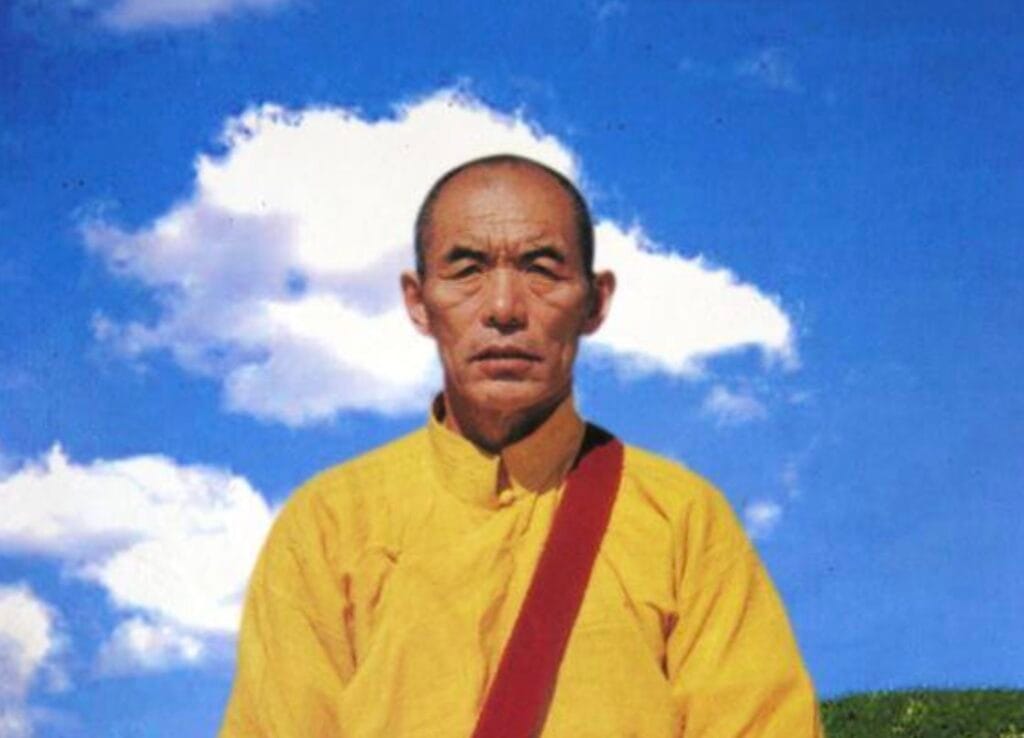
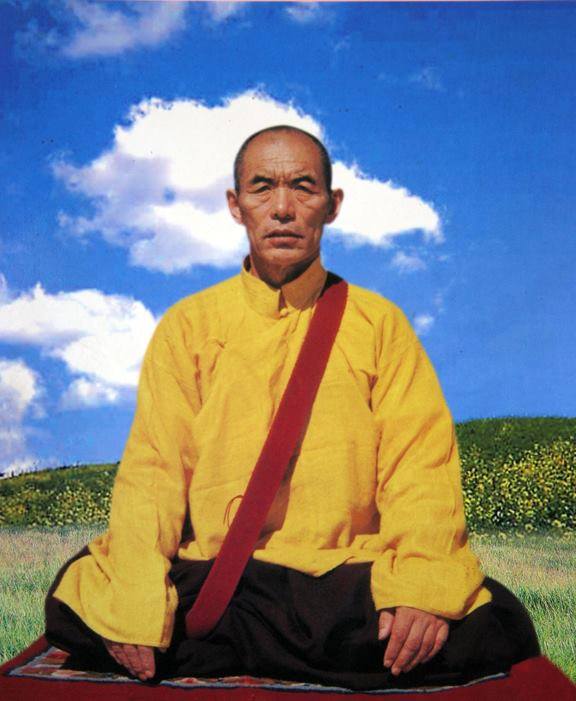
A great master of the Dzogchen tradition and a great saint of the Rime movement: Nyoshul Khen Rinpoche
The precious spiritual connection between Master Bao and Master Nyoshul Khen Rinpoche.
Nyoshul Khen Rinpoche was one of the teachers of Lama Pema Wangyal Rinpoche.
Lama Pema Wangyal Rinpoche received teachings and oral instructions on the Dzogchen Longchen Nyingthig from Nyoshul Khen Rinpoche.
At that time, Nyoshul Khen Rinpoche instructed Lama Pema Wangyal Rinpoche to come to Taiwan, bestowed upon him the name Kathok Rinchen Chokyi Buddhist Society, and gave him the skull of Kathok Kadampa Deshe, the founder of the Kathok lineage, earnestly entrusting him with the task of propagating the Nyingma teachings and the Rinchen lineage.
Nyoshul Khen Rinpoche turned the Dharma wheel of both the exoteric and esoteric traditions throughout the world, having countless disciples. Many great masters of various schools received teachings from him, especially almost all the well-known high lamas and great masters of the Nyingma school were his disciples.
His disciples include Dzongsar Khyentse Rinpoche, Jamyang Khyentse Rinpoche, Jigme Khyentse Rinpoche, Neten Chokling Rinpoche, Mingyur Rinpoche, Tsoknyi Rinpoche, Pema Choedron Rinpoche, Khenpo Sonam Thoggyal Rinpoche, Pema Wangyal Rinpoche, etc. He was a truly remarkable Dzogchen master!
In 1999, Nyoshul Khen Rinpoche passed away at his home in France. According to his disciples’ accounts: “For seven consecutive days, the sky outside was completely clear, without even a single cloud. From his body, which possessed the four liberations, emerged a large amount of essence of the five elements, like clarified butter, filling a large copper pot. This essence of his body was left as a sacred relic for those with karmic connections.”
Three days before Nyoshul Khen Rinpoche’s passing, Lama Pema Wangyal Rinpoche was at Rinpoche’s home in France. At that time, Rinpoche was sitting in a chair in the courtyard and said to Lama Pema Wangyal Rinpoche, “All discursive thoughts rest in the Dharmakaya…” After these few words, Rinpoche spoke very little.
Later, Lama Pema Wangyal Rinpoche went to Hong Kong for some business. Three days later, he learned of his teacher’s passing in Hong Kong. Due to visa issues, he was unable to return to France. According to those close to the Rinpoche, in the days following the passing of Lama Pawo, the Rinpoche hardly spoke, remaining in a state of meditation until his own passing.
Before this, the Rinpoche was receiving treatment in Thailand due to poor health. Lama Pawo, Dzongsar Rinpoche, and Sogyal Rinpoche were all there, and they performed a long-life ritual for the Rinpoche together.
The Rinpoche wrote a letter to Penor Rinpoche and asked Lama Pawo to deliver it. Penor Rinpoche was in Taiwan at the time, and Lama Pawo immediately flew to Taiwan to deliver the letter. Penor Rinpoche spoke with the Rinpoche on Lama Pawo’s phone, hoping that he would live a long life. The Rinpoche replied, “I won’t be staying in this world anymore. The Great Illusionary Net teachings that I was supposed to transmit cannot be completed this time. Let’s transmit them in the next life.”
Nyoshul Khen Rinpoche and Penor Rinpoche were teacher and student to each other; many of Penor Rinpoche’s Dzogchen teachings were transmitted by Nyoshul Khen Rinpoche.
Shortly after, the Rinpoche returned to France, and half a month later, Lama Pawo also arrived in France. The Rinpoche said to him, “The body will be destroyed sooner or later, but that’s nothing. The mind will always be in the Dharma realm and will not be destroyed. We are all together.”
Brief Biography
—Nyoshul Khen Rinpoche’s Autobiography
This is not a biography of a practitioner at all; it is merely a record of a series of sufferings!
I. My Father and Mother
I was born in Eastern Tibet in 1932. My father was a bandit who robbed and plundered, injuring people, stealing property, and even taking lives. Because my father left home when I was very young, I don’t have a strong impression of him. He was like the outlaws we often see in Western movies, habitually roaming the jungles near the border of Eastern Tibet and Kham.
There were three boys and seven girls in my family. My two older brothers were as strong and robust as my father, so my father liked them very much.
Among the three boys, I was the youngest. Because I was relatively thin and weak, my father often ridiculed me, saying that I was like a girl and completely useless. My father often taught the boys how to fight, but since the girls and I didn’t like fighting, my father ignored us.
My mother was a gentle, graceful, and loving woman. Although she had to raise many children and handle numerous household chores, she had immense devotion and reverence for the Dharma. Because I resembled my mother in my loving and gentle nature, she had high hopes for my practice of the Dharma. My mother was perfectly content dedicating her life to her family, understanding the principles of karma, and reciting prayers.
My father’s mother, my grandmother, was also a devout Buddhist practitioner. Her guru was the heart-son of Patrul Rinpoche—the great Dzogchen master Nyoshul Lungtok Tenpai Nyima. Although she was not a scholar, she was very proficient in the teachings she received, and through her practice, she understood the teachings and transformed her mindstream. She constantly prayed that her son would return to the right path.
II. My First Dharma Teachers—My Mother and Grandmother
I still remember when I was very young, my mother and grandmother would rock my cradle and recite to me, “I take refuge in the Buddha, I take refuge in the Dharma, I take refuge in the Sangha…”
They would also sing prayers together, discuss the Dharma with each other, and earnestly pray to their guru, Nyoshul Lungtok Tenpai Nyima. Although they didn’t know where the guru was at the time, they always eagerly hoped that the guru would appear to give them teachings and blessings. They would always remind each other how great this guru was. This was the first time I heard the name of this great guru—Nyoshul Lungtok Tenpai Nyima. This name remains a source of supreme inspiration for me to this day.
When I was a little older, my grandmother told me that Nyoshul Lungtok Tenpai Nyima was her beloved root guru, and she recounted how the guru had given her a new life. Although she didn’t study many scriptures, she had profound experience in the practice of Dzogchen and loved practicing the teachings of Bodhicitta. She recited the Six-Syllable Mantra over 300 million times throughout her life and continuously practiced meditation on compassion and bodhicitta.
My grandmother told me that since I had a gentle and kind personality, I should follow my mother’s path of spiritual practice, and not my father’s. She even further advised me to find a good guru full of compassion and bodhicitta, and to diligently listen to, contemplate, and practice under his guidance, so as to attain the same enlightened wisdom as the guru. She said this was the Buddha’s instruction.
For the next three years, I was responsible for taking care of the livestock and some miscellaneous farm chores. Although I didn’t learn any teachings during this time, I always kept the name of this great guru in my heart.
When I was five years old, my mother and grandmother took me to a nearby Sakya monastery. There, the monks cut my hair and gave me a Dharma name. This monastery had about a hundred lamas, and the abbot was my uncle, whose Dharma name was Jamyang Khenpo Tenzin.
III. Early Life in the Monastery
Because of this family connection, the abbot of the monastery took special care of me. I immediately began to learn to read and write, which was very easy for me. But not every child had this opportunity.
To live in the monastery as a novice monk, we had to go begging for alms in the village every day. To this day, I still have scars on my legs from being bitten by Tibetan mastiffs while begging for alms.
When the young novice monks were too mischievous, they would not only be beaten, but also punished by being forced to sit outside in the cold winter nights. Those were truly hard times!
When I was ten years old, my job was to take care of the hundreds of sheep owned by the monastery. They would occasionally roam within the monastery grounds, and sometimes I had to drive them to the grasslands outside the monastery to graze.
When the weather was good and the sun was shining, I would be especially relaxed and happy, just watching the sheep happily eating grass; but when it rained, the weather was cold, and there was wind and hail, I wouldn’t even have a place to shelter from the wind and rain. Furthermore, I couldn’t just stand by and watch them get lost in the deep valleys and thick fog. I had to go in every direction to gather them together in one place and bring them back to the monastery before dark. I knew exactly how many sheep there were, and I even knew what each sheep looked that and what their names were.
During the spring and the very short summer, the air was filled with the songs of birds and the fragrance of flowers. The scenery of Kham during this period was simply breathtaking! The rest of the time was usually unbearably cold.
I still vividly remember the idyllic summer scene, the sheep grazing peacefully, and me lying comfortably on the sun-drenched grassland, gazing at the azure sky, allowing my mind to relax and settle without any effort. This was the beginning of my natural, unforced progress in meditation.
Sometimes, the birds nearby would start chirping loudly, or some thoughts would come to mind. At that time, I would ask myself:
“What am I doing here? Listening to these little birds sing? Why amm I here? My grandmother told me that the only thing of value in the world is practicing and realizing the sacred teachings. Although I have entered the monastery, I have only been a shepherd. How can I meet a qualified guru, follow him, and practice according to his teachings, instead of just wearing worn-out robes and wasting my time here herding sheep?”
Finally, I mustered the courage to confess to my mother my desire to find a qualified and enlightened guru, to follow him, and to practice according to his instructions. I wanted to know what the true sacred teachings really were! Therefore, I left this monastery and went to another valley. In that valley lived a truly enlightened and accomplished master—Lama Litsin Jampa Dorje. He was a saint who had realized the union of Mahamudra and Dzogchen.
When I was about twelve years old, under the personal guidance of this great master, I received the teachings of the preliminary practices and began to complete the 500,000 repetitions of the preliminary practices. Afterwards, I requested and received from the master a detailed explanation of the union of calm abiding and insight meditation. Following the lineage of practical training, I applied the key principles of Vajrayana meditation in the style of Mahamudra. These practices included the famous Four Yogas of Mahamudra—One-pointedness, Freedom from Elaboration, One Taste, and Non-meditation.
Later, I gradually realized that without a solid foundation in the teachings of the sutras and tantras, especially the precious teachings on bodhicitta, it would be difficult for me to make substantial progress in my practice. As the scriptures say:
Meditating without hearing and contemplating
Is like a blind man trying to climb a mountain;
Having only hearing and contemplation without meditation
Is like a man with broken limbs trying to climb a mountain.
Litsen Jampal Dorje agreed with my view. Therefore, I studied the scriptures with the Khenpos in the monastery who were proficient in the scriptures and had attained realization through practice. I had to study, recite, and even memorize countless prayers, rituals, and scriptures before all the monks assembled… This was truly a heavy burden!
I studied the three sets of precepts of the three vehicles, including the Pratimoksha vows, Bodhisattva vows, and Tantric Samaya vows; I studied Shantideva’s Bodhicaryavatara, Atisha’s teachings on mind training through the exchange of self and others, and other related Buddhist scriptures and teachings passed down from the Buddha and the patriarchs. I was able to memorize the entire thirteen major texts.
Afterward, I delved into Nagarjuna’s Madhyamaka, the dialectics of the Prasangika Madhyamaka school, logic, Prajnaparamita, the Five Treatises of Maitreya, and Vasubandhu’s Abhidharmakosa, etc.
Finally, I studied all 108 volumes of the original Tripitaka—the Kangyur—and even more detailed commentaries by Indian and Tibetan masters throughout history—the Tengyur. In this way, combining both theory and practice, I thoroughly mastered the teachings of the three vehicles of the Buddha, both exoteric and esoteric.
I diligently received scriptural instruction and training. Before the age of twenty-four, under the guidance of my special teacher Litsen Jampal Dorje and the Khenpos, I received traditional training as an Acharya and Khenpo, while simultaneously engaging in meditation and yoga practices of the Rime tradition. I still remember how young and lonely I was back then, in a strange place where I was ridiculed by various people. I also gratefully remember the incredible compassion and selfless teachings of my guru, who guided me throughout my twelve years of doctrinal study and spiritual practice.
IV. Receiving the Essential Instructions
When I was eighteen years old, I received profound and secret oral instructions on the view, meditation, and conduct of the Great Perfection (Dzogchen) from the reincarnation of my grandmother’s guru, Nyoshul Lungtok Tenpai Nyima. This teaching, based on the sublime principle of the non-duality of ground, path, and fruition, reveals the ultimate meaning of the Dharma—the primordial awareness, our inherent Buddha-nature. I quickly developed unwavering faith and conviction in the Great Perfection teachings, which naturally reveal the non-dual, inherently pure, and spontaneously perfect nature during the practices of Trekchö (cutting through) and Thögal (leaping over).
At that time, Nyoshul Lungtok Tenpai Nyima, a heart-son of Patrul Rinpoche, had passed away many years earlier. His reincarnation had been enthroned and educated by his previous life’s disciples, including the invincible Khenpo Yaga (also known as Venerable Agwangpo, Khenpo Achung, or Kathok Khenchen Aga). It was from this reincarnation, Nyoshul Lungtok Shedrup Tenpai Nyima, that I received the profound teachings and realized the nature of mind, thus he became my root guru.
My root guru and I lived in Nyoshul Monastery, a remote area near the great Nyingma Kathok Monastery. Because of this connection and my relationship with my root guru, I was given the name Nyoshul Khenpo.
I received all the profound teachings from the lineage of Longchenpa and Jigme Lingpa from many kind teachers. I was able to memorize Longchenpa’s “Seven Treasures,” “Three Treatises on Rest,” and Jigme Lingpa’s “Yönten Tsö—Treasury of the Qualities of the Awakened Ones,” an authoritative work detailing the nine vehicles of the Nyingma tradition. This filled me with joy!
Tulku Shedrup Tenpai Nyima transmitted to me the profound oral instructions of the Great Perfection Heart Essence. Tulku Shedrup Tenpai Nyima was a principal disciple of Khenpo Yaga. Khenpo Yaga, possessing miraculous wisdom, was a Great Perfection master who achieved profound Thögal practice and was an emanation of Vimalamitra, the founder of the Great Perfection in India. When I was very young, I had an audience with Khenpo Yaga and received some oral teachings from him. Because I was so young at the time, I was unable to study further with Khenpo Yaga. Therefore, I gradually received the teachings originating from Khenpo Yaga individually from Nyoshul Lungtok Tenpai Nyima.
Khenpo Yaga was a saint who naturally exuded extraordinary majesty, immense charisma, and incredible grace. Simply entering his room was enough to subdue our ego and self-cherishing, allowing the selfless and expansive nature of our primordial awareness to unfold spontaneously. Even though I was very young at the time, I still remember how deeply moved I was. This is the true demeanor of a genuine Dharma master! Anyone would be astonished and inspired by his extraordinary spiritual achievements and natural virtuous radiance. How fortunate it is to be able to see such a “living Buddha” in this world!
The renowned Khenpo Yaga was famous for several reasons: he once sat in meditation for three years without moving. During this three-year retreat, this venerable lama was able to remain completely absorbed in a state of clear and transparent primordial awareness called “Rangtong.” During these three years, no one could see the shadow cast by his body. This is absolutely true. Because he was a true manifestation or physical embodiment of the Buddha on this earth, when Khenpo Yaga was in retreat, on every tenth day (the auspicious day of Guru Rinpoche) or fifteenth day (the full moon day), the eight auspicious symbols would naturally appear on his body! Khenpo Yaga possessed so many incredible and extraordinary virtues, which sound unbelievable. However, he had many disciples who achieved realization and praised his practice and virtues as being as vast and profound as the sky!
Jadral Rinpoche and Palden Tulku Rinpoche are the only remaining great disciples of Khenpo Yaga today.
According to the Dzogchen tradition, every hundred years, Vimalamitra manifests from his heart a realized Dzogchen master in Tibet to propagate the Buddha’s teachings. In the 19th century, this incarnation was Jamyang Khyentse Wangpo; in the last century, this incarnation was Khenpo Yaga.
Khenpo Yaga had thousands of disciples who attained realization of the nature of mind, the most important of whom was Nyoshul Lungtok Tenpai Nyima.
He received the unique oral transmission of the Great Perfection Heart Essence from Khenpo Yaga, and then transmitted it to me. This is the essence of the Great Perfection, the heart essence of Longchenpa and Jigme Lingpa, and it is a teaching based on the realization of the Nyingthig Heart Essence, my unique lineage and teaching.
In this extraordinary lineage, it can only be whispered to one disciple at a time, and not publicly transmitted. It is extremely rare and precious! I myself have only transmitted it to a few of my close disciples. All the holders and masters of this unique lineage have attained the state of complete enlightenment, demonstrating many extraordinary realizations and virtues.
Unlike modern lamas like myself, who are merely shadows of these revered sages! Those lineage masters who attained the rainbow body don’t even leave a shadow. Yet now, even the frail and sickly Nyoshul Khenpo claims to be able to transmit this unique and extraordinary teaching. How absurd!
The deathless nectar of liberation through oral instruction in this unique lineage is like the fresh breath of the wisdom dakini. This lion’s roar of the Dharma has been deeply admired by yogis in the land of snow for over a thousand years. But in modern times, only a few dogs like Nyoshul Khenpo are left barking. Not only that, but they shamelessly travel around the world barking, eating other people’s food, causing a commotion and disturbance. This is truly ridiculous!
After Dudjom Rinpoche II and Nyoshul Khenpo Rinpoche, I spent several years at Kathok Monastery, one of the six major Nyingma monasteries. Kathok Monastery is known in Tibet as Kathok Vajra Seat, meaning Kathok Bodh Gaya—the Vajra Seat of Enlightenment. This Kathok Monastery, with its more than seven hundred years of history, is considered the second Bodh Gaya. It is said that one hundred thousand yogis attained the rainbow body there. Another account says that the number of monks at Kathok Monastery was so vast that their yellow robes dyed the sky yellow.
At Kathok Monastery, my teachers included twelve great reincarnated Tulkus; eight Khenpos who had memorized the entire Kangyur and its important commentaries, and possessed profound realization through their practice; and five Lamas who were neither Tulkus nor Khenpos, but who had attained extremely high levels of realization through their diligent practice. They practiced silently and were pillars of the monastic community.
After receiving many essential teachings and oral instructions from my teacher, Nyoshul Lungtok Tenpai Nyima, I went to a cave and practiced Tummo (inner heat yoga) in solitary retreat for a year, following the orally transmitted instructions.
I continued my studies until I was about twenty-five years old. I practiced Tummo in the deep mountains and snow, until the falling snow melted around me.
Furthermore, during an intensive training period, I and several fellow practitioners, under the guidance of our teacher, practiced the preliminary teachings of Dzogchen in the forest, freely and uninhibitedly, like animals. I still remember that time; life was free and unrestrained, free from the traditional constraints of society and conceptual limitations, just like the great accomplished masters of ancient times! These were truly the golden years of my practice! Emaho!
Khenpo Yaga, also known as Khenpo Achung, the great Dzogchen lineage master, Khenchen Akaga, every night I would practice “Chöd”—the practice of offering one’s body—in terrifying cemeteries or charnel grounds, a Vajrayana practice of cultivating Prajnaparamita, to offer to evil spirits and karmic creditors.
At other times, I would usually meditate in the windswept mountains or in caves blessed by ancient lineage masters, or travel to sacred places and hidden valleys, like Shambhala, where accomplished yogis and dakinis had meditated, to make offerings and support various virtuous activities. I have successfully completed the practices of the Six Yogas of Naropa, Mahamudra of the Kagyu lineage, and the Lamdre, Samsara and Nirvana are Non-Dual, Anuyoga, and Kalachakra teachings of the Sakya lineage.
My guru certified that I had completed all stages of practice, just like the root gurus of the past lineages, directly meeting the deities and receiving their blessings, oral transmissions, and empowerments.
Afterward, I traveled extensively, visiting twenty-four other enlightened masters of various Tibetan Buddhist schools whom I also revered as my root gurus.
At that time, I knew what I wanted to pursue, and I knew how to pursue it. I practiced and realized these teachings, thus becoming a Rime (non-sectarian) lama, a lineage holder of all four major schools of Tibetan Buddhism: Nyingma, Kagyu, Sakya, and Gelug.
V. Leaving Tibet
Due to the political situation, I and some Dharma friends left Tibet in 1959. As a result, I lost contact with my family and other Dharma friends who remained in Tibet for a long period. It wasn’t until 1992, when I first returned to Eastern Tibet, that I was reunited with my surviving siblings whom I hadn’t seen for many years.
In India, I requested and received complete lineage teachings from many great Tibetan masters, including Dudjom Rinpoche, the regent of Padmasambhava; Dilgo Khyentse Rinpoche, the true manifestation of Manjushri; and the living Buddha, the 16th Karmapa.
Later, these masters and others, such as Situ Rinpoche, Penor Rinpoche, Sakya Trizin, and Dzogchen Rinpoche, invited me to become a Khenpo or dean in their monasteries’ Buddhist colleges to train monks and cultivate future Khenpos.
I still constantly pray to all twenty-five root gurus who gave me teachings. Because even though we know thousands of people, good or bad, our root gurus are the most important people in our lives. In fact, what truly impressed me most was not my guru himself, but the teachings of Dzogchen—the Great Perfection. These teachings, in my experience, were truly the most astonishing and incredible, and I am most grateful and thankful for them.
I feel an inexpressible gratitude towards the gurus who bestowed these teachings upon me. Throughout these years, wherever I have been, I have done my best to transmit these teachings to others, to repay even a fraction of the kindness of my gurus. Because I firmly believe that this method, and only this method, can bring the most profound benefits.
I lived alone in India for twenty-five years, like a solitary old man, without accumulating any wealth.
Sometimes I would be among groups of red-robed lamas, sometimes I would wear the orange robes of Indian saints or simple clothing. Sometimes I would give lectures and teachings in temples, and sometimes I would live along the banks of the Ganges River with Indian monks in churches, huts, and shelters. This is the ever-changing, dreamlike nature of life!
Sometimes I held a high position and lived comfortably; sometimes I was destitute and struggled to find food. However, the inexhaustible abundance and enjoyment of inner truth and peace—what is called “Dharma”—is my true refuge.
Sometimes I would give empowerments to a large group of disciples, including many reincarnated lamas. They would place golden empowerment vases in my hands, and I would then place them on the heads of thousands of lamas. At other times, I was utterly penniless, even begging on the streets of Calcutta, India. Who can describe these unpredictable ups and downs?
Life is like this, full of unexpected events and fluctuations of fortune. It is so illusory, impermanent, uncontrollable, and unpredictable. And in the end, we all die. How miraculous!
All these experiences, memories, and influences—some good, some bad—are like various dreams.
I went through countless hardships to reach India, and along the way, many of my companions disappeared without a trace, and I still don’t know what happened to them. Upon arriving in India, we followed in the footsteps of accomplished practitioners, settling in places where food, clothing, and shelter could be found, such as Assam, Bhutan, Darjeeling, and Kalimpong.
For several years afterward, I lived crammed together with many people in lowland refugee camps and on steam trains. At the same time, I begged on the hot, dusty streets of India.
Years later, unexpectedly, I found myself flying in jet planes, riding up and down in air-conditioned elevators of modern city skyscrapers, sleeping on blanketed beds in luxurious hotels and modern living rooms, and dining in restaurants or relaxing on terraces. I was treated like an emperor!
In the early 1970s, I seemed to suddenly fall ill and nearly died. Some said I had been poisoned in a restaurant in Kalimpong. My nervous system was severely damaged, leaving me almost completely paralyzed for several years.
Before this, I had bestowed many profound teachings and empowerments upon numerous lamas, reincarnated tulkus, and lay practitioners in the Himalayan region; afterward, my eyesight deteriorated, my legs became weak, my hands trembled, and I seemed to be on the verge of death.
During this unfortunate and difficult period, Khentrul Rinpoche and his family provided me with all the necessary care. They provided me with a temple in Darjeeling where I could recuperate. Lama Sonam Thogya from Livoché Monastery tirelessly and meticulously cared for me for six years. He was my most devoted attendant, both in India and later in Europe.
The great yogi Lopon Sonam Sangpo of Bhutan suggested that my health would improve if I took a consort and practiced longevity practices (before this, I was a monk). This elderly and respected yogi was the father of the former wife of Thinley Norbu Rinpoche. Through his introduction, I married Danchö Wangmo, who proved to be a perfect longevity consort. We then lived together.
After some time, I was sent to Switzerland for treatment. I spent several years in a large Tibetan community there with my Tibetan disciples. Afterwards, although I occasionally gave teachings, I mostly lived in seclusion for eight years at a Nyingma center in southwestern France. Following that, I spent four years teaching at another three-year retreat center in France. Then, in 1984, my Dharma consort, Danchen Wangmo, came from Bhutan to join me in France.
Since then, my health has significantly improved. I have become more actively involved in spreading the Dharma and benefiting sentient beings. Many Dharma centers of various traditions have invited me, and I have traveled around the world to propagate the Dharma.
Danchen Wangmo and I have returned to Tibet twice: the first time in 1990, when I accompanied Khyentse Rinpoche and his entourage; the second time in 1992, when I returned to Tibet with Penor Rinpoche, and was able to reunite with my family. Currently, I am actively involved in rebuilding three monasteries and establishing several small hospitals in Kham to benefit the local residents. Danchen Wangmo and I reside in her home in Thimphu, the capital of Bhutan, the only independent Buddhist kingdom in the Himalayas.
VI. Like a Dream, Like an Illusion
Isn’t life like a movie, or a series of dreams in a vast, illusory mirage? How could I possibly remember all the fleeting memories, like footprints in the snow, from being an illiterate, mischievous child in Kham to becoming a white-haired, wrinkled, bespectacled, and eloquent vagabond? It’s astonishing! I am old now, my back is bent. How miraculous! An elderly Tibetan tourist with failing eyesight, like Grandma Liu entering the Grand View Garden, stepping onto foreign soil. Wow! Amazing! It’s truly incredible!
Facing these ever-changing experiences, what explanation can we offer other than seeing them as the undeniable manifestation of karma and its consequences? And who created this karma? Who else but ourselves?
When we realize that we ourselves created our own karma, and are therefore willing to take responsibility for all our experiences, good or bad, favorable or unfavorable, doesn’t this correct understanding allow us to move away from resentment and complaint, and bring about a broad sense of autonomy and responsibility; and at the same time, naturally give rise to compassion for those who suffer because they lack the understanding of cause and effect?
Perhaps it doesn’t have much meaning for me to talk about my personal experiences in this life, but it will touch upon the sacred teachings I have personally experienced, and these teachings are indeed the true source of inner joy in these turbulent times. The manifestation of the teachings is not limited to any particular form, but their common essence is a great rest and tranquility.
In fact, I am just an insignificant person! My only interest and aspiration is to serve and help others, and to protect and propagate the Buddha’s teachings. I don’t have any special tasks or work to complete, but I do feel that since the Dharma has been of such great benefit to my life, I am willing to share my experiences with anyone who is interested in the teachings.
I hope that in the future, these sacred teachings of liberation will be widely propagated and equally benefit all of humanity. I am not a translator, so I cannot communicate with Westerners in Western languages; I simply do my best to be a spokesperson for the Dharma in various ways.
I am happy to see that many Westerners now also have immense faith in the Buddha’s teachings, considering them not only profound but also practically beneficial.
I have only understood one thing in my life, and that is the wondrous merits of the Dharma. Therefore, I am happy to see that others share the same view. And I believe that if they put it into practice with mindfulness and right understanding, they will surely benefit from the profound and extensive Dharma.
Isn’t it a great thing to understand this one thing, this panacea that liberates from all suffering and bondage? Why should we endlessly pursue various worldly studies that cannot bring ultimate benefit to ourselves and others?
Even in the subways of Paris or London, I have seen many non-Buddhists with excellent potential who, if guided by a qualified teacher, could instantly realize the non-dual nature of mind. Now is the time for Dzogchen! It is not transmitted through a culture or a body of knowledge, but relies on the natural intimacy of the mind and the ripening of karma.
Recently, I have met many Western friends who are not satisfied with superficial religious activities and are sincerely seeking the path of true realization. I am delighted and encouraged by this. They are willing to dedicate all their energy to the study and practice of the Dharma, and even make many sacrifices to allow their true nature to unfold. Aren’t these signs of the flourishing of the Dharma? Where else can the Dharma be found except within one’s own mind?
As stated at the beginning of the extraordinary Longchen Nyingthig Guru Yoga—the Terma ritual of Jigme Lingpa:
Above, there are no Buddhas;
Below, there are no sentient beings;
Transcending existence and non-existence,
The inherent nature of awareness itself is the absolute Guru—the ultimate truth.
Naturally abiding in this self-liberated and perfect awakened mind,
Free from attachment.
VII. Taking Refuge and Generating Bodhicitta
A Vidyadhara like Jigme Lingpa, who attained Dzogchen, indeed achieved Buddhahood through the Dzogchen teachings. Although he himself did not devote much effort to the study of scriptures and treatises, due to the unfolding of his wisdom, he was able to naturally write many extremely precious treatises, reveal the hidden treasures of Longchen Nyingthig, and widely propagate the Dharma… and so on. His teachings, even today, nearly three hundred years later, remain a guiding light on our path to enlightenment.
I myself have not attained Buddhahood; I don’t even know where I will be in the future of this life or in future lives. But none of that matters, not at all! Whatever happens, it has already happened, and there is absolutely no need to worry.
I am simply immensely grateful to my Guru, the Dharma, and the Buddha, and I earnestly hope that all sentient beings can share in this blessing and merit. These originally belong to every sentient being, without exception. Therefore, I constantly pray that all sentient beings may, through various skillful means, establish an auspicious connection with this supreme Dharma.
May all sentient beings awaken in the inner light of Dzogchen, and attain perfect freedom, happiness, and accomplishment!
Sarva Mangalam! May all things be auspicious and perfect, and may the universe be filled with peace and happiness!
Notes:
- Khenpo Yaga: This refers to the great Khenpo Agewangpo of Kathok, also known as Khenpo Achung, Kathok Khenchen Aga.
Khenpo Yaga was the root guru of Nyoshul Khen Rinpoche, Shatra Rinpoche, and Kangtsang Master. These three gurus of my precious Guru were all fellow disciples.
He was born in 1878 and was a reincarnation of the great Pandita Vimalamitra of the holy land and the omniscient Longchenpa, the wise one of the Land of Snows. He was the greatest lineage holder and successor of the Longchen Nyingthig Dzogchen in modern times.
His name is renowned throughout the world like the sun and moon; he was a true sage. The great masters, without exception, all praised him as “a figure of merit in Buddhism comparable to the Second Buddha.”
- Kadampa Deshe, the founder of the Nyingma Kathok lineage:
The founder of Kathok Monastery, Kadampa Deshe, was the true manifestation of Manjushri Bodhisattva, indistinguishable from Manjushri himself. His other name was Sherab Singye Palbar Thaye. He was formerly the great Indian accomplished master, Venerable Bharata Arhat, later Shantideva, and in Tibet, he manifested as Yeshe Tsogyal, and later as the translator Yeshe Yunnu… and so on through various incarnations.
At the age of seventy-one, he gathered all his disciples and admonished them:
No matter how profound your understanding, the essence of Buddhism lies in the Vinaya (monastic discipline), so all your words and actions must be careful and cautious;
The essence of Buddhism does not lie in mastering the scriptures and texts, but in understanding and realizing the ultimate meaning within them;
In any stage of Mahayana, Hinayana, or Vajrayana, nothing is more important than taming one’s own mind!
You should place yourselves in a humble position and learn with humility;
You must diligently practice and make practice your sole goal;
The reason my lineage masters have continuously manifested rainbow bodies is because of the merit of their practice!
If I had practiced in the Gangpa region, the world would have witnessed my achievement of the rainbow body. However, for the sake of the long-lasting and widespread transmission of the Dharma to future generations, I chose the path of teaching and preaching. For me, there is no difference between the two, because I have already attained the eternal and perfect state!
The founder of the Kathok lineage, Kadampa Deshe, repeatedly emphasized:
In practice, you must always remember bodhicitta (the aspiration for enlightenment), never forget it, and you must reflect on your own nature, not seeking outside!
At this time, Kathok Monastery held a grand offering ceremony. After the ceremony was completed, the disciples knew that he was about to enter nirvana and repeatedly begged him to remain in the world. Kadampa Deshe, the founding master, said: “The opportunity for this body to truly benefit sentient beings has ended. I am about to go to the pure land of Amitabha Buddha. May the Dharma endure and flourish, spreading widely, and may those who uphold the Dharma remain in the world to benefit sentient beings!”
Then, he walked to the Sacred Dharma Joyful Garden, faced west, assumed the mudra of mental tranquility, and then entered nirvana! This was in 1192 AD, on the fifteenth day of the fourth month of the Tibetan calendar, which is also the day that Tibetan Buddhism commemorates as the day of Shakyamuni Buddha’s conception, enlightenment, and nirvana.
When he entered nirvana, the earth shook instantly, with a sound like thunder, nine times in total. A rainbow emerged from the west, where the sun sets, extending all the way to the place of Kadampa Deshe’s nirvana, like a seven-colored arch bridge. White snowflakes suddenly fell from the clear sky. All sentient beings who witnessed these auspicious signs developed immense devotion, planting the seeds of liberation from samsara.
His disciple (the second generation master of Kathok), Tsangton Dorje, led three hundred monks in cremating him. During the cremation, a huge red flower grew beside the furnace. After the cremation, the entire skull showed images of Buddhas and Bodhisattvas. The forehead bone showed Avalokiteshvara with a thousand hands and a thousand eyes, next to whom was Amoghasiddhi Bodhisattva. To the right were the Five Dhyani Buddhas, with four guardian deities in the four directions. On top were ten Heruka deities, and to the right of the top was Samantabhadra Buddha, and to the left were sixteen deities of “Guo” and “Xin.” Inside were Manjushri, behind whom was Vajrakilaya, and behind him were Shakyamuni Buddha, relics, and Maudgalyayana. Numerous Buddha images naturally appeared from the skull. The images were all very detailed and lifelike, like exquisite carvings. This precious and miraculous skull relic is still preserved today!
After the cremation, a thousand relics emerged. The monks built a stupa and a great hall for him to preserve the common and uncommon sacred relics of Kadampa Deshe, and his incredible and perfect achievements during his life on earth! On this auspicious day, the day of Shakyamuni Buddha and a solar eclipse, and also the last day of the Saga month, I offer this writing to my Guru, the Three Jewels, and all Buddhas and Bodhisattvas of the three times! May my kind and precious Guru remain in good health and live long! May the teachings of Dzogchen flourish! May the Rinzin lineage spread widely! May the sublime Dharma endure forever, the Dharma wheel continue to turn, and its teachings remain constant! And I dedicate this merit to all sentient beings throughout the vast universe: May all beings partake in the nectar of the Dharma! May they soon escape the suffering of samsara and attain ultimate happiness! May they realize the supreme Buddhahood! May there be world peace, national prosperity and security, and may the pandemic end soon!