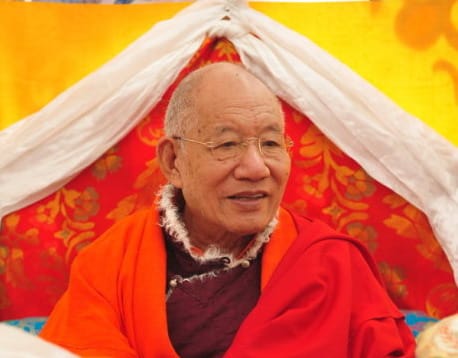
The Supreme Master of the Dzogchen Longchen Nyingthig lineage: Dodrupchen Rinpoche
I. The Auspicious Birth of the Dharma King
The great master of the Nyingma Longchen Nyingthig lineage, the supreme accomplished being, the Fourth Dodrupchen Rinpoche, Jigme Thubten Trinley Palzangpo, was born, as prophesied by the Fifth Dzogchen Rinpoche, in the village of Tsi, near the Sechu River, south of Dodrupchen Monastery, into a prominent family of the Jega tribe. He was the son of Dzala of the Jega tribe and Gali Kyi of the Gashi tribe. At his birth, the house was filled with light, flowers bloomed on the roof, and the flowers continued to bloom for twelve years, regardless of the season… many miraculous signs appeared.
During the year Rinpoche was in his mother’s womb, a rainbow appeared in the sky, the protector deity Loro descended onto the roof, a snake with a bright ball of light in its mouth entered the wall, and the sacred bird of Mahakala, the protector deity of Dodrupchen Monastery, a large crow with a distinctive mark, occasionally flew by, displaying signs of joy… many special signs were witnessed by everyone. His father also dreamt of wielding a crystal sword, its blade long and reaching into the sky, its end invisible.
When the infant was still unable to walk, Rinpoche was found on the second floor of the house. His parents then sealed off the stairs, but Rinpoche was still found on the second floor. Once, a mani stone fell on him, seemingly breaking many bones, but after a few hours, all the injuries disappeared. On many occasions, many people heard him chanting the Guru Rinpoche mantra. One day, a disciple of the Third Dodrupchen Rinpoche, named “Guru,” came to see him. As soon as Rinpoche saw him, he immediately called out, “Guru! Guru!” and placed his hand on his head, chanting the Guru Rinpoche mantra to bless him. II. The Recognition and Enthronement Ceremony of the Dharma King
That year, when the search party was looking for the reincarnated Tulku in various places around Dodrupchen Monastery, they sought guidance from Yukho Shatra Rinpoche. The master indicated that he had dreamt of two treasure vases in the mandala, thus there would be two reincarnated Tulkus; he also said that according to the prophecy from Zhiwu Ma, the correct Tulku would be found without a doubt.
Later, when the list of children born in the Year of the Fire Rabbit was collected and presented to Dzogchen Rinpoche, Rinpoche examined each name, then picked up one name slip and placed it on his pillow. After continuing to look at the others, he picked up another slip and placed it on his head, saying, “This is the reincarnation of Dodrupchen.”
Subsequently, when auspicious astrological signs and omens converged, the search party went to recognize and welcome the reincarnated Tulku. At that time, Rinpoche recognized many items and belongings from his previous life, which convinced everyone and brought tears to their eyes.
On the way back to the monastery, the search party camped overnight. The next morning, they found that several horses were missing. They couldn’t find them nearby, so they asked Rinpoche about the horses’ whereabouts. Rinpoche pointed to a mountain with his small hand, and they indeed found the horses there.
When Rinpoche returned to the monastery, people joyfully set up various magnificent decorations in both sacred and secular ways. An incredible procession of people, horses, and offerings followed in order to welcome him. At the enthronement ceremony in “The Great Secret Siddhi Auspicious Luminous Continent,” Rinpoche rose from his throne and, with a melodious voice, sang the “Seven-Line Prayer to Guru Rinpoche” and “Invocation of Guru Rinpoche,” looking around and smiling. He concluded with a prose prayer and blessings, astonishing everyone and instilling in them unwavering faith. III. The Miraculous Powers Manifested by the Dharma King in His Childhood
One day, Tulku Pema Norbu, a relative of the Third Dodrupchen Rinpoche, came to see the Rinpoche. He was holding a rosary with a coral bead on it. The Rinpoche saw it, took the rosary, rubbed it, and said, “This is mine.” Tulku Pema Norbu replied, “I, an old man, have no wealth except for this coral bead. You are Dodrupchen Rinpoche; isn’t it shameful to take my treasure?” The Rinpoche said, “No! No! I gave it to you before, and I will still give it to you now. But in fact, it is mine.” This rosary with the coral bead was given to Tulku Pema Norbu by the Third Dodrupchen Rinpoche in the past, and this incident proved that the Rinpoche was indeed the reincarnation of Dodrupchen Rinpoche.
Following Khenpo Gonme’s suggestion, the attendants gave him candy and asked him some questions, and the Rinpoche answered questions about his past life. For example, when asked where he came from, he said, “From Sangdopalri (the Copper-Colored Mountain of Auspiciousness).” When asked what it looked like, he said, “It’s like this,” and formed the shape of a heart or a mountain with his hands. When asked who lived there, he said, “Padmasambhava.” When asked who else was there, he replied, “Avalokiteshvara.” When asked if he knew Singha Rakshasa (the Rakshasa King manifested by Padmasambhava), he indicated that he did. When asked about the appearance of the Rakshasa King, he said, “Many mouths, many eyes, various colors.” Once, when asked where he lived, he pointed to the forest where he had lived in seclusion in his previous life and said, “There.” When people told him that there was nothing there but trees, he said, “No! No! My house is there.”
Sometimes, the two Dodrupchen Rinpoches would make torma (ritual cakes) from tsampa (roasted barley flour) and throw them out, saying, “May all obstacles be removed!” People could see sparks coming out of the torma.
One night, when the Rinpoche was about to go to sleep, he suddenly recited some verses. The attendants wrote down the parts they remembered. Among them is an eight-line rhyming verse, which contains profound Buddhist philosophy and practical meaning of meditation: “I and perfect enlightenment—the unchanging vajra wisdom—are inseparable. In the vajra source of male and female yogis, I am the realization of great bliss. In the unchanging vajra realm, I praise the inherent virtues and the vajra protectors. I am the Vajra Acharya, and I have attained great bliss.” Later, Khenpo Jala expounded on this verse using the three methods of Mahayoga, Anuyoga, and Atiyoga, and composed a commentary on it.
IV. Strict Observance of Precepts and Extensive Study of Scriptures
Khenpo Gongme once said, “Judging from the signs of miraculous powers he displayed since childhood, Rinpoche could manifest as a great accomplished master with supernatural powers comparable to those of Dodrupchen Rinpoche.” However, after Rinpoche grew up, except in individual cases, he never displayed supernatural powers again. On the contrary, when others displayed supernatural powers or gave prophecies, he repeatedly told them, “In this era, displaying supernatural powers is inappropriate. This may harm one’s lifespan, career, or the Dharma, and may also lead to the leakage of the secrets of the mantras.”
When he was studying scriptures with the scripture teacher Woqiong Rangri, he could understand the text with just a little guidance. From the age of seven, he first listened to and studied “Praise of Auspicious Wisdom and Virtues,” “Letter to a Friend,” “Entering the Bodhisattva’s Way of Life,” “Treasury of Virtues,” etc., from Khenpo Lushi. Then he listened to the complete “Upper and Lower Nyingthig” and the lineage of scriptures from Khenchen Kunsang Palden. Khenchen was very happy and explicitly entrusted him, saying, “This lineage of mine has a true basis, is short and direct, and has a blessing power different from other lineages; now the father has handed the treasure to the son.” In short, before and after the age of eighteen, he studied extensively under many virtuous teachers, including Khenpo Lobsang, Khenchen Kunsang Palden, Khenpo Shudra, Khentrul Sonam, Garla Tulku Dorje Chokyi, etc., diligently studying and contemplating various teachings such as Pramana (Logic), Madhyamaka (Middle Way), Vinaya (Monastic Discipline), Tantra, Secret Treasury Tantra, and mind training. He also completed the 500,000 preliminary practices more than three times, completing all the recitations and practices of the mandala of the Three Roots of the Nyingma tradition, and perfectly performed the supplementary fire offering. He also thoroughly mastered all the training of a Vajra Acharya, including chanting, musical instruments, and mudras. He went to the place where he lived in his previous life and tied a knot on a large tree, which can still be seen today.
V. Propagating the Dharma and Benefiting Sentient Beings
After succeeding as the abbot of Dodrupchen Monastery, Rinpoche built a Buddhist college and a meditation center, including temples and Buddha statues, which later became the source of many great scholars and enlightened yogis. At this time, in the presence of his guru, Yukho Shatra Rinpoche, with whom he had a karmic connection from past lives, he distanced himself from worldly distractions and diligently practiced according to his guru’s instructions. His guru cherished and valued him greatly, like a father cherishing his only son, and transmitted to him all the introductory teachings and oral instructions of Great Perfection, Trekchö, and Tögal, as if pouring from one full vase into another. At that time, Rinpoche refrained from all external activities, intensely practicing in retreat, and attained vast wisdom and realization, becoming a king among the highest yogis. His achievements brought great joy to his guru.
Due to the circumstances of the time, Rinpoche had to leave. From that time until now, Rinpoche established Chöden Monastery in Gangtok, providing food, clothing, and Dharma teachings to over a thousand monks and nuns. He also established numerous monasteries in Bhutan and Nepal, providing for their daily needs. Furthermore, he continuously bestows the nectar of Dharma teachings upon all faithful people throughout the world, primarily in Western countries such as the United States and the United Kingdom, and in Eastern regions such as Taiwan and Hong Kong, so that all sentient beings may be liberated from the ocean of suffering and attain the state of omniscient Buddhahood.
In short, Rinpoche has dedicated his entire life solely to the Dharma, remaining detached from worldly concerns such as fame and reputation, following in the footsteps of past saints and virtuous beings. It goes without saying that he is revered as a great yogi and a supreme guru by Dharma masters of all traditions.
The precious Guru’s studies and practices under the great Dharma King Dodrupchen: The precious Guru received the complete empowerments and oral transmissions of the Longchen lineage, the activity section of the Tsimar Dharma protector, and the oral transmissions and instructions of the powerful mantra treasury of Nyima Öser from the great Dharma King Dodrupchen, the lineage holder of Longchenpa.