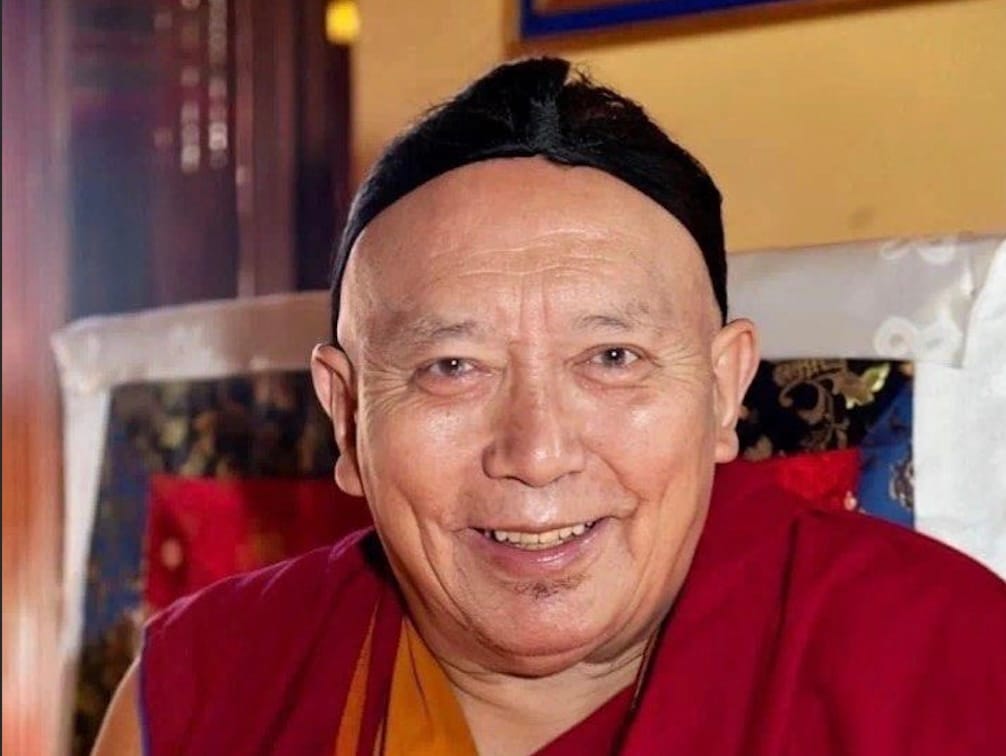
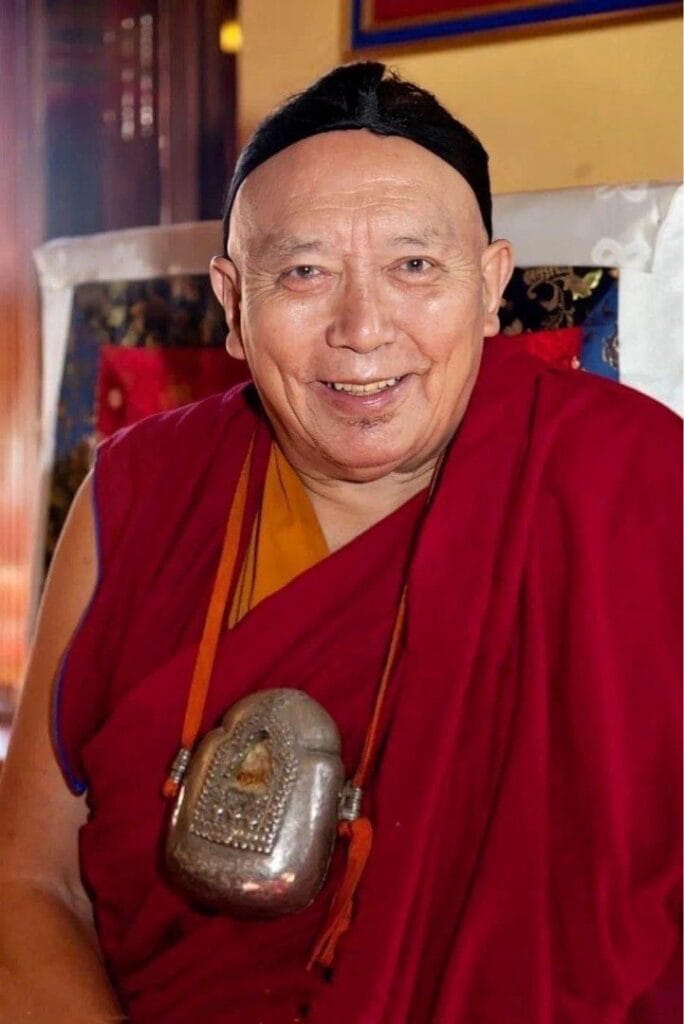
The precious jewel of the Dharma teachings: White Arya Rinpoche
Birth and Recognition
The abbot of Baiya Monastery, Baiya Rinpoche (Pema Rinpoche), was born in 1933 near Dzongsar Monastery. His father was Kangshe Namgyal Tsering, and his mother’s name was Guru Tso.
At the age of five, he was recognized by Dzongsar Khyentse Chökyi Lodrö (the Second Dzongsar Khyentse Rinpoche) as the reincarnation of Thartse Shabdrung Kunga Tenpai Nyima, a lineage holder of the Sakya tradition and an emanation of one of the eighty-four great Indian Mahasiddhas—Virupa. He was also prophesied to be the Dharma Lord of Baiya Monastery, and the system of reincarnated lamas at Baiya Monastery began from that time.
Extensive Study of Scriptures and Teachings
From a young age, Baiya Rinpoche studied reading, writing, and various cultural subjects with Khenpo Tenzin Rabgye.
At the age of thirteen, he took Dzongsar Khyentse Chökyi Lodrö as his principal guru and extensively studied: the Lamdre (Path and Fruition) teachings (twice), Lamdre for the Assembly (once), The Great Treasury of Precious Revelations, The Treasury of Instructions, The Collection of Accomplishment Practices, The Hundred Methods of Bari, The Hundred Methods of Narthang, The Four Teachings of the Protector, and The Seven Mandalas of the Ngor Tradition, etc., receiving empowerments; the transmission of The Three Categories of Red Dharma and The Three Books of Dakini Blessings and Guidance, as well as various empowerments and guidance related to protector deities, etc., all of which he completed. He also received empowerments and profound guidance on the Yamantaka Tantra, General Commentary on the Tantras, Hevajra Tantra, Commentaries on the Hevajra Tantra, etc., as well as many profound teachings on the inseparability of samsara and nirvana, Mahamudra, and Dzogchen.
During his five years of study at the Kangshe Buddhist College of Dzongsar Monastery, Baiya Rinpoche systematically completed the more than forty texts of exoteric and esoteric teachings from the Kangshe Buddhist College under the guidance of great Khenpos such as Thubten Chökyi Gyaltsen. At the age of twenty-three, he traveled to a monastery in Tsang (southern Tibet) and became a disciple of Luding Khenchen Rinpoche, Jamyang Tenpa Nyima (Sakya Ngorpa Luding Khenchen Rinpoche), receiving the three vows of Pratimoksha, Bodhisattva, and Tantra. Subsequently, he studied under many masters without sectarian bias, including Dilgo Khyentse Rinpoche, Sakya Trizin Rinpoche (Sakya Dolma Phodrang), Sakya Dagchen Rinpoche (Sakya Phuntsok Phodrang), the Fourteenth Dalai Lama, Mindrolling Trichen Rinpoche, Dzogchen Khenpo Kunga Gyaltsen, and others.
Regarding his actual practice:
While residing in the monastery, Baiya Rinpoche primarily practiced Tantric methods according to the common Sakya tradition, such as Vajrakilaya, Hevajra, Vairocana, Yamantaka, and Khon lineage Phurba. Later, due to changing circumstances, for twenty years he practiced in secluded retreat, focusing on Long-Life White Tara, Six-Armed White Mahakala, Long-Life Hayagriva, Vajra Kila, Rongzom’s Lotus Dakini, and Collection of Teachings. He also practiced Dzongsar Khyentse Chökyi Lodrö’s profound terma Lion-Faced Dakini, and completed over 700,000 recitations of the Hundred-Syllable Mantra of Heruka, 400,000 prostrations, and countless recitations of the Sutra of Liberation and the Continuum of Unconditional Repentance. He continuously practiced profound Tantric methods such as Essence of the Supreme One, Dakini Gathering, Purification of Transgressions, Jigme Hayagriva, Mati White Manjushri, Golden Key to Dispelling Curses, Naropa Dakini, Yangzab Combined Essence, Essence of the Immortal Mother, etc., and observed at least one session of silent meditation daily. Regarding the Acceptance of Disciples:
When Pema Rinpoche taught the seven mandalas of the Sakya Ngor tradition at Dzongsar Monastery, he had over 200 disciples; when he taught the Biography of the Path and Fruition Disciples at Muri Riku Monastery, he had approximately 500 disciples; when he taught the Biography of the Path and Fruition Disciples (Uncommon Path and Fruition Teachings Commentary) at Yulong Lhaga Monastery, he had approximately 300 disciples; when he taught the Great Treasure of Revealed Teachings at Yinbilinedeng Monastery (the monastery of Urgyen Dorje Rinpoche), he had approximately 300 disciples; and when he taught the Biography of the Path and Fruition Disciples at Derge Gonchen Monastery, he had approximately 700 disciples.
Pema Rinpoche also transmitted the lineage and teachings of the Biography of the Path and Fruition Disciples, the Khyentse Collection, and the Collection of Accomplishment Practices, etc., to the Third Dzongsar Rinpoche. At the same time, he also transmitted the Kalachakra Great Empowerment and other esoteric teachings of the Jonang tradition to Dilgo Khyentse Rinpoche, Shechen Rabjam Rinpoche, and Shadrup Chökyi Rinpoche, etc. Based on the different levels of understanding of his disciples, Pema Rinpoche transmitted new and old tantric empowerments, lineages, and teachings appropriate to their capacities.
Furthermore, in 1986, when the Panchen Lama inspected the Kham region, Rinpoche served as the Panchen Lama’s secretary. Subsequently, he served as a professor and textbook compiler at the China Tibetan Buddhist Academy; he collected and compiled fifteen volumes of the works of Dzongsar Khyentse Chökyi Lodrö, and had them carved into woodblocks for printing; he also collected many rare and precious texts frequently recited in the Sakya tradition, and had them printed using offset printing.
Currently, Rinpoche is engaged in the final review of the Tibetan Buddhist Canon at the Tibetan Buddhist Canon Collation Bureau of the China Tibetan Studies Center. His main works include A Brief History of the Sakya Tradition, etc., in Tibetan. A Brief History of the Sakya Tradition has been published by the Beijing Nationalities Publishing House and is a required textbook at the China Tibetan Buddhist Academy.
What the Precious Guru Learned and Practiced Under Guru Pema Rinpoche:
The Precious Guru received the Dzogchen Jetsun Nyingthig oral transmission and empowerment, and the complete Shangpa Kagyu empowerment and oral transmission from Pema Rinpoche. The teachings include the complete empowerments and oral transmissions of Khyentse’s collected works, the great empowerment of Guru Rinpoche’s thirteen deities, the complete empowerments of the Sakya thirteen golden dharmas and Naropa’s Vajrayogini, etc. The Yuthok Medicine Buddha lineage was received through empowerments and oral transmissions from the accomplished master Palya Rinpoche. The long-life White Tara lineage of Vimalamitra has been received from many masters, such as Penor Rinpoche, Lama Marpa Rinpoche, Palya Rinpoche, etc. The lineage from Palya Rinpoche was specifically requested by the precious guru because several practices in the Great Treasury of Precious Revelations were transmitted by the Second Khyentse to Palya Rinpoche. The Second Khyentse had two different lineages: one transmitted by Jamgon Kongtrul Rinpoche, which is the lineage of the Great Treasury of Precious Revelations; and another transmitted by his father.