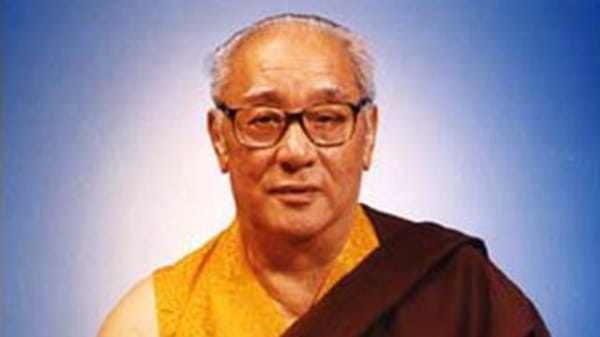
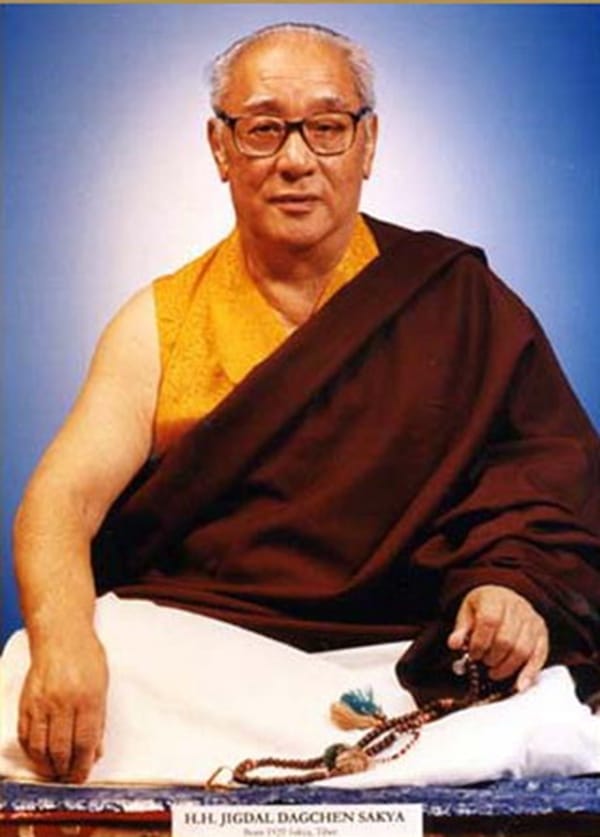
The ten-stage Bodhisattva in this present world: Sakya Trizin, the Dharma King.
The title of the Ten-Stage Bodhisattva is truly authentic.
Sakya Dagchen Rinpoche was the root guru of His Holiness Jigme Phuntsok Rinpoche, and Togar Rinpoche referred to him as a Ten-Stage Bodhisattva.
Togar Rinpoche and His Holiness Jigme Phuntsok Rinpoche’s root guru was Sakya Dagchen Rinpoche. From Togar Rinpoche’s praise, it is evident that Dagchen Rinpoche’s spiritual attainment was extraordinary.
According to Khenpo Sherab Rinpoche’s recollections of his guru, His Holiness Jigme Phuntsok Rinpoche: At that time, His Holiness Jigme Phuntsok Rinpoche was still studying Buddhism under his guru Togar Rinpoche at the Jiangma Buddhist Academy in Shiqu. Due to his advanced age, Togar Rinpoche spent most of his time in retreat or giving lectures at the Buddhist academy, rarely leaving his residence. Even when many famous lamas and khenpos came to Shiqu, he rarely went to them to seek teachings or empowerments.
One year, when Dagchen Rinpoche came to Shiqu, Togar Rinpoche, upon hearing the news, said to his disciples, “A Ten-Stage Bodhisattva has now arrived at our doorstep. It would be incredibly foolish if we didn’t go to him to seek teachings and blessings.” After saying this, he immediately led all the monks of the Jiangma Buddhist Academy to the residence of Sakya Dagchen Rinpoche to request empowerments and prayed for the Rinpoche’s long life.
After Sakya Dagchen Rinpoche passed into nirvana on April 29, 2016, a large area of green light, similar to the aurora borealis, appeared in the sky above Seattle. Especially above the Rinpoche’s residence and the Sakya Monastery, frequent appearances of circular rainbows and other unusual celestial phenomena were observed, demonstrating the auspicious signs of a saint’s achievement. Brief Biography
I. Historical Prophecy
The auspicious Sakyapa tradition records in the Manjushri Illusionary Net Tantra of Shakyamuni Buddha, as well as in the biographies of Guru Rinpoche and Atisha, that: “After seven generations of true emanations of Manjushri, successive emanations of Avalokiteshvara, Manjushri, and Vajrapani will appear, continuing the teachings of Shakyamuni Buddha to benefit countless sentient beings.”
II. Lineage
The Khön family lineage began with Khön Lu-yi Wangpo, a disciple of Guru Rinpoche and a great accomplished master of Vajrakilaya, in the 8th century. From him to the present-day Dagchen Rinpoche, each generation has produced great accomplished masters, scholars, and kings who protected sentient beings, such as Sakya Pandita, Sakya Pandita Kunga Nyingpo, and Chögyal Phagpa… From the five Khön ancestors to the present day, the bloodline has remained unbroken, the Dharma lineage has flourished, and each generation has achieved great accomplishments, earning the lineage the title of the bloodline of Manjushri or the Three Protectors.
In Tibetan Buddhism, the religious and political status of the Sakya lineage holder, Dagchen Rinpoche, is second only to Avalokiteshvara and the Panchen Lama. He oversees the three branches of Sakya, Ngor, and Tsar, and is the supreme leader of the Sakya tradition. In the hearts of Tibetans, the Rinpoche’s spiritual attainments are considered equal to those of the great accomplished masters of previous generations.
In the late Qing Dynasty, the 41st Sakya lineage holder, Trichen Ngawang Thutop Wangchuk Rinpoche, was the father of Dagchen Rinpoche. Besides inheriting his father’s Sakya royal power and leadership, Dagchen Rinpoche also inherited the unbroken lineage of Hevajra, Vajrakilaya, and the common and uncommon Sakya Lamdre teachings… He also completed long and short-term retreats on the fundamental and branch deities of the Sakya tradition.
After the passing of his father, Trichen Ngawang Thutop Wangchuk Rinpoche, Dagchen Rinpoche, in order to seek Dharma teachings in Eastern Tibet, resolutely relinquished his position as the Sakya ruler. He followed and associated with many virtuous teachers in Eastern Tibet, among whom the non-sectarian Dzongsar Khyentse Jamyang Chökyi Lodrö Rinpoche became his root guru, profoundly influencing his thought. After completing his main studies, the Dharma King remained in Eastern Tibet to propagate the Dharma, establishing seventeen Sakya colleges and ten retreat centers. In 1955, when the Dharma King gave the second transmission of the Sakya Lamdre teachings in Eastern Tibet, over 1,200 people received the teachings. Later, he also transmitted the Lamdre teachings in Nepal, India, and other places.
III. Global Propagation of the Dharma
In 1959, the Sakya Dharma King, accompanied by his consort Damo La and his entire family, went to India. The following year, he was invited by the University of Washington to participate in a Tibetan civilization research project funded by the Rockefeller Foundation. He then settled in Seattle, USA, and established a Sakya monastery of Tibetan Buddhism. Later, he also established Sakya South Garden in India.
To benefit those who longed to learn the Buddha’s teachings, the Dharma King extensively propagated the Dharma throughout the world, including India, the United States, Canada, the United Kingdom, France, Italy, Germany, Australia, Sweden, Switzerland, the Netherlands, Malaysia, Singapore, Nepal, and Taiwan, enabling disciples from all walks of life to receive the ultimate teachings and attain supreme enlightenment as soon as possible.
IV. Entering Nirvana
The compassionate Dharma King Dakchen dedicated his entire life to Buddhist education, teaching, and transmission, without complaint or regret, and with selfless devotion. However, as time passed and circumstances changed, the elderly Dakchen Rinpoche’s health deteriorated. Finally, on April 29, 2016, the 23rd day of the third month of the Fire Monkey year in the Tibetan calendar, he peacefully passed away, entering parinirvana amidst various auspicious signs, and remaining in profound meditation for seven days, demonstrating the freedom and liberation from life and death of a great practitioner.
The passing of the Dharma King left his disciples around the world without their protector! After the Dharma King’s passing, memorial services were held in various places at home and abroad to mourn this great and revered Vajradhara—Dakchen Rinpoche. The venerable Sakya Trizin, His Holiness Dagchen Rinpoche, with his incredible realization, profound knowledge, and boundless compassion, revealed the value of Buddhist practice to the world. Even though His Holiness’s physical body has departed from this world, his spirit and achievements continue to inspire and enlighten all beings, like the warm sunlight, blessing all sentient beings.
Precious Guru and His Holiness Sakya Dagchen Rinpoche
Precious Guru (Rinchen Chinpoche) received the complete empowerments of the Sakya Thirteen Golden Dharmas, Naropa’s Vajrayogini, Mahakala, and Dzogchen oral transmissions from His Holiness Sakya Dagchen Rinpoche.
From His Holiness Sakya Dagchen Rinpoche’s consort, he received the empowerments and practical teachings of White Tara and Green Tara, among other most profound Sakya teachings.
On the 25th day of the eleventh month of the Fire Dog year in the Tibetan calendar (Dakini Day), His Holiness Sakya Dagchen Rinpoche personally composed a long-life prayer for Precious Guru, “The True Words of the Ancient Sage,” which mentions the wish for Rinchen Chinpoche to live long, propagate the Nyingma teachings of the Buddhas’ secret treasury, and that the Three Roots and Dharma Protectors will closely accompany him, and his activities will resound throughout the four directions.
Precious Guru (Rinchen Chinpoche) was one of the disciples who received many teachings from His Holiness Dagchen Rinpoche in his later years. Precious Guru’s first empowerment in the United States took place at Dagchen Rinpoche’s Sakya Monastery in Seattle. This monastery is very special; many renowned and highly respected masters have opened mandalas and given teachings there.
In 2009, at the command of His Holiness Dagchen Rinpoche, Precious Guru gave the Guru Yoga empowerment and teachings on the Six Bardos to His Holiness’s family and group members at the Sakya Monastery. During the subsequent offering ceremony, His Holiness’s family and benefactors requested His Holiness to compose a long-life prayer for Precious Guru (this text has not yet been translated by Precious Guru). The currently circulating prayer for the long life of the Venerable Master Bao—”The True Words of the Ancient Sage”—was written by His Holiness Dakchen Rinpoche in 2006, on the 25th day of the eleventh month of the Fire Dog year of the Tibetan calendar, and sent to Venerable Master Bao.
On October 19, 2018, the Guru Rinpoche Tsog offering day, Venerable Master Bao, at the request of Dakmo Lha, Khenpo, and other lamas, gave an oral transmission and explanation of the Seven-Line Prayer of Guru Rinpoche at Sakya Monastery. The Seven-Line Prayer of Guru Rinpoche is a ritual that has been practiced every tenth day of the month, the Guru Rinpoche Tsog offering day, since the founding of this monastery.
Prayer for the Swift Reincarnation of His Holiness Sakya Dakchen Rinpoche
“Entreating the Great Compassionate Drum Sound”
To the Gurus, Deities, Buddhas, and Bodhisattvas,
Before the vast assembly in the sacred realm,
With sincere and sorrowful hearts, we respectfully pray,
May our heartfelt wishes be swiftly fulfilled!
Wisdom’s sovereign speech, like the waxing moon,
A perfect friend benefiting all sentient beings,
Born of merit, a luminous lineage,
We pray before the fearless lotus feet of the Venerable One!
The luminous dance of the Dharma realm, without duality,
The supreme body, protector of fortunate beings,
Appearing in this娑婆 world to benefit sentient beings,
Why now manifest great nirvana?
Therefore, may you be reborn as a pure moon of divine lineage,
Holding the treasury of compassionate wisdom and power,
Propagating the great compassionate teachings of Sakya,
May you swiftly appear as a Kun family child!
Through the blessings of the root lineage Gurus,
Through the blessings of the true meaning of the mantra,
The supreme and auspicious Sakya tradition,
May this supreme lineage spread throughout the ten directions!
This prayer was composed by Ngawang Kunga, the holder of the Dharma seat of the Sakya Tara Palace, with sincere reverence, at the time when His Holiness Dakchen, the protector of the complete palace of the auspicious Sakya tradition, entered into great nirvana and his mind merged into the Dharma realm. It was composed at the request of his nephew, the holy son of the Kun family, Asanga Rinpoche, who witnessed Dakchen Rinpoche’s mind abiding in luminous and supreme meditation and performed Dharma offerings before his physical body. May this prayer be fulfilled! (This prayer for reincarnation was translated into Chinese by Tulku Pema Rinpoche.)