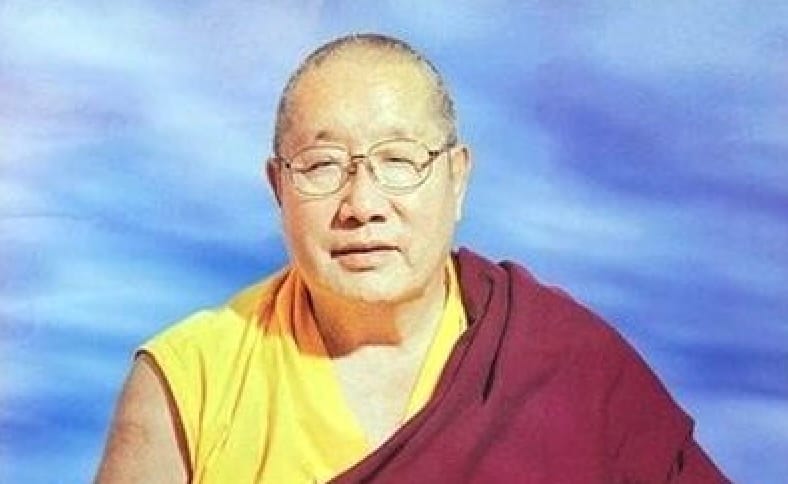
White Jade Sect Leader: Venerable Benno
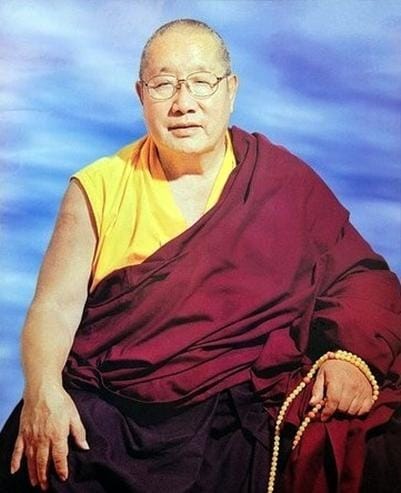
The Third Penor Rinpoche is widely recognized as an emanation of the great Indian Pandit Vimalamitra. He was born in December 1932 (Tibetan Water Monkey Year) in a place called Powo (anciently known as Pomi, also called Powo) in Kham Province, Eastern Tibet (Sichuan). His father was named Sonam Gyurme and his mother was named Tsogyal. In this village, flowers are not seen during the cold, dry winter, but when Rinpoche was born, fragrant flowers bloomed unexpectedly.
According to the prophecies of the Fifth Dzogchen Rinpoche and Kathok Khenchen Aga (the perfect lineage master, Venerable Agwangpo, also known as Khenpo Achung, Kathok Khenchen Aga, Khenpo Yaga), the Third Penor Rinpoche was identified. The Fifth Dzogchen Thubten Chökyi Dorje described the birthplace of Penor Rinpoche as follows:
In the sacred land of Powo,
On the spontaneously adorned peak of the wondrous rock mountain,
Adorned with various green trees and villages,
By the side of the extremely pure and cool great river,
The parents, Sonam and Tsogyal,
Gave birth to a victorious and wise son in the Water Monkey year,
Whose excellent name and virtuous deeds will flourish among the teachings and people,
As prophesied by Dzogchen King Thubten Chökyi Dorje.
At the age of five, Penor Rinpoche was brought to the Palyul Monastery in Kham. Under the guidance of the previous Chötrul Rinpoche Thubten Chökyi Dawa and the Tenth Dharma King—the Fourth Karma Kuchen Rinpoche Karma Thekchok Nyingpo—he was enthroned on his predecessor’s throne, officially recognized as the reincarnation of the Second Penor Rinpoche Pema Thubten (1887-1932), and became the eleventh lineage holder of the Palyul tradition.
A contemporary accomplished practitioner of Dzogchen, Kathok Khenchen Aga (Khenpo Yaga), foresaw the special mission of this new reincarnation and bestowed upon the child the refuge vows, the Manjushri empowerment, and a sacred Buddha statue. He also composed a long-life prayer for him, which is still recited by thousands of disciples worldwide. One of the six major monasteries of the Nyingma school, Palyul Namgyal Chöling, was built in 1665 under the patronage of the contemporary Derge King Lachen Jampal Phuntsok and Tsultrim Sangye Tenpa. The monastery’s founder was the tertön (treasure revealer) and accomplished Dzogchen master, Rigdzin Kunzang Sherab, who was prophesied by Guru Rinpoche.
Kunzang Sherab was a disciple of the great accomplished master Karma Chagme Rinpoche and the tertön of the Namchö Terma (Sky Dharma) tradition, Dechen Tulku Mingyur Dorje. Due to the blessings of his teachers and his own diligent practice, the monastery quickly developed into one of the largest monasteries in Tibet.
Over the following centuries, Palyul Monastery (often referred to as “the glorious Palyul of the East”) under the leadership of successive lineage holders, became renowned for its devout adherence to the Dharma and diligent practice. Thousands of monks attained the rainbow body and other spiritual achievements. Penor Rinpoche’s responsibilities included overseeing this main monastery and over four hundred branch monasteries throughout Tibet and Buddhist centers worldwide, as well as educating the fourfold assembly of disciples, including over 300,000 ordained monks and nuns.
Penor Rinpoche spent his childhood in Palyul and Dakpo. There, he studied and received teachings from the Tenth Lineage Holder, Karma Dechen Nyingpo, who was responsible for nurturing him to become the Eleventh Lineage Holder, and other precious masters.
When he was a young boy, one day he was playing with a precious vajra (ritual scepter) and accidentally dropped it, breaking it into two pieces. Unwilling to be scolded by his teacher, he glued the two pieces back together with his saliva. The vajra became even stronger than before.
At another Dharma assembly, he accidentally dropped a vajra bell onto a stone slab. Everyone present thought the bell would surely break, but when Rinpoche picked it up, he found it perfectly intact, and its sound was even louder than before.
When Rinpoche was a young boy, one day an old man approached him and insisted that Rinpoche perform the Phowa (transference of consciousness) practice for him. The Rinpoche naively agreed and practiced the Dharma accordingly. After a while, the Rinpoche was surprised to find that the old man had passed away. He performed the ritual again on the body lying before him to bring the old man back to life. When the old man revived, the Rinpoche finally breathed a sigh of relief. But the old man said, “Oh my! Why did the Rinpoche call me back? I was already in Amitabha Buddha’s Western Pure Land!” Another incident also illustrates the miraculous powers the Rinpoche displayed at a young age. As a child, the Rinpoche left his footprints deeply imprinted on a stone, which is still visible today.
Later, the Rinpoche learned various Dharma teachings from many great masters, abbots, and teachers, including: the Nyingma tradition’s Dzogchen teachings such as the Buddha in the Palm, the Eight Great Herukas, the Great Treasure Teachings, the Ratna Lingpa Treasure Teachings (Ratling), Dzogchen, the Heart Essence of Dzogchen, and secret protector deities, etc., and practiced according to the teachings, achieving realization.
At the age of thirteen, in the retreat center in Dagpo, in the sleeping quarters of the previous Penor Rinpoche, he received full ordination under the witness and guidance of five principal abbots and monks, and was formally tonsured, receiving the Dharma name “Doya Shedrup Tenzin Chökyi Namgyal,” meaning “the supreme holder of the victorious teachings of the sutras and tantras.”
In Dagpo, he also studied the guidance of Anu Yoga with the previous Dzongsar Rinpoche Jamyang Khyentse Chökyi Lodrö, as well as the nine-part guidance of Pema Lingpa by Pema Jigme, and the thirteen chapters of Karma Chagme’s “A” practice. During the transmission of the teachings, the Dharma King formed intricate vajra knots with his tongue in his mouth. This learning continued until 1958, when the Rinpoche was twenty-seven years old.
Among the Rinpoche’s many teachers, he maintained a very close relationship with the previous Chötrul Rinpoche Thubten Chökyi Dawa, and received great benefit from his teacher. At the age of thirteen, he received the novice vows from Thubten Chökyi Dawa, and at twenty-one, he received the full monastic vows. Other important Nyingma oral transmissions and empowerments were also bestowed upon him by Chökyi Rinpoche.
The elderly Chökyi Rinpoche, whose eyesight was failing, often said, “If I cannot transmit the complete teachings, oral transmissions, and empowerments to Penor Rinpoche, then I will not have truly lived this life.” Afterward, Penor Rinpoche undertook a long retreat with his guru, Chökyi Thubten Chökyi Dawa, in the Tarthang area, practicing from the basic preliminary practices to the most profound Dzogchen, until the naked nature of reality manifested before him.
The second Dharma King of the modern Nyingma lineage, Dilgo Khyentse Rinpoche, once said on an occasion, “Penor Rinpoche is already a saint who has transcended the samaya vows.” The spiritual mentor of the Larung Gar Buddhist Academy in Sichuan, Khenpo Jigme Phuntsok, also frequently praised Penor Rinpoche as a living Buddha.
During an accomplishment ceremony, many monastics saw a rainbow appear on the mandala plate, and nectar overflowed from the kapala (skull cup). On one occasion, during a “Mahakala” accomplishment ceremony, the offering biscuits of the dakinis visibly trembled.
On another occasion, while receiving the oral transmission of the Kangyur (Tibetan Buddhist canon), Penor Rinpoche recalled his teacher, Shakyamuni Buddha, sitting by a river, giving profound teachings to him and thousands of disciples. According to Khenpo Yaga, Rinpoche is also a manifestation of Vajrapani; Rinpoche’s clear memory confirms that in a past life he had studied under the Buddha as a manifestation of Vajrapani.
To make a pilgrimage to Lhasa, especially to visit the renowned Jowo Buddha statue (the life-size Buddha statue in the Jokhang Temple), is every Tibetan’s dream. In 1956, when Rinpoche was twenty-five years old, he traveled to central Tibet with a large entourage. There, Rinpoche visited many monasteries and ancient holy sites that recounted the glorious history of Tibet. Rinpoche also received the long-life empowerment from the Dalai Lama. During the prayer ceremony at Jokhang Temple, the Rinpoche offered tea and other provisions to the monks.
In 1961, the Rinpoche and his entourage of six hundred people arrived in Mysore. Rebuilding the Palyul Monastery—”Victorious Southern Dzogchen”—at Bylakuppe in Mysore was no easy task. At the beginning of construction, the Rinpoche only had a meager three hundred rupees. Here, the Rinpoche had to rebuild his Buddhist activities and the monastery. He had limited material resources, but unlimited resources in the form of unwavering courage and determination.
Some of those who followed the Rinpoche at the time could not understand his vision, nor could they grasp even a drop of his ocean of wisdom, and insisted that he reduce the scale of the monastery construction. This was because only a very small number of monks were with the Rinpoche at that time. Today, Namdroling Monastery has become one of the largest Tibetan Buddhist monasteries in the world, yet there are still many monks and laypeople who don’t even have a place to sit during major ceremonies. Now, more than thirty years later, everyone is amazed and grateful for the Rinpoche’s foresight.
Few lamas of the same stature as Penor Rinpoche have experienced the hardships and suffering that Penor Rinpoche endured. Under the scorching sun, the Rinpoche, along with other workers and monks, carried stones and mud, their hands even bleeding and aching. The lack of running water and paved roads made the construction work even more difficult. The Rinpoche even had to fetch water from a distance himself.
One day, under the blazing sun, a man came to where Penor Rinpoche and the monks were working. He excitedly approached the Rinpoche and said, “I have come from a long distance just to see Penor Rinpoche. May I see him?” “Oh! Of course, what’s the problem?” After saying this, the Rinpoche led him to his simple room and said, “Okay, how can I help you?” The man was both surprised and embarrassed. He had never imagined that the Rinpoche would be so approachable. He had always thought that Penor Rinpoche would be different, surely dressed in solemn attire and sitting on a precious throne. In fact, Rinpoche is a true wish-fulfilling jewel, and everything is manifested on the ordinary land where he diligently works.
Year after year, Rinpoche, with his inexhaustible perseverance, energy, and great vows, steadily treads the path forward, undisturbed by the difficulties and obstacles in his way. Everything Rinpoche has invested has not been in vain; today, Namdroling Monastery has over three thousand monks and nuns, making it arguably the largest Nyingma monastery in the world. The Dharma King has rebuilt the monastic system and the tradition of summer retreat here, holding a thousand offerings ceremony of the Hundred Peaceful and Wrathful Deities, a Vajrakilaya puja, and a hundred million Medicine Buddha pujas every year. During the Medicine Buddha puja, auspicious signs frequently appear: rainbows rise from the mandala offering plate, nectar overflows from the skull cup, and the Dharma King’s mouth becomes unusually sweet.
Because he could not bear to see the Buddha’s teachings, especially the teachings of the Nyingma school, facing the danger of extinction, Rinpoche established the Palyul Nyingma Buddhist Institute in 1978. This institute has now become a renowned center for advanced Buddhist education and research. This is another glorious achievement of Penor Rinpoche’s tireless Dharma activities.
Namdroling Monastery also has a retreat center, where about thirty monks are undertaking traditional three-year retreats. Penor Rinpoche personally guides them in the Dzogchen Longchen Nyingthig and the Namchoe teachings revealed by the terton Mingyur Dorje. Every three years, a group of qualified Vajra Masters emerges from retreat. Every autumn, Rinpoche holds a one-month retreat for monks, nuns, and lay practitioners. Rinpoche personally teaches the Four Foundations, Qigong, and Dzogchen. All study courses are combined with practice, making Penor Rinpoche’s monastery an ideal place for intensive study and practice. This is due to Penor Rinpoche’s great vows, which he constantly emphasizes. Currently, more than a thousand young monks are enrolled in basic primary schools, studying Tibetan and English reading and writing, as well as other basic subjects, along with fundamental Buddhist studies and preliminary practices. This number increases by one to several hundred each year, as many Tibetans send their children to monasteries to receive education and cultivate their character.
In 1993, Rinpoche built a nunnery, “Tsojey Sherab Ling,” where approximately three to four hundred nuns receive education and study Buddhism. Penor Rinpoche also built a nursing home where many elderly people live and practice. They can often be seen walking under the trees or circling the two sets of eight stupas built by the Dharma King to pray for world peace, holding prayer wheels or rosaries in their hands.
The Dharma King’s compassion even extends to the local residents. He built bridges and roads to benefit the local people. All the offerings he receives are spent on these projects. Now, to address the medical needs of tens of thousands of local residents, Penor Rinpoche is planning to establish a comprehensive hospital with both Western and Tibetan medicine, and construction has already begun. Rinpoche is renowned for his prayers for timely rain during dry seasons. Local residents have given him the nickname “Rain Lama.”
Penor Rinpoche has given numerous empowerments, including several Great Treasure empowerments and many teachings on Nyingthig and Namcho. He is the first and, to date, the only Tibetan master to have given the Great Treasure empowerment in the West. Rinpoche is deeply revered by the public for his boundless compassion and abilities. For his devoted followers, especially the monastics under his care, the Dharma King is not only a guru, but also a father, doctor, psychologist, and even a therapist for both mind and body.
The Dharma King is a fully ordained monk with pure precepts, and he has conferred monastic vows to over 2500 monastics. In addition to giving teachings and empowerments, Rinpoche also provides answers to people’s various questions. Day after day, from morning till night, His Holiness the Dharma King selflessly benefits the living, the dying, and those who have passed away.
Rinpoche not only rebuilt the main Palyul Monastery and the Palyul Buddhist College established in his previous lives, founded Namdroling Monastery and Yagyu Nyingma Buddhist College, and gradually restored various sub-monasteries in the lineage that urgently needed restoration, but also established Buddhist centers in Hong Kong, Taiwan, Macau, mainland China, Singapore, Malaysia, the Philippines, the United States, and Canada. In recent years, his footsteps have even reached European countries such as Greece, Germany, and France. Rinpoche tirelessly travels across India, the Himalayas, Southeast Asia, and Europe and America, all to spread the blessings of the Dharma to all corners of the world, allowing all sentient beings worldwide to equally benefit from the Dharma.
In 1993, at the Nyingmapa Monlam Chenmo Ceremony for World Peace held at the Vajra Seat in Bodh Gaya, the place where the Buddha attained enlightenment, Nyingma masters from all over the world unanimously elected His Holiness Penor Rinpoche as the current head of the Nyingma lineage, succeeding His Holiness Dudjom Rinpoche and His Holiness Dilgo Khyentse Rinpoche. This honor is truly well-deserved! Because Rinpoche, for the benefit of the Dharma and all sentient beings, has demonstrated the extraordinary wisdom of Manjushri, the compassion of Avalokiteshvara, and the courageous power of Vajrapani!
May His Holiness the Dharma King guide all sentient beings, who are adrift in the cycle of samsara, to the shore of ultimate liberation!
The Auspicious Dharma Connection Between Venerable Master Bao and His Holiness Penor Rinpoche
- Regarding the Great Treasure Trove (Rinchen Terdzö)
Under the guidance of His Holiness Penor Rinpoche, the great Dharma King of the Nyingma school, I received the complete empowerment of the Great Treasure Trove, the essence of the Three-Word Striking Point teachings, and many other long-distance and close-transmission Dharma methods.
- Regarding the Yuthok Tradition of Medicine Buddha
I received the Yuthok Heart Essence empowerment from the Great Treasure Trove under the guidance of His Holiness Penor Rinpoche.
- Regarding the Vimalamitra Tradition of Long-Life White Tara
I have received the Vimalamitra tradition of Long-Life White Tara from many masters, such as His Holiness Penor Rinpoche, Lama Marpa Rinpoche, and Palya Rinpoche, etc. I specifically requested this from Palya Rinpoche because several Dharma methods in the Great Treasure Trove were transmitted by the Second Khyentse Rinpoche to Palya Rinpoche. The Second Khyentse Rinpoche had two different lineages: one transmitted by Jamgon Kongtrul Rinpoche, which is the lineage of the Great Treasure Trove; and the other transmitted by his father.
- Regarding the Self-Arising and Self-Manifesting Eight Great Herukas
Today I will be giving you the empowerment of the Self-Arising and Self-Manifesting Eight Great Herukas (the Eight Great Herukas are also called the Eight Great Sugatas, the Eight Great Tathagatas, or the Eight Great Dharma Practices. When appearing as peaceful deities, they are the Eight Great Tathagatas; when appearing as wrathful deities, they are the Eight Great Herukas). You should have already seen introductions to this before, but due to time constraints, I cannot explain it in detail this time. Most of what you see online was written by me. A long time ago, I invited His Holiness Penor Rinpoche to give the long-distance empowerment of the Eight Great Herukas in Taiwan, and I wrote the introduction to the long-distance Eight Great Herukas. Later, I invited Chosang Rinpoche to transmit the three major lineages of the Eight Great Herukas, and I also wrote the introduction to those three major lineages at that time. 5. Regarding the Manjushri Lion of Speech Dharma Practice
From the age of five or six, I began receiving oral transmissions and empowerments of the Hundred Deities of Peaceful and Wrathful Manifestations (including the Manjushri Lion of Speech Dharma practice). This was also one of the first Dharma practices I undertook in retreat. During this time, based on my feelings and dreams (including signs such as receiving empowerments and scriptures from Sakya Pandita), I wrote a hymn of praise to Manjushri. The first person to transmit this Dharma practice to me was Master Kangcang, who also wrote a short ritual text for me. Later, I received the oral transmission of the ritual and Dharma practice from Pema Sogyal, a disciple of Mipham Rinpoche and a Dzogchen accomplished master. Since then, I have continuously practiced the Manjushri Lion of Speech Dharma for a long time.
I have received the empowerment lineage of Manjushri Lion of Speech from Penor Rinpoche, Shechen Ongdrup Rinpoche, Langya Rinpoche, and Pema Rinpoche.
- Regarding the White Tara Dharma Practice
Many disciples requested me to transmit the White Tara Dharma practice last year, and I agreed. In this degenerate age, many obstacles arise, whether tangible or intangible, or various physical and mental obstacles, etc. During this time, practicing White Tara is a very good choice, and this is the reason I am transmitting this Dharma practice to everyone. I have received this Dharma practice twice from Pema Rinpoche and also from Penor Rinpoche, so I am qualified to transmit this Dharma practice. Among all the tantras, considering all aspects of learning, practice, and retreat, I am most familiar with the Tara Dharma practice and the Guru Rinpoche Dharma practice.
- Regarding the Wisdom Blazing Wrathful Guru Rinpoche Dharma Practice
The Wisdom Blazing Wrathful Guru Rinpoche Dharma practice has extensive, medium, and abbreviated methods of practice and empowerment. The empowerments include a detailed two-day empowerment, a medium-length definitive empowerment (the definitive empowerment is divided into a more extensive detailed definitive empowerment and a concise monastery empowerment), and a brief Torma empowerment, as well as body, speech, and mind permission empowerments, life-force empowerments of the eight classes of deities and nagas, and long-life Buddha empowerments, etc. This particular Dharma practice involves more than ten empowerments. If we include the empowerment of the Dharma protectors, it would take at least two to three days. The empowerment we received this time was a detailed, definitive empowerment.
Regarding my lineage, I have received the transmission of this Dharma practice from many masters. I received the detailed, definitive empowerment twice, once from Penor Rinpoche and once from Pema Rinpoche. I received the simpler, definitive empowerment from Ongdrup Rinpoche, who transmitted it in Nepal. I received oral transmissions and explanations from several masters, including my uncle, Tsazur Rinpoche, whom I mentioned earlier, and also from Shartra Rinpoche. I recall receiving a transmission from Kangtsang Rinpoche, but I’m not entirely sure if it included oral transmission, and I’ve also forgotten if I received other transmissions from him. Therefore, this is how I received the lineage of this Dharma practice.
- Regarding the Kurukulla Dharma Practice
I received the Kurukulla Dharma practice from Penor Rinpoche, Karma Chame Rinpoche, Pema Rinpoche, and others.
- Regarding the Vajrayogini Dharma Practice
Penor Rinpoche was invited to Miaocheng Dharma Center to give the Vajrayogini empowerment.