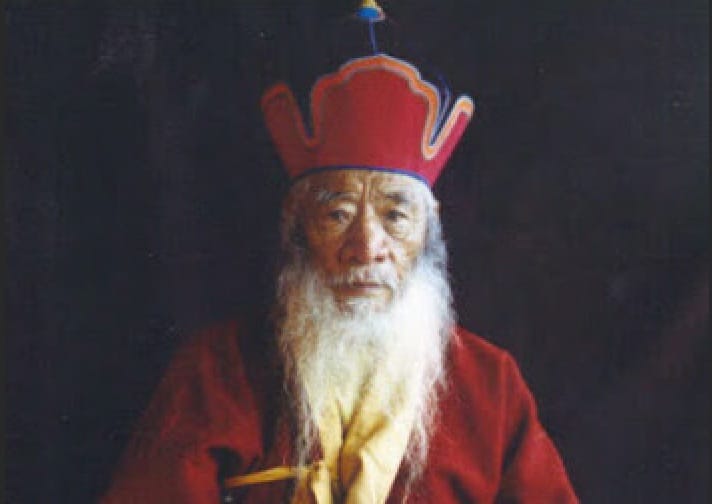
A supreme accomplished master of the Nyingma school of Tibetan Buddhism: Chatral Rinpoche
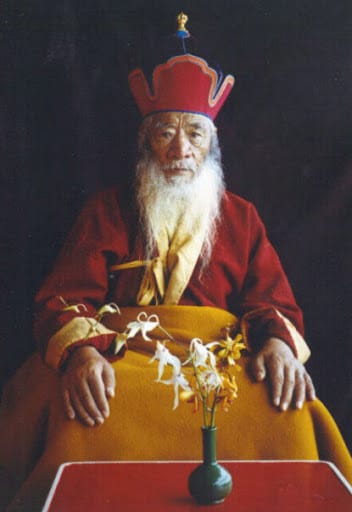
Chatral Rinpoche (1913-2016)
Chatral Rinpoche was the highest lineage holder of the Nyingma tradition of Tibetan Buddhism, a master among masters.
The Karmapa and other masters of various schools all acknowledged that Chatral Rinpoche’s practice had reached the highest level.
Chatral Rinpoche’s main teachers included Shara Khandro Rinpoche, the Second Dudjom Rinpoche, and Kathok Khenchen Aga Rinpoche.
Throughout his life, Chatral Rinpoche primarily guided meditators in retreat, establishing many meditation and retreat centers in Nepal and the Himalayas.
The venerable Chatral Rinpoche passed away in early 2016 at his monastery in Yangleshö, Nepal. This centenarian, in the eyes of Buddhist practitioners, was like Mount Everest—majestic, towering, and inspiring awe.
Precious Master’s Dharma Practice under Chatral Rinpoche
Chatral Rinpoche was one of the teachers of Renjin Chenpo Rinpoche (hereinafter referred to as Precious Master).
From the age of eighteen to twenty-four, Precious Master studied in Nepal under his root guru, the great accomplished master Chatral Rinpoche of Kathok. He received some of the teachings of Kathok Renjin Chenpo, some of the distant and close lineage teachings of Kathok, the complete common and uncommon Dzogchen teachings of Longchen Nyingthig, and the preliminary and main practices of Dudjom’s New Treasure tradition, and also received the teachings of Shara Khandro.
During his time in Nepal, Precious Master undertook long-term retreats for over three years at various locations, including the Vajrayogini sacred site in Kathmandu, the shores of Pokhara Lake in Gorkha, Bodhi Spring, and the Yumoche Snow Mountain. Bao Rinpoche received the complete teachings of the Kathok Rigdzin Chenpo lineage of his second incarnation, Rigdzin Tsewang Norbu, including empowerments, oral transmissions, and instructions. There were two instances of receiving these teachings: one was when Chatral Rinpoche invited his teacher, Norbu Rinpoche, to the monastery to give teachings. At that time, Bao Rinpoche and several of his Dharma brothers, including Kalsang Rinpoche, received the complete transmission, but that time only included oral transmission, not empowerment; the other was when Chatral Rinpoche felt that this lineage was currently very rare and precious and must be propagated, so he introduced Bao Rinpoche to the great yogi Lama Made Rinpoche to seek the Dharma. This transmission was even more complete and comprehensive, because many of the teachings were scattered Dharma methods not found in the Great Treasure Trove of Terma. Lama Made Rinpoche himself collected the texts and received these transmissions, and later he gave Bao Rinpoche empowerments and oral transmissions, including the relics of Rigdzin Tsewang Norbu.
Brief Biography
Chatral Rinpoche is also known as Sangye Dorje, Chokgyal Dorje, and Chatral Buddha Vajra.
Chatral Rinpoche was born in 1913 AD, in one of the four valleys of Shamo Gang in Tibet, called the Yea Zhi Rong Valley, a secret sacred place. Rinpoche’s birth date coincided with the day when Guru Rinpoche manifested as Vajra Heruka.
Chatral Rinpoche’s father was Pema Dongdrup of the Mupo Tang family, and his mother was Sonam Cho of the Hua Yong family. Rinpoche’s parents always maintained a respectful and pure attitude towards the Dharma. On the second day after Chatral Rinpoche’s birth, a great accomplished master personally came to their home and bestowed upon the child the name: Chokgyal Dorje (meaning Vajra Wrathful King).
Chatral Rinpoche began studying Tibetan language and Buddhist scriptures at the age of four, and at the age of fifteen, he studied with the human dakini and tertön (treasure revealer) Shara Khandro, learning many terma teachings and tantras. Later, Master Shalakhandro told him, “Go to Kathok Khenchen Aga and study with him; you will benefit many sentient beings in the future!” Therefore, the Venerable One went to Kathok Khenchen Aga Rinpoche to study the Dzogchen Longchen lineage, receiving oral instructions and empowerments from Khenchen Aga, and then entered into retreat there for three years and six months.
Later, Shatra Rinpoche went to Kathok Monastery to study the sutras, tantras, and culture of Tibetan Buddhism, and also undertook rigorous retreats in many sacred places and on snow-capped mountains. During these retreats, he ate only one mouthful of food a day. After six months, when Golok Sozhi Rinpoche saw him, Shatra Rinpoche was so thin he was practically skin and bones. Therefore, Sozhi Rinpoche advised him to stop the rigorous ascetic practices and invited Shatra Rinpoche to his monastery to teach the Dharma.
Shatra Rinpoche later went to study the seventeen Dzogchen tantras with the great accomplished master Tsangpa Zhichen, who lived for over 150 years. Afterward, he returned to Khenchen Aga and told his teacher that he wanted to go to Tibet. After receiving permission from his teacher, Shatra Rinpoche traveled from Kham to Tibet, prostrating himself every three steps, a journey that took many years. When the Venerable Avalokiteshvara was young, King Lhaten, who was acting as his regent, implored Khenchen Aga, a master from Kathok Monastery, to be his guru. However, Khenchen Aga replied, “My spiritual path is the same as that of Shatra Rinpoche. You can take Shatra Rinpoche as your guru; he will be my representative.” Therefore, Shatra Rinpoche went to Lhasa Monastery in Tibet, became the king’s guru, and met Dudjom Rinpoche, becoming each other’s guru. He was also the root guru of the King of Sikkim. Shatra Rinpoche was a Vidyadhara (knowledge-holder) of the Nyingma school. Tibetans called him Shatra (meaning “renouncer of the world”) Buddhavajra (Sanskrit for “Buddha Vajra,” Tibetan: Sangye Dorje).
The Karmapa and Dudjom Rinpoche both stated that Shatra Rinpoche had the greatest achievements among the current Tibetan Tantric masters and wrote praises celebrating his accomplishments.
The Venerable Avalokiteshvara also said, “When I was two or three years old, I wanted to see Dodrupchen Rinpoche and Shatra Rinpoche, but they were ascetic yogis, and I couldn’t see them.” The Venerable Avalokiteshvara held them in great respect.
Dudjom Rinpoche said, “Not only Shatra Rinpoche himself, but many of his disciples are also accomplished masters.”
Padmasambhava’s prophecy also states: “Later, when Tibet faces great difficulties and people are exiled to India and Nepal, there will be an accomplished master in the snowy mountains of Nepal (Yolmo). His face will resemble a wrathful deity, his zodiac sign will be the ox, he will be a yogi of subtle energy channels and vital points, and his body will be like that of a young man.” Padmasambhava’s prophecy refers to him. Furthermore, over a hundred years ago, the great tertön (treasure revealer) Yongri prophesied: “In the future, when Tibet faces difficulties, in Yangleshö, a place of accomplishment of Guru Rinpoche in Nepal, there will be an accomplished master, born in the year of the Ox, who will establish a retreat center. He will propagate the Great Perfection teachings, and there will also be a master blessed by Vimalamitra and Guru Rinpoche, whose name is ‘Vajra,’ also born in the year of the Ox, who will transmit tantric teachings in many places in Nepal and India. Many of his disciples will be accomplished practitioners.” Dudjom Rinpoche stated that the person described by Yongri was none other than Chatral Rinpoche.
Chatral Rinpoche dedicated his entire life to spiritual practice, remaining detached from all worldly affairs. He often traveled alone to Tibet, Bhutan, Nepal, and India for pilgrimages and meditation. Throughout his life, he tirelessly devoted himself to the Buddhist cause, using all the offerings he received for releasing animals, practicing Dharma, and giving alms. He built countless stupas, both large and small (three stories or more in height), and eighteen retreat centers in Tibet, Nepal, the Himalayan region, Bhutan, and India. Countless Tibetans and Nepalese held him in the highest esteem, considering him a master of perfect accomplishment and merit.
Those familiar with Chatral Rinpoche know that he had no personal savings. He only had an iron box with a slot on top. He would put all the money offered to him into this box, and when it was full, he would take it out and buy fish to release, a practice he maintained year after year.
Chatral Rinpoche’s wisdom was extraordinary, earning him immense praise and respect even from those of other faiths. In India and Nepal, many Hindus also revered Chatral Rinpoche as a saint.
Recollections of my Guru, Chatral Rinpoche
Like my guru, Chatral Rinpoche, who was always very healthy in Nepal, and lived to the age of 104 (passing away in early 2016), his greatest characteristic was his simple lifestyle. He was known as a renunciate yogi, meaning he had no need for many worldly things, remaining detached from fame, status, and wealth. His Holiness Chatral Rinpoche’s life was always very disciplined. At midday, unless there were many people to see, he would meditate and rest at the same time every day; meditation was his form of rest.
He often advised his disciples to cultivate contentment, reduce desires, and diligently practice the Dharma. He didn’t build large monasteries; he had two small ones. He previously had over twenty retreat centers, which he later donated one by one to worthy practitioners for management and Dharma propagation, including offerings to Penor Rinpoche and several other masters.
Even in his eighties, he still personally handled all the affairs of the monastery, including word processing, painting thangkas, making Buddha statues, preparing offerings, etc. He supervised and worked diligently himself; he was a very industrious person.
When I was under his tutelage, I never saw him get angry. He usually looked very serious, and everyone was afraid of him; it’s true that we rarely saw him smile.
Rinpoche never scolded anyone; his speech was always direct. He would often say a sentence and then stop speaking, like that. Therefore, everyone was afraid, not knowing what he was thinking. He was a man of few words.
Similarly, he was a practitioner of patience and had a joyful disposition. He was serious but cheerful. Whether we lived in the mountains or in the lowlands, his life was very simple. He would sleep wherever he was; he had no strong attachment to material possessions, and his heart was joyful. This is the kind of practitioner he was.
His Holiness Rigdzin Chenpo constantly remembers the teachings of the holy master and reflects repeatedly on the teachings given to the disciples, sharing them below, hoping to benefit those who are fortunate enough to encounter them!
Teachings of Chatral Rinpoche to his disciples:
Please listen carefully to my teachings and carefully examine and observe your own minds. A human life is difficult to obtain—it is very difficult to obtain a human body, but if you obtain a human body without practicing the Dharma, you will have no more opportunities in the future. Therefore, you must have the spirit of pursuing the Dharma and should not waste time on meaningless sleeping, playing, etc. You should make good use of your body, speech, and mind to perform virtuous deeds and find a quiet place to practice. Throughout our lives, we toil and struggle for food, shelter, and other necessities… We should deeply reflect on the fact that these things cannot be taken with us in death; we should also reflect on how the delicious food and fine wine we consume daily turn into unclean waste the next day. Thinking about this, we understand even more clearly that there is no need to desperately indulge in gourmet food every day to sustain our lives; moderate nutrition is sufficient!
If we cannot constantly remember the impermanence of life and immediately practice to attain ultimate enlightenment, but instead waste time needlessly and tell ourselves we will do it later, then our practice of Buddhism will ultimately remain just a pipe dream. We must know that the demon of death is everywhere, and can take our lives at any moment, and we are completely powerless to resist. At that time, there will be no escape, and even regretting not having practiced properly will be too late!
Furthermore, sentient beings in the six realms have no true happiness. When we hear about the various sufferings endured by sentient beings in the three lower realms, we already feel fear. If these painful karmic consequences were to befall us, how could we endure them? The happiness in the three higher realms is like delicious food laced with poison; it seems to offer some happiness now, but in the long run, it is the cause of downfall and failure. Pain and happiness are merely psychological sensations, not real; they are simply a law of cause and effect, and nothing else exists. Therefore, we should know how to choose and reject according to the law of cause and effect!
We should rely on a truly qualified Vajrayana master to learn the Dharma, which is far more important than listening to many Buddhist teachings everywhere. We should eliminate any doubts about the Vajrayana master and all the Dharma teachings he transmits, and wholeheartedly follow the master’s guidance and practice diligently. We should try to find a quiet place and truly understand the meaning of practice.
We should abandon the thoughts of subduing enemies, helping relatives and friends with their lives and careers, etc. If these thoughts cannot be abandoned, it is truly lamentable. If we cannot be content with little, and cannot let go of our desires for worldly possessions and other things, then we will only become even more inferior than ordinary people, and we will not even be able to complete our daily Buddhist practice. It is important to know that without diligent practice in the Dharma, you will become an unrighteous practitioner, and this requires great attention.
As practitioners, our minds should be focused on the thought of wanting nothing! If you don’t feel aversion to worldly matters and want to practice happily and comfortably, such thoughts will not lead to the blessings of the Dharma. It is far better to reduce worldly affairs in a simple dwelling and diligently practice the Dharma, thus reducing mental distractions. Only such practitioners will naturally possess the necessary karmic affinity for enlightenment!
After years and months of long retreats, if you haven’t made significant progress but still think you have gained merit from the long retreat; if you become arrogant when praised; if you become happy when others speak kindly to you; if you become angry and resentful when criticized; and if you are busy finding fault with your Vajra brothers and sisters, these all indicate that you have not reflected upon and observed your own mind. Your unstable mind will cause conflicts among friends and fellow practitioners, thus violating the Samaya vows. Therefore, you must diligently maintain right mindfulness and carefully guard it!
Do not let your mind wander; practice cautiously and steadily. Whether in a quiet or noisy place, the most important thing is to subdue your five poisons. Besides the eight worldly winds, there are no other enemies. Use methods of elimination, transformation, application, and self-observation of your true nature, choosing appropriate methods of practice according to your level. A person who skillfully manages their inner mind is like a very brave person winning a tough battle without any weapons!
When practicing the Sutra and Tantra Dharma, the most important thing is to cultivate the vast and beneficial Bodhicitta of aspiration and action. This is the foundation of Mahayana Buddhism. If you truly cultivate Bodhicitta in your practice, that is enough! Without it, you cannot achieve perfect enlightenment.
This was written by the poor old man, Sangye Dorje (Chatral Rinpoche), who walks in the secret lotus grove, in the secluded place of the Great Perfection Samantabhadra Dharma Wheel. Prayer of Supplication by Shabdrung Sangye Dorje, “The Nectar Pool”
Written by Rigdzin Chenpo Rinpoche at Bodhi Spring, Nepal
Namo Guru!
In the clear expanse of the sky, free from the clouds of dualistic perception,
The great compassionate, radiant moon, the embodiment of virtue,
Who causes the lotus petals of wisdom to bloom for his disciples,
To the Vajradhara, the virtuous master, I pay homage!
In the turbulent ocean of samsara, amidst the turmoil of the mind,
For those whose lives are in peril at the crucial juncture of liberation,
The protector who rescues with the vajra boat of bodhicitta,
Now, in my sorrow, I humbly pray for your compassionate gaze!
Like a fire kindled by a madman in the wind,
The pure roots of virtuous deeds are on the verge of being consumed,
When good and evil actions are difficult to discern,
I pray to the wise and luminous mirror-like Guru!
Alas! Like impure things and flies,
Worldly possessions and pleasures are not examined,
When the weak fledgling of the mind is caught unaware,
I pray for the wisdom eye of renunciation from the Guru!
Also, like a waterhole drying up prematurely,
The three friends are trampled by wrong views,
When the pure path is repeatedly abandoned,
I pray for the nectar of blessings from the Guru!
At the trembling tip of the vine of the three vows,
The precepts are gnawed away by the worms of decay,
When the cool fruits of liberation are stripped away,
I pray for the wondrous medicine to protect the mind from the Guru!
In the cool ocean of the wondrous bodhicitta,
Threatened by the gathering of the angry crocodiles of the three poisons,
When the altruistic golden fish are mutilated and dismembered,
I pray for the white conch of right view from the Guru!
The wish-fulfilling jewel of the secret mantra,
The casket of vows is broken and fallen into the mud,
When it is difficult to escape the burning flames of hell,
I pray for the iron shackles of repentance from the Guru! When the precious tree of leisure and opportunity is severed by the wind of Yama,
And the terrifying fire of the intermediate state burns the heart and veins,
Even virtuous thoughts and contemplation are difficult to nourish;
I pray and invoke the aid of my Guru, the Venerable One!
When the balance of genuine practice is unstable,
And the arrows and pincers of drowsiness and distraction threaten,
And transgressions are like fire burning dry grass,
May I transform adverse circumstances into the path, O Venerable Guru!
By the shining sun of your Bodhi, my refuge,
The lotus pond of my heart blossoms in all directions;
May all sentient beings connected with me, like virtuous bees,
Enjoy the nectar of your teachings and realization, O Venerable Guru!
Now, in the profound meaning of the Great Perfection of Luminosity,
Not merely in words, but in genuine realization from the depths of my heart,
May I break through the shell and net of grasping at phenomena,
And attain the youthful vase body, O Venerable Guru!
The wondrous sound of prayer manifested by the three faiths,
The white conch of speech praises your virtues,
May the three root deities and celestial beings,
Sing the truth and auspiciousness of the Venerable Guru!
Written by the young, carefree Pema Wangchen, at the age of 23, while in retreat at the secluded charnel ground of Purang Bodhi, on the border of India and Nepal, under the guidance of his kind and gracious Guru, Chatral Rinpoche, out of longing for his Guru. May this be a virtuous cause for purifying all sentient beings’ broken samayas and ripening the effortless realization of the ultimate fruit!
Translated by Sherab Gyaltsen!