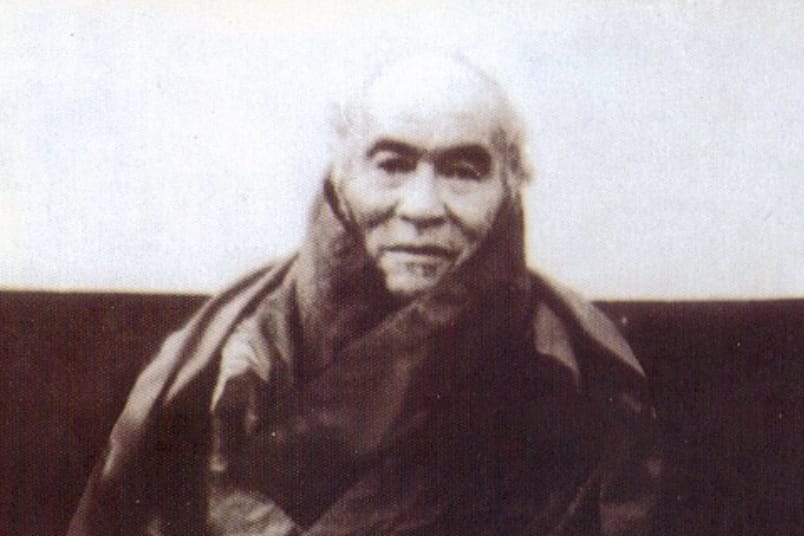
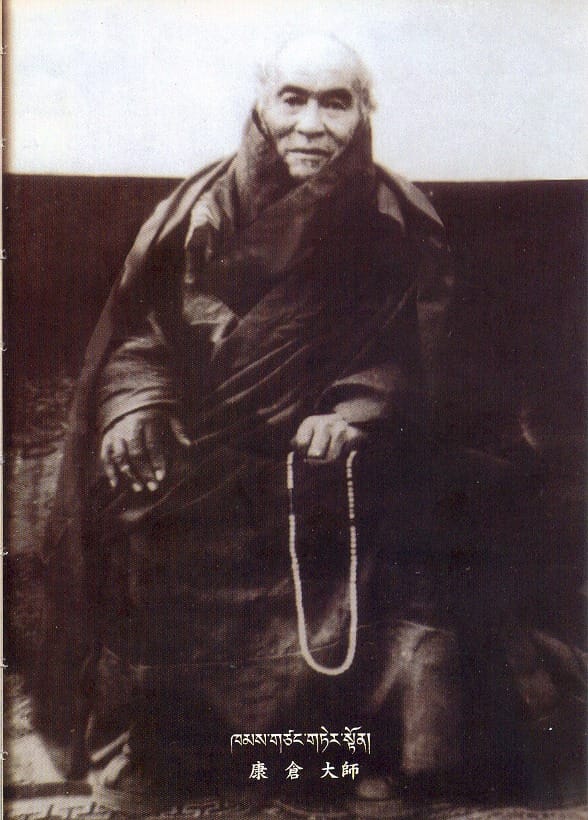
A renowned Tibetan physician and great master of discovering hidden treasures: Master Kangcang
Khangtsang Rinpoche had three very important gurus.
His first guru was Kathok Khenchen Aga (Khangtsang Rinpoche and Chatral Rinpoche were fellow disciples). He studied under Kathok Khenchen Aga for a long time and served as his personal physician. Among Kathok Khenchen Aga’s disciples, only Khangtsang Rinpoche and Getse Panchen were accomplished in the five sciences.
His second guru was Yikho Choktrul. Yikho Choktrul was a heart son of Anzong Zhupa and is the root guru of the current Dodrupchen Rinpoche.
His third guru was Lang Lama Rinpoche. Lang Lama Rinpoche was an anonymous, accomplished Dzogchen practitioner with few disciples. Qinghai Chalong Monastery was established by Lang Lama Rinpoche, initially as his retreat center, where the master and disciple practiced in retreat for nine years!
Khangtsang Rinpoche also had close connections with many treasure revealers, including Apang Tertön and Agya Tertön, etc.
The current Sakya Trizin is a reincarnation of Apang Tertön, and Apang Tertön’s daughter is Nyelong Buddha Mother.
Apang Tertön and the first Sogyal Rinpoche, among other gurus, prophesied that Khangtsang Rinpoche was a reincarnation of Gyana Kumara (Wisdom Child), one of the twenty-five heart sons of Guru Rinpoche, and a treasure revealer for this era.
The first treasure revealed by Khangtsang Rinpoche was successfully retrieved under the prophecy and guidance of the first Sogyal Rinpoche and Apang Tertön, with Kathok Chacha Rinpoche as the Dharma holder at that time. He subsequently revealed many more treasure teachings!
What Precious Guru learned and practiced under Khangtsang Rinpoche:
Khangtsang Rinpoche was one of Precious Guru’s (Rinchen Chenpo Rinpoche) gurus. Before the age of sixteen, Precious Guru studied medicine and astrology under Khangtsang Rinpoche, receiving the twelve sets of teachings on treasure revelation, the empowerments and teachings of the two main treasure revealers of Kathok—Dundul Dorje and Longsal Nyingpo—and twice received the Kalachakra empowerment from Khangtsang Rinpoche. The treasure text of Hayagriva revealed by Kangkang Master also records that the Precious Guru is one of the holders of this Dharma, and will propagate this Dharma to all directions, benefiting countless sentient beings.
Brief Biography
Kangkang Master, also known as Kyongsin Ningdoje, Pema Choyang Robi Dorje, Gawang Kudu Je, Pema Vajra, and Pema Dorje, was born on the tenth day of the fifth month of the Tibetan calendar in 1908 (the same day as Guru Rinpoche), in the Amdo region of China (near the border of Sichuan and Qinghai provinces). His father was Kangkang Dongzhu, and his mother was Suzha Suoji. He passed away on the twenty-third day of the eighth month of the Tibetan calendar in 1984.
Before Kangkang Master’s birth, one day, his mother dreamt of a man in blue giving her a conch shell and telling her that she would give birth to a son who was an emanation of Guru Rinpoche, and then he disappeared. Another day, she dreamt of a woman, like Ekajati, giving her something to eat. After eating it, she felt refreshed. After ten months of pregnancy, she gave birth to Kangkang Master.
When Kangkang Master was born, many people near the pasture saw many beautiful clouds and heard celestial music, and many auspicious flowers that had never been seen before bloomed on the ground. When Kangkang Master was born, there was a white “Ah” syllable on his tongue. The Master was exceptionally intelligent; at the age of seven, he could write Tibetan, and he could fluently recite the eight thousand verses of the Prajnaparamita Sutra after hearing them.
Kangkang Master’s reincarnation was recognized by Dzogchen Rinpoche, the treasure revealer Abang Rinpoche, the treasure revealer Agya Rinpoche, and many other Rinpoches, as the reincarnation of Sang Chung Rinpoche, whose previous life was Nyangchen Yeshe Gyaltsen, one of Guru Rinpoche’s twenty-five heart disciples.
Later, Kangkang Master held his enthronement ceremony in front of more than two thousand lamas at Dazai Monastery in Sichuan Province. Later, he went to the Amdo region to study the Tripitaka with Jiangzhu Rinpoche. He studied rituals, art, and Sanskrit with his teacher Dangzhong Rinpoche, and learned to make sand mandalas. At the age of sixteen, Master Kangcang encountered a dakini who told him, “Go and study medicine, and you will help many sentient beings.” Therefore, he went to the Serthar Monastery in Sichuan (also known as Xueqing Monastery) to study Tibetan medicine, divination, geography, and geomancy, and achieved great success in divination! In the field of medicine, he received unique secret teachings from Lama Gandan of Xueqing Monastery and received the empowerment and oral instructions of the Yuthok Heart Medicine.
Later, Master Kangcang met Khenchen Akya Rinpoche of Kathok Monastery and received the Kathok lineage, the Longchen Nyingthig lineage, the uncommon accomplishment teachings, and the empowerments and oral instructions of the three inner sections of Dzogchen. Within six months, he mastered the Dzogchen teachings of Trekchö and Thögal.
Master Kangcang studied tantric scriptures, treasure texts, and Dzogchen tantras and many other secret teachings with Kathok Chaksar Rinpoche. Apang Rinpoche, Yikö Shatra Rinpoche, and the treasure revealer Akya Rinpoche all encouraged Master Kangcang to retrieve hidden treasure teachings and write them down. Therefore, Master Kangcang traveled to many sacred sites in Tibet previously visited by Guru Rinpoche, retrieved many hidden treasure teachings, and encountered many dakinis who gave him many Buddha images. He also undertook retreats of varying lengths at different sacred sites, totaling three years.
Later, Master Kangcang went to the medical college of Lhasa Monastery in Tibet to study medicine, where the dean of the college imparted to him key techniques and recommended him to return to the Amdo region to propagate Tibetan medicine, providing him with a letter of recommendation.
Master Kangcang returned to Tsaleng Monastery in Qinghai. At that time, the local government had killed many people near Tsaleng Monastery, resulting in the appearance of three zombies that were causing harm to the area. Many lamas and local officials were unable to pacify them, so they requested Master Kangcang to perform rituals, which finally quelled the zombie disturbance.
While Master Kangcang was in retreat in many places, dakinis gave him many hidden treasures and secret dakini scriptures. During his retreat in a cave near Tsaleng Monastery, many circular halos of light appeared outside, a phenomenon witnessed by the local residents! Many hackberry trees, which are not supposed to bloom in cold climates, also bloomed at his retreat site. Furthermore, when Master Kangcang and two others were practicing Tummo (inner heat) meditation in the snowy mountains, the snow around them melted. During one meditation session, the surrounding environment turned blue, and he saw a five-colored light in front of him. Within the light was Green Tara, who said to him, “Hey! Hey! Son of the Vidyadhara, your terma (hidden treasure) transmission place is in the south, and your yidam (meditational deity) is me. I can destroy any obstacles. You must always remember me!” After saying this, she transformed into light and disappeared.
On another occasion, Master Kangcang saw Vajradhara in meditation, who gave him the oral instructions and empowerment of Dzogchen (Great Perfection), and said to him, “From today onwards, you need to inherit the Dzogchen lineage. If you don’t go out to propagate the Dharma, you will achieve the rainbow body through your own practice! If you go out to propagate Buddhism and medicine, your lineage will spread throughout the world!”
Yet another time, while in retreat practicing the Lion-faced Dakini, he saw a terrifying place, but when Master Kangcang carefully observed it, he saw a small piece of Padmasambhava’s pure land.
During his practice, Master Kangcang met Yeshe Tsogyal and Mandarava, the eight manifestations of Padmasambhava and the eight great Vidyadharas. They all gave him empowerments, and Padmasambhava said to him, “I will always be with you, but you will not be able to see me. Today you have perfected your practice and seen me; you are me, and I am you. From today onwards, you must propagate the Dzogchen teachings.”
One or two days later, the tertön (treasure revealer) Agya learned of this (referring to the direct encounter with Padmasambhava and the two consorts) and wrote a letter to Master Kangcang, telling him, “You must have seen Padmasambhava; you need to write down the terma teachings.” However, the master did not want to write them down, believing that in this degenerate age, there were few practitioners, so writing them down was unnecessary.
One day, Ekajati told him, “You have retrieved many terma teachings from Tibet; you need to bring them all out!” After this, he continuously wrote down many terma texts.
The first incarnation of Sogyal Rinpoche told him, “Don’t miss this opportunity in this world. You have many obstacles at this time. If you get married, many obstacles will be eliminated!” Therefore, Master Kangcang married a famous Vidyadhara girl from the Golok region, whose Tibetan name was Wangchen Tso, meaning “Ocean of Freedom” in Chinese. Before her marriage, she recited the Guru Rinpoche mantra one hundred million times and undertook many solitary retreats, becoming a highly accomplished female practitioner.
Master Kangcang once went to the sea to retrieve a hidden treasure (terma). Moksha Rinpoche and many Tantric followers witnessed this miraculous retrieval of the Dharma at the seaside. Master Kangcang said to everyone, “Today is the 25th day, the day of the Dakinis. This is the first time I am publicly performing the ritual of retrieving a hidden treasure.” Then the Master removed all her clothing, held a vajra and a bell in her hands, and performed a vajra dance on the surface of the sea without sinking.
Before Master Kangcang went, all her relatives and friends advised her not to go, fearing she would drown. But the Master said, “I am a heart-son of Guru Rinpoche; I will not sink, and I will surely obtain the hidden treasure—the essence of Guru Rinpoche.”
When Master Kangcang entered the sea, she obtained a five-colored light of the sun and moon. When she held it in her hand, it transformed into a treasure vase and a statue of Guru Rinpoche, emitting many rays of light. Everyone was astonished. When Moksha Rinpoche touched the Guru Rinpoche statue, the heart area of the statue was still warm.
Master Kangcang also obtained a Guru Rinpoche treasure vase, about the size of four fingers, in another region. It had a small hole at the bottom, and supplicants received varying amounts of nectar pills depending on the individual. Nectar pills also spontaneously appeared from the vase on the 10th and 25th days of the Tibetan lunar calendar each month.
The hidden treasures left by the Master are divided into three parts:
- Explanations of the rituals of the peaceful and wrathful forms of Guru Rinpoche: two volumes.
- Hayagriva deity practice: one volume.
- Black Dakini practice: two volumes.
The Master originally had more than twenty volumes of precious Tantric Dharma texts, but due to special circumstances, they were lost, and now only twelve volumes remain. The Master held a doctorate in medicine and received eighteen awards for her humanitarian medical work from the central government, the Qinghai provincial government, and the Jiuzhi county government.
Someone once tried to deceive Master Kangcang by presenting cow urine as human urine for treatment, but the Master saw through the deception. There were also patients who were too ill to travel for treatment, but the Master was able to prescribe medicine and cure them without even seeing them. Master Kangcang left behind many Tibetan medical texts, and the governor of Qinghai Province and the dean of the medical college requested that the Master leave behind his prescriptions to benefit future generations.
Especially during his Dharma teachings, after meditating, his students would request any Dharma teaching, and he could transmit the requested teachings without referring to any texts, with the content and wording being exactly the same as the original teachings. This is proof of the Master’s extraordinary achievements, an incredible accomplishment in this era!
Master Kangcang passed away at the age of 76 in the Tibetan region of China. One day, a Dakini (female celestial being) told him, “You are now going to the pure land of Guru Rinpoche. Most of your aspirations in this life have been fulfilled.” Before his passing, the Master entrusted his Vajrakilaya, Buddha statues, Dharma texts, and other items to his disciples, and bestowed the Guru Rinpoche empowerment upon more than two hundred disciples. The Master instructed that his body should not be moved for three days after his passing, and then his body should be cremated. He told his disciples, “I will never leave you. Whenever you pray to me, I will give you my blessings! Do not be sad. The Dharma realm does not change; only the minds of sentient beings change. Self and others are equal; everything is perfect in the Dharma realm. Ah! Ah! Ah!” After saying this, he peacefully entered Nirvana in a meditative posture.
During the cremation, Master Kangcang’s skull immediately cracked and flew into the air, then slowly descended, emitting many colorful circles of light and leaving behind many white relics. His bodily remains contained many fragments resembling red, white, and multi-colored glass. The relics were distributed among many disciples, and towering stupas were erected in his memory at Aso Monastery, Gathok Mula Monastery, Jiantasi Monastery, Daoqian Monastery in the Guoluo region, Master Kangcang’s residence, and Mount Wutai in Shanxi Province.
May Master Kangcang’s Dharma nature remain with us always, and may he bless all fortunate disciples!
Recollections of Master Kangcang by Precious Guru
From the time I met Master Kangcang until his passing, I always considered him to be none other than Guru Rinpoche. I never considered him an ordinary person; I always regarded him as Guru Padmasambhava.
Perhaps it was because I was a child at the time, and a child’s heart is very pure. I didn’t observe or analyze. Not observing or analyzing was my good fortune, because maintaining a pure heart is not easy.
We can believe in the Dharma body and wisdom life of the Guru, believe in the Guru’s spirit, believe in the Guru’s true nature, and believe in the Guru’s virtuous conduct, but we may not necessarily believe in the Guru’s actions, because when we have human “self-clinging,” what we see will be tainted by impurity. Therefore, unless he is a great accomplished master, some human “discriminating thoughts” will inevitably arise.
Because children are very pure, I didn’t discriminate. If I had discriminated, I would have seen the birth, aging, sickness, and death of a human being; I would have seen the Guru’s aging. Although I witnessed the Guru’s passing, I thought at the time that the Guru had returned to Guru Rinpoche’s pure land, not that he had passed away due to old age. Because of this pure heart, I also received pure blessings.
I can confirm that I have not broken any major precepts with any of the virtuous teachers I have followed. However, it’s impossible to completely avoid discriminating thoughts. I still saw the Guru’s human side. Fortunately, while Master Kangcang was alive, I didn’t see his human side, I didn’t see his birth, aging, sickness, and death; I always regarded him as Guru Padmasambhava. Master Kangcang was a very kind and benevolent guru to me. He had a very gentle personality, never getting angry or upset, always smiling. We felt that he was always in a state of meditative absorption.
When I was under Master Kangcang’s tutelage, I was still a child, his youngest disciple. Because I was a child, I was very mischievous. Master Kangcang never scolded me, never reprimanded me, and was always gentle and compassionate in imparting the Dharma to me.
Master Kangcang had a senior disciple named Jiumei Tudeng Rinpoche, who was a renowned Tibetan physician. Master Kangcang said that he and Jiumei Tudeng Rinpoche were inseparable. He was very famous for both his medical skills and his spiritual practice, and I was very afraid of him. When he was around, I didn’t dare to be mischievous, but when he wasn’t there, I was just a mischievous child in front of Master Kangcang.
I wasn’t always by Master Kangcang’s side. Sometimes, when I went to receive teachings with my teacher Tudeng Norbu, I would study with him for a few days or months. But I always carried his picture with me, and I often felt that my guru was always by my side, never leaving me.
Master Kangcang was a famous physician. He had disciples in many places, including Qinghai, Sichuan, and Gansu. According to statistics from 2000, more than 500 people studied medicine and became doctors under his guidance. Due to some historical reasons, Master Kangcang’s time of teaching the Dharma was short, but many fortunate disciples still came to learn from him.
Master Kangcang was an astrologer. His writings include many books on calendars and almanacs.
Master Kangcang was also a painter. He painted many thangkas.
The most special thing about Master Kangcang was that he attained the siddhi of perfect memory. No matter what Dharma teachings he imparted that day, whether it was empowerment or lecturing on scriptures, he didn’t need to look at any texts. He never forgot anything he had learned in his life—art, astronomy, medicine, etc. During any teaching, his eyes would gaze into the void, and in meditation, the teachings would flow out effortlessly like a flowing stream. Perhaps only he possessed this ability in the whole world; it was truly unique. He could recite the Dharma teachings spoken by Guru Rinpoche and compiled by Yeshe Tsogyal, the correct and pure hidden Dharma teachings, without any errors. At that time, there were hundreds or thousands of people seeking teachings, and he held different Dharma ceremonies every day, yet he never needed to consult any Dharma texts.
Master Kangcang also possessed various abilities of prophecy. In his presence, everyone was transparent; he could clearly describe everything, whether it was things done in the past, things happening in the present, or things that would happen in the future. He possessed the ability to understand the past, present, and future.
The prophecies he wrote for his disciples were never wrong, including those for myself. He clearly wrote down everything that would happen to me every year before I turned thirty-five, and all of it came true. The manuscripts he wrote are still in my possession.
The Guru usually didn’t read; he said he couldn’t see the words, so he would speak and his disciples would write. Among the Guru’s disciples, there was one named Guonian who had excellent calligraphy and wrote very quickly; the prophecies the Guru gave me were also written by him.
Also, my teacher, Thubten Norbu, the time of his passing was clearly written by Kangsang Rinpoche, and these predictions later proved to be true.
In the biographies of the Nyingma lineage’s spiritual father and mother, there are also prophecies given by Kangsang Rinpoche to the Nyingma lineage’s spiritual father and mother.
Previously, His Holiness Jigme Phuntsok also asked Kangsang Rinpoche to write prophecies for him. In the biographies of many modern gurus and great masters, there are also accounts of Kangsang Rinpoche giving them prophecies or teachings. Therefore, Kangsang Rinpoche’s compassion, wisdom, and miraculous powers… in my eyes, he is no different from Guru Rinpoche (Padmasambhava).