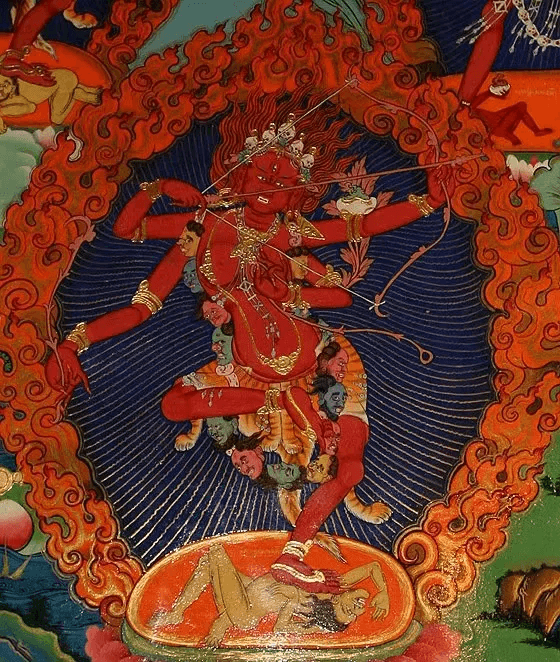
Kurukulla, also known as “Kurukulla,” is translated as “Kurukulla Bodhisattva” in Chinese scriptures. She is a principal deity of authority in Esoteric Buddhism, one of the most supreme deities encompassing the ten directions. She possesses immense power and compassion, embodying both great compassion and emptiness, and her merits pervade the three realms with effortless ease. All her actions are accomplished, hence she is also called “The Dakini of the Three Realms” or “The Compassionate Mother.” Her merits are vast and profound, truly immeasurable.
I. A Brief Introduction and Lineage of Kurukulla
Kurukulla, Secret Wisdom Mother, and Red Tara are all the same. In the image, Amitabha Buddha is above the deity’s head; she is an emanation of Amitabha Buddha. The praise text of Master Gongtang also states: “Kurukulla is an emanation of Amitabha Buddha.”
Where does this tantra originate? Because it is secret, there is no complete tantra. For example, the Hevajra Tantra mentions a small part about how to practice Kurukulla. Connecting the beginning and end of the tantra, or the preceding and following sections, forms the complete practice of Kurukulla.
The Jonang school’s Taranatha lineage of the Tara Yoga Tantra (which has two parts, the Upper and Lower Yoga Tantras) mentions practicing Kurukulla to embrace all sentient beings. It also discusses some simple practices, but these are distributed in the upper and lower parts of the tantra, with other methods inserted in between, without being directly stated.
Therefore, the complete and direct Tibetan lineage with oral instructions is that of Varro Drakpa, whose recitation, practice, and activities are all complete. He transmitted this lineage to the Sakya school.
Our Kurukulla lineage has two branches: one is the direct transmission this year by His Holiness the Sakya Trizin at the Mahabodhi Temple, and the other is the transmission given in 2004 by Langga Rinpoche of the Gelug school at the Wanfolin Temple in Singapore. Both are extremely auspicious.
II. The Merits of Kurukulla
Practicing with a sincere heart brings joy to all beings, improves interpersonal relationships, facilitates success in all endeavors, bestows authority and influence, and earns the love and respect of subordinates and relatives. It also brings wisdom, rapid learning of worldly matters, and the attainment of heavenly blessings. In the study, contemplation, and meditation of Buddhism, the faults of laxity and lack of concentration caused by mental distraction gradually diminish, leading to focused concentration. The mind’s distraction is transformed, and negative thoughts are turned into positive ones—these are the external merits.
The internal merits include increased wisdom and merit, a direct vision of Kurukulla in this lifetime, and the attainment of the eight common accomplishments.
All sentient beings should be grateful for the great compassion of this Mother. This practice not only provides swift relief but also pacifies beings in the six realms, benefits liberation from samsara, and leads to the attainment of the Great Perfection of loving-kindness.
The Kurukulla practice involves first attaining the common accomplishments, and then naturally attaining the uncommon accomplishments.
Within Kurukulla, the number of mantras and the special samaya vows of the Mother Tantra are of utmost importance. This is her merit.