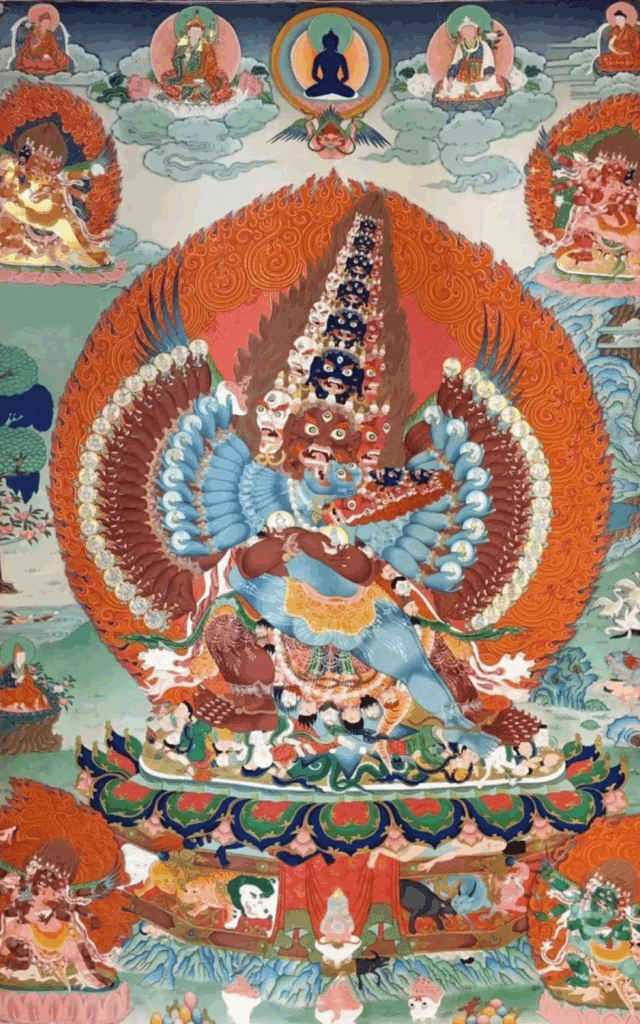
Guru Rinpoche’s most important and supreme teaching is the Eight Great Herukas. He mentioned that the Eight Great Herukas are like his heart, the core of his lineage, and the essence of the Eight Great Herukas are the True Meaning Heruka and Vajrakilaya. The essence of the heart is the Dzogchen teachings, through which Guru Rinpoche attained enlightenment. Guru Rinpoche lived a very long time in this world, studied countless teachings, directly perceived countless deities, and received blessings. Among all of Guru Rinpoche’s deities, the most important teachings are the True Meaning Heruka and Vajrakilaya.
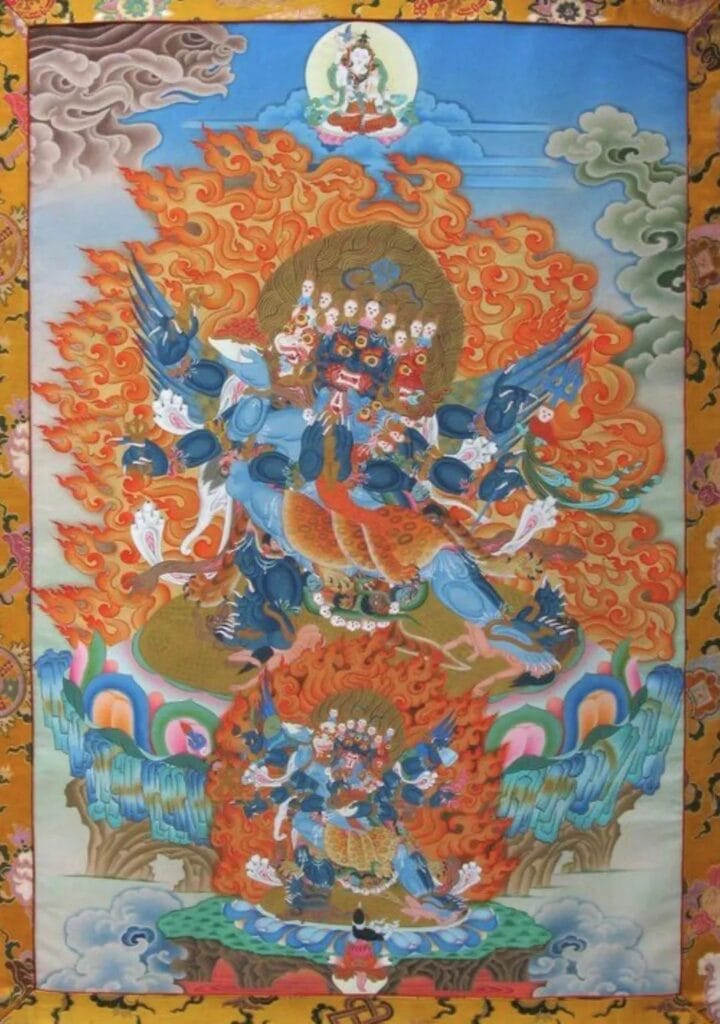
Guru Rinpoche likened the True Meaning Heruka to a wealthy merchant and the Vajrakilaya to a highly skilled bodyguard. To clear obstacles, one needs to practice the Vajrakilaya teachings; to attain enlightenment, one needs to practice the True Meaning Heruka teachings. Both are necessary. These two teachings are often practiced separately, but rarely together.
These two deities are the wrathful forms of Vajrasattva. All Buddhas and Bodhisattvas manifest as peaceful and wrathful deities in three forms: half-peaceful and half-wrathful, wrathful (Heruka of True Meaning), and extremely wrathful (Vajrakilaya).
Why do Buddhas and Bodhisattvas have so many forms? It’s because sentient beings have various afflictions and thoughts. Many sentient beings cannot communicate because each has a shared and individual “self-grasping.” When the points of “self-grasping” differ, and sentient beings’ afflictions differ, Buddhas and Bodhisattvas manifest different forms, using countless Dharma methods to liberate sentient beings. These countless Dharma methods represent the immeasurable wisdom, immeasurable merit, and immeasurable power of Buddhas and Bodhisattvas. Because of the inconceivable merit and activities of Buddhas and Bodhisattvas, they manifest countless deities. Understanding these principles helps one understand that Buddhas and Bodhisattvas are of the same essence; although their manifestations differ, their nature is the same.
From a basic Buddhist perspective, the path of practice is “form-based,” while reaching the ultimate fruition is “formless.” During practice, we cling to form, sound, smell, taste, and touch; therefore, Buddhas and Bodhisattvas manifest various forms. Ultimately, the highest state of enlightenment has no specific form; it is formless. Form implies inequality, and only the pure wisdom of formlessness can manifest equality. Therefore, when you see various forms, do not find them strange or complicated; know that they are naturally manifested in the unborn realm of phenomena.
Explanation of Terms:
There is no unified translation in Vajrayana, and these two deities have many different translations.
True Meaning Heruka is translated as Pure Meaning Heruka, True Meaning Heruka, Vajra Heruka, etc.
Phurba Vajra is a translation that combines Tibetan and Chinese. Phurba is Tibetan, and Vajra is Chinese. Phurba means “peg,” and is sometimes translated as Vajra Peg, a ritual implement, the most powerful ritual implement in Buddhism. It is also translated as Vajra Child or Activity Peg.
Both deities are emanations of Vajrasattva. When practiced together, sometimes one is practiced as an object of meditation, and the other as a self-practice; sometimes one is practiced as a wisdom deity, and the other as an activity deity.
The ritual transmitted this time is practiced together; most other rituals are practiced separately.
Origin of the Dharma:
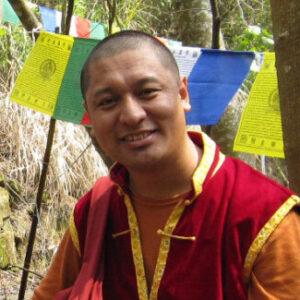
During Guru Rinpoche’s time, Nepal suffered many natural disasters, man-made calamities, and plagues. Guru Rinpoche brought the Vajrakilaya teachings from India to Nepal to subdue these disasters, demons, and the eight classes of celestial beings. Guru Rinpoche himself also attained the Mahamudra state. The Yangreshw Cave in Nepal is where Guru Rinpoche practiced the True Intention Heruka and Vajrakilaya. Previously, my teacher, Shakya Rinpoche, also resided there; it is now a monastery, and the monastery still practices these two teachings. Shakya Rinpoche and many other great masters of the Nyingma school have practiced these two teachings there.
Later, Guru Rinpoche also brought these two teachings to Tibet. His 25 disciples all attained realization through the practice of the Eight Great Herukas. The Eight Great Heruka practices involve many different deities. Some disciples practice the body (Manjushri Heruka), some the speech (Lotus Speech Heruka), some the mind (True Mind Heruka), some the merit (Nectar Heruka), and some the activities (Vajrakilaya Heruka). While the deities they attain differ, most practice the Eight Great Heruka practices.
All of Guru Rinpoche’s teachings can be categorized under the Eight Great Heruka practices, including Dzogchen. This practice has continued to the present day, with different lineages of Tibetan Buddhism practicing the Eight Great Heruka practices. True Mind Heruka and Vajrakilaya are the most important deities in the Nyingma school; the Sakya and Kagyu schools also highly value them. The Sakya school originated from the Khon family, and each Kagyu lineage contains the Eight Great Heruka practices, all transmitted from Guru Rinpoche’s lineage.
Unique Features of the Ritual:
The True Meaning Heruka and Vajrakilaya transmitted this time are terma teachings of my Second Rinchen Tsewang Norbu. The Second Indra wrote extensively; we have compiled twelve volumes so far. He didn’t reveal many terma teachings, but each one is an essence, containing essential instructions. Although the ritual is simple, the instructions are complete. Whether it’s the Eight Great Herukas, True Meaning Heruka, Vajrakilaya, Red Tara, or Red Jambhala, they are all comprehensive collections of instructions.
The practice of this ritual is very important because in the Nyingma school’s Three Roots—Guru, Yidam, and Dakini—the Guru is the root of blessings; the essence of Vajrayana tantra is Guru Yoga, and the True Meaning Heruka in this ritual is Guru Yoga, practiced in the way of the Guru. The Yidam is the root of accomplishment, and Vajrakilaya in this ritual is practiced in the way of the Yidam. The Dakini is the root of activity; the ritual contains the wheel mudra and mantra of the Dakini. Therefore, it is a practice that unites the Three Roots.
Distinctive Features of the Lineage:
My Second Rinchen Tsewang Norbu was the embodiment of Namkhai Nyingpo’s “mind,” and Namkhai Nyingpo was one of Guru Rinpoche’s five closest disciples. Among the nine disciples of the Eight Great Heruka lineage, Namkhai Nyingpo was also one. Of Guru Rinpoche’s 25 heart-sons, one who transmitted the teachings to King Trisong Detsen on his behalf was Namkhai Nyingpo, and another was Vairocana. They were the two most important of Guru Rinpoche’s lineages. Guru Rinpoche praised Vairocana as being like himself and also mentioned that Namkhai Nyingpo was the achievement of his “mind.”
Namkhai Nyingpo received the True Mind Heruka teachings under the Indian master Humbhadra, and received the True Mind Heruka and Vajrakilaya teachings under Guru Rinpoche. He was an enlightened master in this lifetime, propagating the True Mind Heruka in countless lifetimes.
The Second Rigdzin Tsewang Norbu’s teachings are predominantly Vajrasattva practices, including the Five Stages of Vajrasattva, the Secret Attainment of Vajrasattva, and explanations of Vajrasattva. This is because Vajrasattva is the peaceful deity of Heruka, and in every incarnation, he has a karmic connection with Vajrakilaya and Heruka. Furthermore, when many people ask Shakya Rinpoche who their personal deity is, he always answers, “You are a lineage holder of Guru Rinpoche; your personal deity is Vajrakilaya or Heruka.” Therefore, all those connected to Guru Rinpoche are also connected to Vajrakilaya and Heruka.
The True Meaning Heruka is the most extensive work transmitted from Guru Rinpoche. Although Vajrakilaya and the Eight Great Herukas also appear in other transmissions, the explanation of True Meaning Heruka in Guru Rinpoche’s transmission works is over two hundred pages long, while other transmission methods only have twenty or thirty pages, or fifty pages. Later, the Nyingma school’s introduction of any of the Eight Great Heruka deities was based on Guru Rinpoche’s True Meaning Heruka.
This is because the Eight Great Herukas share a common method of visualizing the deity, which is also found in True Meaning Heruka. While there are many individual explanations of Guru Rinpoche’s teachings, the shared methods are few. Therefore, much information about Guru Rinpoche’s teachings on the generation stage, completion stage, etc., largely comes from two texts: the extensive explanation of True Meaning Heruka, and the dialogues between Guru Rinpoche and Yeshe Tsogyal.
Unfortunately, although Guru Rinpoche has many rituals, many important and representative works and explanations have not yet been translated into Chinese, so many people are unclear about the meaning of these rituals. If you have read the extensive explanations of the Eight Great Herukas and the True Meaning Heruka, it will be clear at a glance. The extensive explanation of the True Meaning Heruka written by Guru Rinpoche is not hard to find; the complete explanation transmitted from the Nyingma school is available.
Now we should contemplate that the transmitted Dharma is pure. When the Dharma is pure, it is easier for everyone to understand. The Dharma is truth; no matter how you observe it, it has no flaws; it is perfect, it is truth. The emptiness and luminosity spoken of in all our teachings is truth. Some places mention dependent origination and emptiness, which is also truth; dependent origination is luminosity. Without understanding these principles, when people have problems, they think the Dharma is also problematic. Many people’s problems arise from their own impure minds, from “attachment.” Every sentient being has shared karma; shared karma is common karmic force. When common karmic force arises, all people and things have problems.
The True Meaning Heruka and Vajrakilaya that we are transmitting today are pure and wonderful teachings transmitted by Vajrasattva’s Vajra speech. Therefore, everyone should not forget Bodhicitta, nor forget the five pure contemplations of Vajrayana. When listening to the Dharma, one should know how to listen, and understand the methods of listening. To hear the Mahayana teachings, one must have the Bodhicitta of benefiting both oneself and others; to hear the Vajrayana teachings, one must have a foundation and concept of pure perception.
Because everyone is in the same state of purity, you can receive the blessings of the pure Dharma, the pure deity, and the pure meditation. If the guru and disciple have different thoughts, they will not receive blessings. During the visualization process, it doesn’t matter what ritual implements the guru holds, what clothes he wears, or what hat he wears; even if you don’t understand the meaning of the visualization, it doesn’t matter. Having a pure mind and faith is enough to receive blessings.