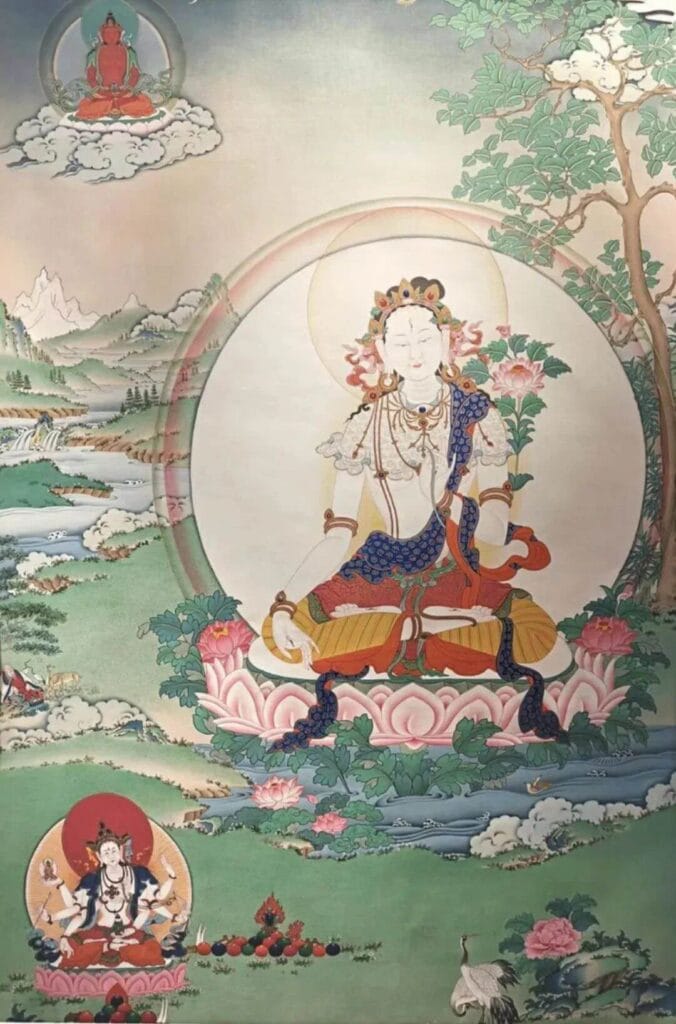
June 14, 2019, Longevity White Tara Empowerment Teaching at Miaocheng Dharma Garden
What are the merits of practicing Tara? Tara’s merits are immeasurable. Every Buddha and Bodhisattva possesses the four activities of pacifying, increasing, magnetizing, and subjugating. These four activities are a summary; all the deeds of Buddhas and Bodhisattvas for the benefit of people in the world are categorized into these four activities. From a worldly perspective, White Tara has the merits of pacifying, increasing, and magnetizing activities. The White Tara practice doesn’t emphasize subjugating activities. Although it has the merit of subjugating afflictions, subjugating activities are not encouraged. The focus is mainly on pacifying, increasing, and magnetizing activities, with pacifying and increasing activities being the primary ones.
Pacifying activities mainly involve eliminating obstacles and adverse conditions, divided into external, internal, and secret aspects.
External obstacles refer to eliminating disasters such as those caused by earth, water, fire, and wind. The merits of Tara and Avalokiteshvara are explained very clearly. External obstacles include earthquakes, fires, floods, threats from wild animals, insect bites, etc.
Internal obstacles refer to various physical illnesses, whether external or mental. These are internal obstacles that need to be eliminated and purified.
Secret obstacles refer to afflictions, which are also the causes of sin. Without afflictions, one cannot commit sins. However, afflictions can be primarily based on anger, greed, or ignorance. All afflictions involve greed, anger, and ignorance; there are no single afflictions. When you feel anger, it arises from ignorance; the object of anger gives rise to greed, creating attachment to yourself—the belief that your existence is intertwined with the existence of the other. Therefore, anger contains all three poisons, as do pride and jealousy. All afflictions contain all three poisons; the key is which one is dominant. When practicing pacifying karma, the focus is primarily on afflictions and sins driven by anger.
Increasing karma mainly refers to increasing merit, and it is divided into three types: external, internal, and secret.
“External” refers to increasing wealth, encompassing aspects of life such as food, shelter, and clothing. Some people have a good appetite and enjoy all kinds of food, while others often suffer from indigestion; some have the blessing of having enough clothes, while others don’t look good in anything. These are all external blessings. Increasing blessings is not just about money. Some people equate wealth with everything, believing that wealth is money, money is wealth, and riches are wealth. This is not necessarily true. The food we eat, the clothes we wear, the place we live—the various enjoyments in our external environment and life—if you have the ability and means to enjoy them, this is called external increasing karma.
“Internal” refers to the body, including physical strength, eyesight, hearing, and daily living skills. Without good health, nothing is possible. For example, if your eyesight is poor, you can’t see even the most beautiful things; if your hearing is poor, you can’t enjoy even the most beautiful sounds. Any defect in any part of the body indicates poor health. Therefore, increasing the strength of the five or six faculties of the body is what we call internal growth.
“Secret” refers to merit, such as the growth of compassion, wisdom, and supernatural powers. The growth of meditative power leads to supernatural powers. Although supernatural powers do not entirely arise from the power of meditation, stable supernatural powers definitely rely on the power of meditation. Supernatural powers can arise from external forces, self-power, or dependent origination, among many others, but the most important are those arising from the power of meditation.
The “external” aspects of pacifying, increasing, magnetizing, and subjugating are completely different, the “internal” aspects are different, but the “secret” aspects are almost the same. The obstacle of “extreme secrecy” refers to “self-grasping,” and all afflictions arise from self-grasping.
The White Tara practice mainly focuses on pacifying and increasing karma, with increasing lifespan and wealth being the most important. However, many great masters of the past, whether in India or Tibet, practiced White Tara less for the sake of wealth; most practiced it to eliminate obstacles in life, prolong life, and improve health, etc. This is indeed true; it has been so throughout history, and we see many eminent Buddhist masters today who achieved longevity and health through practicing longevity methods.
Therefore, practicing the Tara Dharma can bring health, longevity, and wealth in worldly terms; and in spiritual terms, it can increase compassion, wisdom, perfect one’s spiritual practice, and lead to enlightenment.