I. Introduction to Akshobhya Buddha
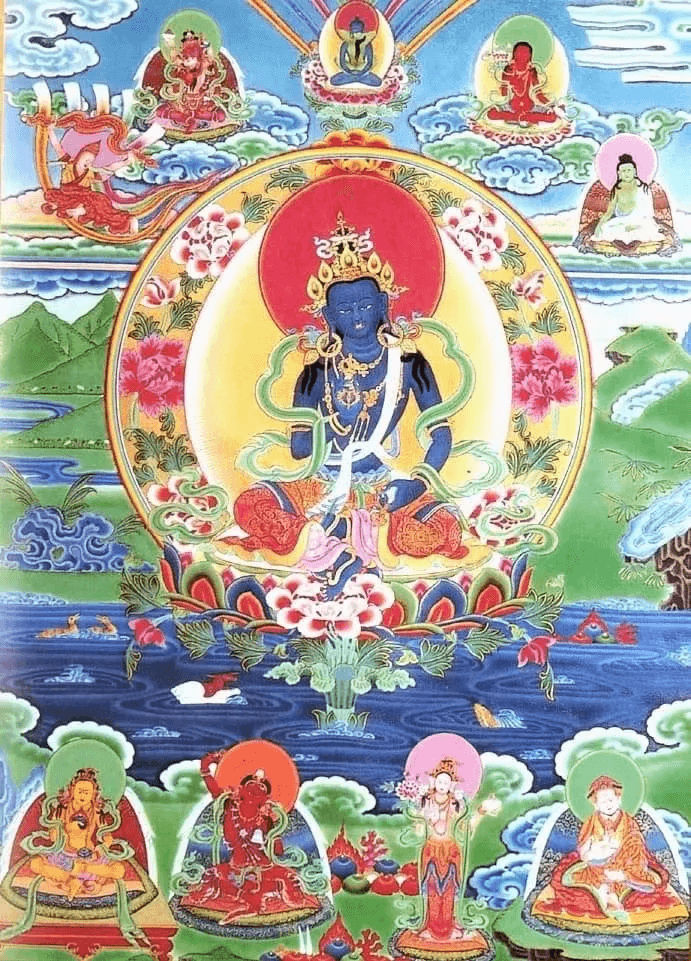
Akshobhya Buddha, also known as the Buddha of the East, is the lord of the Five Dhyani Buddhas according to Vajrayana Buddhism. His Pure Land is called the Land of Blissful Joy, also known as the Land of Good Joy or the Land of Wonderful Bliss, detailed in the “Akshobhya Buddha Sutra”.
He represents the “Great Mirror Wisdom” among the Five Wisdoms, representing the awakened nature of Shakyamuni Buddha’s Great Mirror Wisdom. He constantly uses the Great Mirror Wisdom to destroy all afflictions and demons, revealing the originally pure and immaculate Bodhicitta.
In his past lives, Akshobhya Buddha was an attendant of Vairocana Buddha, accumulating immeasurable merit. When he attained the supreme path, he vowed “not to harbor anger towards sentient beings,” hence the name Akshobhya, meaning without anger or rage. His Pure Land is free of the three evil realms, where everyone performs virtuous deeds, making it extremely auspicious.
The deity’s body is blue, his right hand in the earth-touching mudra, and his left hand holding a vajra.
II. Related scriptures about Akshobhya Buddha are briefly mentioned below:
(Buddha’s name) Aksobhya, the name of the Tathagata. His full name is Akshobhya, meaning “immovable” or “unmoving,” and “without anger.”
In the past, a thousand Buddha-lands to the east of here, the Great Eye Tathagata appeared in the country of Abhirati, where he made a vow, practiced diligently, and attained Buddhahood in the east in a land called Sukhavati. He is now appearing in that land to preach the Dharma. The Amitabha Sutra states, “In the East there is also Akshobhya Buddha.”
The Ci’en Commentary states, “Akshobhya Buddha, named Anhāṣṭra, resides in the eastern country of Abhāṣṭra.”
The Vimalakirti Sutra, in the chapter on Akshobhya Buddha, states, “There is a country named Abhirati, where the Buddha is named Akshobhya.”
The Tong Huiyuan Commentary states, “Akshobhya is a Sanskrit word, meaning ‘unmoving’.”
The Xuan Ying Phonetic and Semantic Dictionary, Volume 9, states, “Akshobhya, also called Akshobhya-bhava, is translated as ‘unmoving’.”
The mudra (gesture) of Akshobhya Tathāgata: The right hand extends five fingers pointing to the ground, while the left hand holds the corner of the robe with five fingers; this is called the Demon-Slaying Mudra. See the Sutra of the King of Teachings. The Karma Mudra (gesture) of Akshobhya Tathāgata: The left hand rests on the navel, while the right hand touches the ground.
III. Merits and Benefits
Paying homage to and making offerings to the mantra of the Immovable Buddha can subdue demons and eradicate heavy sins such as the five heinous crimes, rendering all demons, spirits, and afflictions unable to hinder the practitioner, ensuring peace and auspiciousness free from calamities and obstacles.
Practicing this deity’s mantra has particularly supreme merit in purifying karmic obstacles. The Buddha said: Reciting this deity’s mantra once can eliminate the heavy sins of one hundred kalpas of birth and death.
Anyone who hears this mantra or sees this Dharani mantra that eliminates all karmic obstacles will have all their karmic obstacles eliminated and will not fall into the lower realms.
This deity’s mantra is traditionally used for the purification and liberation of the deceased, or for curing the illnesses of the living suffering from serious illnesses, possessing particularly great merit.
Appendix: The Heart Mantra of Akshobhya Buddha
Namo Rinpoche Tsaya Om Gangani Gangani Ruozani Ruozani Zhuozani Zhuozani Zhasani Zhasani Zhadihana Zhadehana Sarva Karma Baranbaria Nume Soha