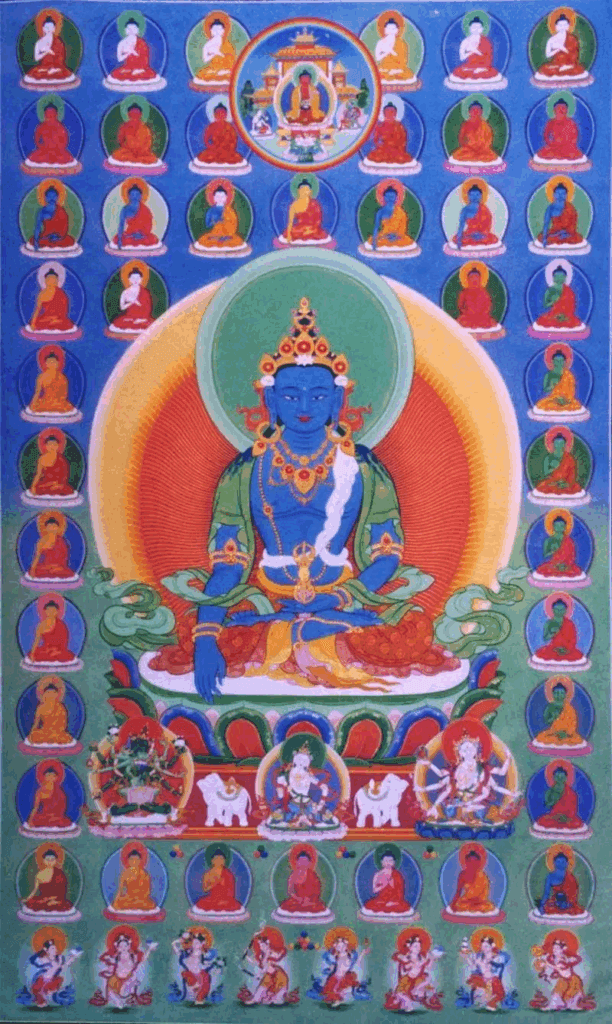
Akshobhya Buddha is the Buddha of the East, and all Buddhas of the East practice methods related to eliminating karmic obstacles, focusing on pacifying negative karma. While all Buddhas possess perfect virtues in pacifying, increasing, magnetizing, and subjugating, some Buddhas have specific vows: some vow to eliminate karmic obstacles, some to unite sentient beings, and some to increase merit, etc.
Regarding these shared vows, all Buddhas’ virtues are perfect; regarding their unique vows, the Buddhas of the East focus on eliminating karmic obstacles. Because of this relationship, one should practice the Dharma of Akshobhya Buddha to eliminate karmic obstacles.
The reason all sentient beings are subject to samsara is due to karmic obstacles. Because of the karma accumulated since beginningless time, one is subject to samsara. If this karma is not eliminated, one will continue to samsara and suffer. To eliminate this karma, one must uphold pure precepts and maintain a pure mind while practicing this Dharma. Among all Buddhas and Bodhisattvas, the most supreme Dharma for eliminating karmic obstacles is that of Akshobhya Buddha.
When the great Indian master Atisha was in Tibet, people asked him: “What is the most supreme Dharma gate? What is the fastest and most supreme Dharma gate for eliminating karmic obstacles?” Atisha replied, “The Dharma gate of Akshobhya Buddha is the most supreme.” Atisha specifically translated the Akshobhya Buddha Dharma gate from Sanskrit and also created the ritual texts for Akshobhya Buddha practice. These gradually spread to Tibet, and all Tibetan traditions include the Akshobhya Buddha Dharma gate.
The Akshobhya Buddha Dharma gate is not only found in Tibetan Buddhism but also in Chinese Buddhism. The ritual texts and practices of Akshobhya Buddha are translated into Chinese in the Tang Dynasty’s Tripitaka. Akshobhya Buddha is a Dharma gate found in both the Chinese and Tibetan Buddhist Tripitakas.
The name Akshobhya Buddha and his Buddha name are not as familiar to most people. Amitabha Buddha is more familiar to everyone. The merits of Amitabha Buddha are also possessed by Akshobhya Buddha, and vice versa. Amitabha Buddha’s teachings primarily focus on rebirth in the Western Pure Land of Ultimate Bliss, while Akshobhya Buddha’s teachings primarily focus on eliminating karmic obstacles.
Some people ask: If practicing Amitabha Buddha’s teachings leads to the Western Pure Land of Ultimate Bliss, will practicing Akshobhya Buddha’s teachings also lead to the Western Pure Land of Ultimate Bliss? Practicing Amitabha Buddha’s teachings can lead to rebirth in the Western Pure Land of Ultimate Bliss, or to any Pure Land. Practicing Akshobhya Buddha’s teachings can also lead to Amitabha Buddha’s Pure Land.
The scriptures on Akshobhya Buddha mention that if one practices Akshobhya Buddha’s teachings and aspires to Amitabha Buddha’s Pure Land, it is still possible to go there. Therefore, which is easier: going to the Western Pure Land of Ultimate Bliss through Akshobhya Buddha’s teachings, or going to Akshobhya Buddha’s Pure Land? The Western Pure Land of Ultimate Bliss is easier.
Practicing Akshobhya Buddha’s teachings requires a foundation of pure precepts, which is not easy to achieve. However, regarding the elimination of karmic obstacles, the scriptures on Akshobhya Buddha’s teachings extensively discuss the merits of eliminating karmic obstacles.
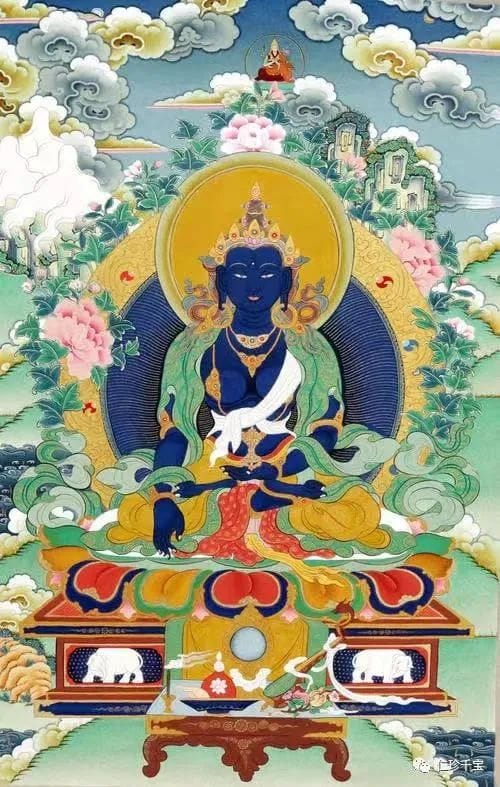
Many people are unfamiliar with the Dharma name “Immovable Buddha,” but “immovable” in Immovable Buddha means unwavering, and unwavering means free from afflictions and hatred. Among all Buddhas, only Immovable Buddha, after beginning his study of the Dharma and receiving the precepts, never broke the precepts, never had his mind swayed by afflictions, and never harbored hatred, thus attaining enlightenment. Among all Buddhas, only Immovable Buddha is this.
For a practitioner, pure precepts are extremely important. Precepts are crucial; guarding one’s body, speech, and mind is essential. Precepts are like the earth; on fertile land, whatever you wish to plant can grow. If the soil is problematic, nothing we plant will bear fruit.
Practicing the practice of Immovable Buddha purifies the defilements of precepts. Defilements of precepts refer to impurities in body, speech, and mind, such as breaking precepts, harboring hatred, or committing acts of killing. Through the power of Immovable Buddha’s vows, these impurities can be purified.
The Dharma of Immovable Buddha is extremely important for sentient beings in this degenerate age. The first reason is that sentient beings in the Dharma-ending Age are not pure in their adherence to precepts. We often use a repentant mind before the Three Jewels, reciting the mantra of Akshobhya Buddha, to restore and purify our precepts. The second reason is that sentient beings in the Dharma-ending Age have bad tempers and are prone to anger. Therefore, Akshobhya Buddha has the merit of purifying the sins of anger.
Many people often get angry, become troubled, and frequently harbor anger. Whether it’s family matters, company matters, group matters, or national matters, whether related to themselves or not, they easily become troubled or distracted. For these people, practicing Akshobhya Buddha is very suitable. This is because the karma of anger is more serious than the karma of greed. Simple greed won’t lead to hell, but anger will.
Therefore, if a person constantly harbors anger in their heart, unable to let go or release it, this sin is extremely terrible. Practicing Akshobhya Buddha can improve one’s temper; this is mentioned in many stories of practitioners.
Nearly 100 years ago, there was a master named Kathok Khenchen Aga (Agwangpo). His biography records that after completing a retreat on Akshobhya Buddha, he never harbored anger or resentment for the rest of his life.
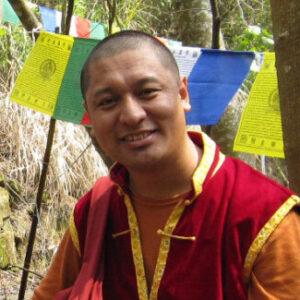
My master, Shichen Ongzhu Rinpoche, also improved his temper after practicing Akshobhya Buddha. To correct our temper and purify the karma of anger, we should recite the Akshobhya Buddha mantra frequently. We should also recite the Akshobhya Buddha mantra to purify the karma of killing.
In this age of darkness, many beings have heavy karma of killing, especially those living near the sea. Many people by the sea eat seafood, meat, or various kinds of animal products, killing frequently. There are also many abortions, a very serious situation. Whether killing is for food or for other reasons, the way to purify the karma of such people is through repentance. Among the methods of repentance, the Akshobhya Buddha practice is the most supreme.
Many people, to repay the kindness of their parents—whether deceased or living—or to repay the kindness of their friends or relatives, use the name of Akshobhya Buddha to purify negative karma. Reciting Akshobhya Buddha’s name or mantra for the person you are thinking of can purify their negative karma and repay the kindness of all beings.
For beings in the intermediate state (Bardo), other realms, or the Asura realm—those you cannot see but whom you perceive as interfering—reciting Akshobhya Buddha’s mantra can be effective.
For tangible beings, it’s not easy for humans to immediately generate compassion or eliminate anger when offering blessings. However, it’s very easy to influence the emotions and minds of intangible beings. If we recite mantras with compassion and faith in Akshobhya Buddha, and with compassion for all sentient beings, we will surely resonate with them. Their anger and resentment will disappear, their resentment will be purified, and the grudges between them and their enemies and creditors will be eliminated.
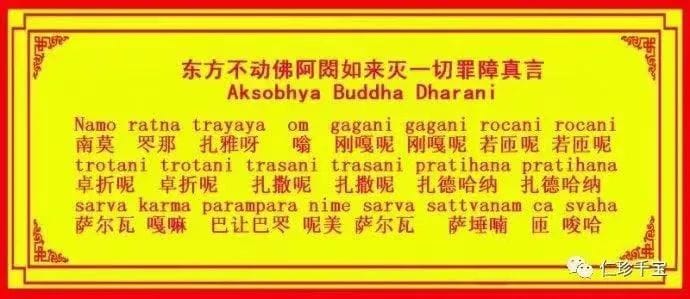
Therefore, when we recite the mantra of Akshobhya Buddha for the sake of unseen beings and for our karmic creditors, we will not be disturbed by them. Similarly, carrying the mantra of Akshobhya Buddha on our person will prevent us from falling into hell and protect our body, speech, and mind from harm by unseen beings.
Practicing Akshobhya Buddha requires frequent practice. Before practicing, one should contemplate the various merits of Akshobhya Buddha. The Ratnakuta Sutra contains two or three chapters on the merits of Akshobhya Buddha. Read about his merits, contemplate them, and develop faith in Akshobhya Buddha. Then, begin reciting the mantra; it will be effective.
When we contemplate the kindness of all beings—whether they are beings in the six realms, karmic creditors we have encountered in past lives, or beings we have come into contact with—and recite the mantra with a compassionate heart, it will benefit others and increase our own Bodhicitta. Reciting the mantra of Akshobhya Buddha casually will bring merit.
If you have faith in Akshobhya Buddha and compassion for all beings, reciting this mantra with abundant compassion will have greater power, merit, and faster results.
During the empowerment ceremony, we will use water and a vase for initiation. Whether it’s nectar you touch, nectar you drink, or a ritual implement placed on your head, treat it as if it were the real Akshobhya Buddha bestowing blessings upon you. Have this real feeling, this genuine sense of receiving, this feeling of attainment.
Empowerment means authorization, the right to receive. Empowerment has many meanings, one of which is receiving the right. What kind of right are you receiving here? You are qualified and entitled to visualize Akshobhya Buddha, to recite the mantra, and to practice meditation. After receiving this empowerment of body, speech, and mind, you must always remember this deity, this mantra, and the vows of this deity.
Before receiving empowerment, we receive the vows made before all Buddhas and Bodhisattvas, and before all sentient beings, whom we consider our mothers. These vows must not be forgotten. You often see Buddha images, whether painted on a wall, made of bronze, or of wood. If you treat them as real and make supplications, you will receive genuine blessings. When you see them, think of them as real Buddhas.
When you recite mantras, you receive the blessings of the mantras. When you contemplate the vows and wisdom of the Buddhas and Bodhisattvas, you receive the blessings of their intentions. Similarly, you should make vows that you yourself can fulfill.
Normally, before and after empowerment, we offer a mandala. Offering a mandala is a sign of respect for the Three Jewels, the Dharma, the Guru, and the Yidam. It also cultivates a heart of generosity and offering. Therefore, this mandala offering is very important.
The most important thing is Dharma offering. Dharma offering means that after receiving the Dharma, you must practice it correctly and consistently. Your body, speech, and mind must align with the body, speech, and mind of all Buddhas and Bodhisattvas. This should be practiced regularly. However, if you cannot do this regularly, you should make a vow. For example, after receiving this empowerment today, you might recite the mantra 108 times, or vow not to get angry for one day, two days, or a week. You might generate Bodhicitta and meditate until you attain Buddhahood. If you sincerely practice with this mindset, you will experience the most effective results when you encounter the Dharma.
If you cannot recite it 100 million times, but you can recite it millions of times, then recite it. Make a vow to recite it 108 times, or simply say, “I will recite this mantra.” Make this vow and practice accordingly.
After receiving the empowerment, you must constantly cultivate Bodhicitta (the aspiration for enlightenment for all beings). Never forget Bodhicitta; it is our goal. However, we often cannot achieve our goal. When this is not possible, you should make a vow in your heart to always cultivate compassion, especially to refrain from anger, and so on.
Similarly, the same applies to reciting the mantra of your chosen deity. In terms of vows, you should always practice it. But in reality, if you cannot practice every day, such as on the six fasting days or when observing a vegetarian diet, you can recite the mantra of Akshobhya Buddha, etc., and make such a vow.
By resolving to practice this Dharma in this way, the empowerment will be helpful to you. Otherwise, even if you have received the empowerment and blessings, if you completely let go afterward and don’t think about it at all, the help it provides will be limited.
That’s all for today. We will now begin the empowerment. Please do not record the empowerment; maintain a pure mind. We pray to Akshobhya Buddha and the lineage masters to bless us.