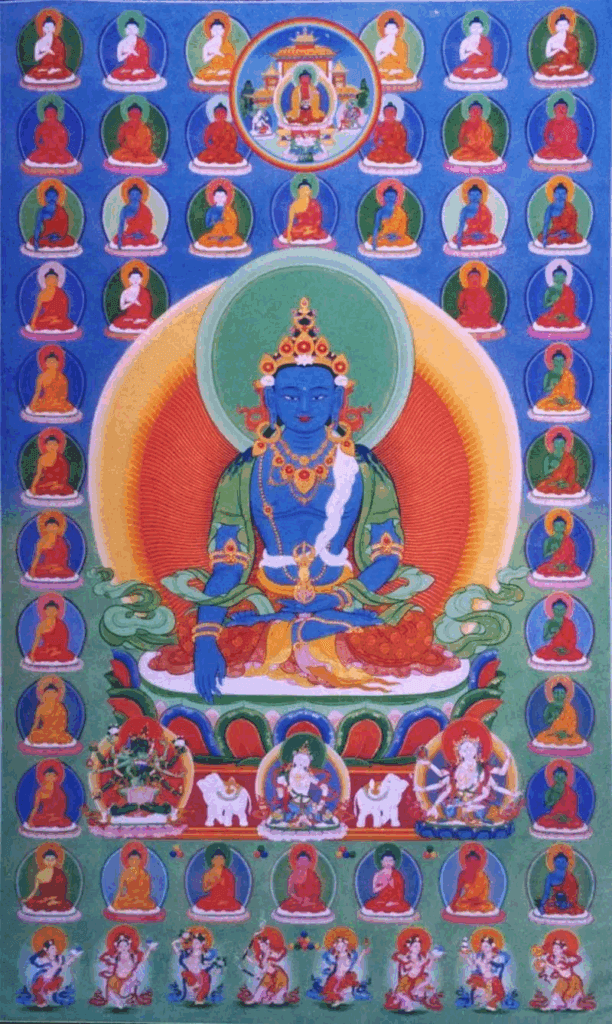
The Akshobhya Buddha Sutra mentions that he “did not flatter, did not lie, and did not harbor greed. After receiving the Bhikkhu vows, he never violated them, becoming a symbol of pure precept-keeping among all Buddhas and Bodhisattvas.”
Consider other Buddhist scriptures, such as the Hundred Deeds Sutra, which recounts stories of those who broke precepts before attaining Buddhahood and suffered the karmic consequences of descending to hell. Akshobhya Buddha, from the moment he made his vows, never harbored anger, and after receiving the Bhikkhu vows, never harbored greed or violated the precepts. Therefore, the power of Akshobhya Buddha’s vows is truly extraordinary.
Akshobhya Buddha is similar to Vajrasattva. Some Vajrasattva tantras mention that “after attaining Buddhahood, he manifests as a Bodhisattva to liberate sentient beings.” The vows of Vajrasattva and Akshobhya Buddha are also very similar. For example, both made offerings to their guru, Virupaksha, with a vajra before entering the path, expressing joy upon seeing the Buddha and offering the vajra. Based on this connection, their later vows remained unwavering.
The stories of Master Akasagarbha and Bodhisattva Akasagarbha are similar, as are the stories of Guru Rinpoche and Avalokiteshvara, and their activities are alike. When one desires to repent for wrong views, violations of precepts, or feelings of anger, one should repent before Akshobhya Buddha, whose vows are especially powerful. This will purify past karma and make it less likely for anger and afflictions to arise in the future.
This is not just idle talk. Many stories record this. For example, the biography of the modern master Kathok Khenchen Aga (my guru, the root guru of my teachers Kangtsang and Shakya Rinpoche) states: “At the age of 49, he entered into a retreat to practice Akshobhya Buddha. During this time, he saw Akshobhya Buddha in the Eastern Pure Land of Bliss in a state of samadhi. After completing the retreat, he never felt anger or lost his temper.”
Similarly, my teacher (also my great-uncle), the modern Ongzhu Rinpoche, after studying the Akshobhya Buddha teachings and practicing in retreat, never felt anger. This is the power of Akshobhya Buddha’s blessing; previously, he had a bad temper.
His Holiness Jigme Phuntsok (His Holiness the Dalai Lama) has praised Ongzhu Rinpoche in public on several occasions, saying, “In this degenerate age, Ongzhu Rinpoche is an extremely rare and compassionate master in Tibetan Buddhism who upholds the precepts purely.”