One of the obstacle-removing practices we perform at the end of the year is the Marici practice. This practice has been held annually for many years and is considered very auspicious; many practitioners have experienced responses and signs. Therefore, it is deeply believed in and loved by many.
I. Introduction to Marici
Marici’s Tibetan name is “Uri Khyenma,” the Holy Mother of Light. Among the 21 Tara deities are Ekajati and Marici, who stand to Tara’s left and right. They are transcendent dakinis, manifesting as protectors of Tara. Many Tara rituals mention that Ekajati and Ekajati stand to Tara’s left and right.
Ekajati is essentially the same as Ekajati, but their appearance differs. She is usually called Ekajati Tara, with a blue body, holding a halberd in her right hand and a skull in her left.
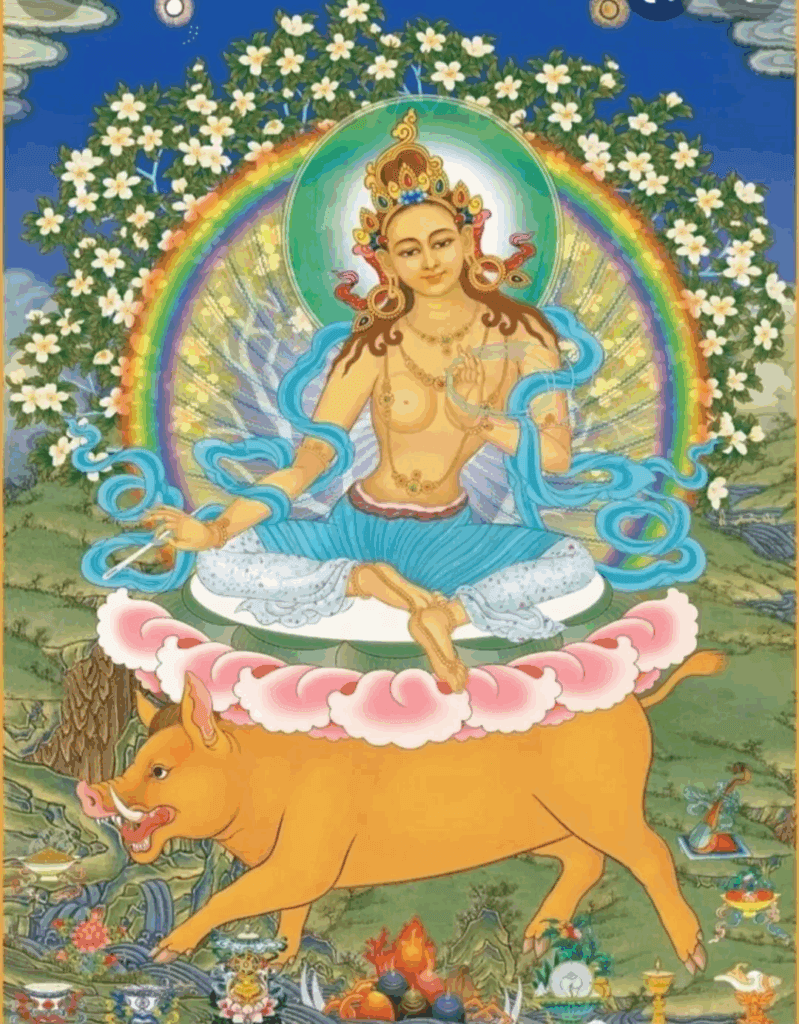
Marici, the Radiant Mother, is yellow and often holds an Ashoka tree. The two fundamental ritual implements are the Ashoka tree and a needle and thread. The 21 Taras are commonly practiced, and the ritual texts also include the practice of the Radiant Mother of Light.
II. The Marici Practice in Various Regions
In Han Chinese areas, this practice was initially the most frequently practiced deity within the Buddha Mother practice. It is also widely practiced in Shingon Buddhism and Taiwan, by both Buddhist and Taoist groups.
In Tibet, it is mostly practiced by pastoralists and farmers, and less frequently in monasteries. Pastoralists practice it to protect their livestock from robbers and wolves, for worldly benefits such as the prosperity of animal husbandry; farmers practice it for bountiful harvests and protection from hailstorms, primarily for worldly benefits.
Those who frequently engage in illegal activities such as gangsters and robbers may also practice the practice of the Radiant Mother. Some believe she is a goddess of darkness, but this is not the case; it’s a matter of mindset. The Radiant Mother is actually Tara and Avalokiteshvara, a transcendent deity. However, her practice is highly effective and easily resonates with worldly benefits, hence its popularity in both Han and Tibetan regions.
In Taiwan, the most practiced are the Cundi and Marici practices within the Shingon tradition, both in Buddhism and Taoism. The Peacock King practice also exists, but it’s less common. Similarly, while there are practitioners of the Great Compassionate Mother practice, it’s not as widespread.
We have practiced this for a long time. Marici is also included in the Avalokiteshvara Bodhisattva who liberates from suffering; therefore, she is a very important dakini in the Longchen tradition, considered one of the four Bodhisattva Mothers, and is widely practiced.
III. The Practice of the Marici Mantra
In our area, because monasteries and surrounding communities are very fond of practicing, the most commonly heard and learned mantras are the Avalokiteshvara mantra “Om Mani Padme Hum,” the Guru Rinpoche mantra, and the Tara mantra, followed by the Marici mantra.
Generally, pastors practice this mantra mostly around dinner time, practicing together for half an hour or an hour. It’s common to see some people fall asleep during the practice due to exhaustion from work. The Marici mantra is essential for protecting livestock and families.
When I was young, many people invited my teacher to their homes to practice the Marici mantra. After entering a Buddhist temple at the age of seven, I often recited the Marici mantra to bless others, so I am very familiar with the Marici mantra.
We practice it almost every year in Taiwan. Previously, before the ritual texts were translated, other ritual texts such as The Treasure Source of Accomplishment, The Treasure Source of a Hundred Dharmas, and The Collection of Accomplishments were used for practice; or the first four lines were recited, followed by the mantra. Short mantras were easy to recite, while longer mantras were more popular and easier to pronounce.
Since 2000, the fundamental ritual texts have been translated and practiced annually, sometimes once, twice, or three times a year. Sometimes, a special fire offering to Marici is performed. Besides Tara, Vajravarahi, and Guhyasamaja, Marici and Kurukulla are usually practiced annually.
The monastery practices Lion-Faced Dakini daily, a practice instructed by Shakya Rinpoche and Langga Rinpoche, who instructed: “Recite it every day, whether many or few times!” While not practiced daily, Luminous Mother is practiced once, twice, or three times a year at fixed times.
Although there are many teachings related to her, we can only perform a fire offering. Due to time constraints, we will only perform the offering of torma and the repelling ritual. May everyone receive the blessings of the Three Jewels and Marici, and may you enjoy good health and have your wishes fulfilled!
Please relax your mind and body, have the correct intention, and recite the Seven-Line Prayer to Guru Rinpoche to invoke the lineage masters.
IV. Visualization of the Marici Mandala
Visualize Marici as Tara. In front of her is her wrathful form, Ekajati, holding a halberd in her left hand and a skull in her right. To her four sides are four dakinis: white in the east, holding a hook in her right; yellow in the south, holding a rope; red in the west, holding an iron chain; and green in the north, holding a vajra bell and dagger. All four hold triangular dharma jewels in their left hands, adorned with bone ornaments and precious jewels. Each dakini rests a staff on her left shoulder.
In your own heart is a sun and moon kavat, with the golden syllable “Mang” in the center. The syllable “芒” (máng) is generally used in the mantras of many Buddhas and Bodhisattvas, representing a particularly auspicious Dharma practice. It is the seed syllable of Manjushri Bodhisattva and many other Buddha Mothers, such as Marici. Alternatively, one can visualize a yellow light point emitting the sound “芒” and sincerely recite the Marici mantra a thousand times.
We will now continue our Marici practice; we also had a group practice this morning.
I. Preparation of Body and Mind Before Practice
Before practice, everyone should relax, put down their work, and let go of their thoughts. Observe your breathing, regulate it to be calm, gentle, and long—not impatient. A comfortable state will naturally lead to physical comfort and mental stillness.
Many people struggle with their daily practice, finding it difficult to concentrate. The main reason is the lack of key points regarding mindset, breathing, and posture. Without these key points of body, speech, and mind, the mind cannot be still, resulting in poor or improper practice, or difficulty concentrating. Therefore, the effectiveness of our practice is limited.
In Vajrayana practice, entering a meditative state is crucial for achieving results; mantra recitation, blessings, and visualization will all be effective. Without entering a meditative state, it’s merely a prayer with limited effect.
While the highest tantras are considered the most supreme in terms of mantras and practices, possessing the vows and blessings of Buddhas and Bodhisattvas, the power of any practice is limited due to insufficient personal meditative concentration.
Therefore, preparation is essential before beginning any practice, whether worldly or transcendental. Rushing in without preparation will yield poor results. When everything is prepared and perfected beforehand, practicing the correct methods or undertaking any task will be less strenuous.
II. Proper Practice
We often speak of “contemplation” or “insight.” Before doing anything, one should observe one’s own mind, understand and control one’s mental state. A completely stable mind is essential for effective practice of any method, and the chances of success are greater.
Therefore, before practicing the practice of Marici, everyone should generate vast Bodhicitta. What is the Dharma we are practicing? What are its aspirations, supreme merits, etc.? Reflect repeatedly in your heart, and sincerely pray to the Three Jewels, Tara, and Marici: “For myself, others, the world, and all sentient beings in samsara, may they attain enlightenment.” By generating vast Bodhicitta, your mind merges with that of all sentient beings. To influence sentient beings, your mind must merge with their wishes; in this way, you can benefit them.
When you generate a pure mind, your state of being is very pure. Any Dharma practice you undertake will be pure. When it is impure, even if you are practicing a supreme Dharma, you will not attain supreme merit or benefit.
With a pure mind, you perceive your surroundings, your guru, and all phenomena as pure; you are practicing the Dharma in a pure land. Whether it’s five minutes, ten minutes, half an hour, or an hour, maintaining a pure mind and a state of pure consciousness during this time ensures that the practice is pure. This means that the motivation, conduct, and meditation are all pure, from beginning to end. Therefore, cultivating a pure mind is paramount.
Without a pure mind, without faith, and without the power of meditation, even thousands of years of practice will yield limited merit. The merit of reciting a single mantra while cultivating a vast Bodhicitta and a pure mind is inconceivable. Therefore, the practice should be conducted with a state of purity in body, speech, and mind.
Although the practice of the Marici method mentions averting negative influences, pushing away all undesirable things, it may appear impure externally. However, if the mind is not attracted by afflictions, there will be no obstacles.
If there are afflictions and demons within, there will also be obstacles and afflictions outside. All external demons are attracted by the afflictions and demons within ourselves; they are constantly beckoning and betraying the practitioner. Inner demons collude with outer demons, thus causing obstacles in spiritual practice, health, and career. If the mind is free from greed, anger, and ignorance, external obstacles will not exist. We clearly understand that the Buddha’s state is free from obstacles because he has severed the four demons, the afflictive obscurations, and the cognitive obscurations.
The state of pure Dharma nature is free from obstacles because the essence of Dharma nature is free from the defilement of afflictions. Therefore, without inner demons, there will be no outer demons. Thus, inner purity is of utmost importance.
Here, there is the practice of averting afflictions. If we have discriminating thoughts at this time, it will lead to external discrimination, or we will frighten ourselves. The impure mind corresponds to external circumstances, resulting in impure appearances and demons, all of which we wish to eliminate and purify.
We practice Dharma on the conventional truth, but our view is the view of ultimate truth. We bring the view of ultimate truth onto the conventional path. This method of removing obstacles is practiced by combining the conventional truth of dependent origination with the ultimate truth of emptiness, specifically the principle of dependent origination and emptiness.
Understanding before practicing is better. If you don’t understand, you should have faith in the Three Jewels, in Tara, and in Marici, using their vows to “make big problems small,” dissolving all obstacles within the Dharmadhatu. Practice with this mindset.
For those who haven’t received empowerment or oral transmission, I will first recite the oral transmission of the mantra, after which you can practice.
III. The Dharma’s Origin
Marici can be considered part of the highest tantra, and it exists within the outer three tantras (Kriya Tantra, Charya Tantra, and Yoga Tantra). This oral transmission can also be recited. While empowerment is definitely required for the highest tantras, some deities exist within all four tantras, so you can practice even without oral transmission.
The Treasury of Attainment by Taro Nata, sometimes translated as Treasury of a Hundred Dharmas, contains over 300 rituals. It mentions, “The empowerment of the mantra can be repeated,” meaning that disciples can recite it together with a lineage master. First, one must generate bodhicitta and receive vows before reciting. Reciting the mantra is permitted after a few oral transmissions.
Everyone should first generate vast bodhicitta and pure mind, praying to the lineage masters and the luminous Buddha Mother.
IV. Mandala Offering Before Oral Transmission
The offering of the mandala for requesting the Dharma primarily involves making vows and reciting the mantra, regardless of the number of repetitions, or vowing not to get angry for a week. This has great merit. Offering this to the Three Jewels is considered an offering for requesting the Dharma; it shows respect for the Dharma, because the Dharma is very sublime.
Usually, welcoming the master, seating them on a high Dharma seat before transmitting the Dharma, or making offerings in front of them are all expressions of respect for the Dharma. The master themselves must not have arrogance or a needy mind; this is a requirement for a master. However, because the Guru, in order to propagate the sublime Dharma, possesses a mandala within his body, inhabited by Buddhas and Bodhisattvas, he bestows blessings upon others with this mindset. Therefore, the Guru can sit on a high seat and receive offerings!
Generally speaking, “cause and effect are infallible.” What you sow, you reap. If the Guru who is invited and offered to is not an accomplished being, he himself is committing sinful deeds, which may benefit the disciple. Out of respect for the Dharma, one welcomes the Guru and places him on a high seat; what cause one sows, one reaps. The one who reaps the reward is the disciple, not the Guru. The Guru may deplete his merit, but the disciple gains merit.
Similarly, frequently reciting the Guru’s longevity prayer is important for the disciple, as longevity and health are crucial. However, the primary purpose is not only the Guru’s long life, but the greatest benefit is the removal of obstacles in the disciple’s own life.
Like releasing animals, the one who releases them receives the karmic reward, not the released animals. There is a temporary benefit, but the person who spends money to release animals will enjoy longevity and health, receiving the benefit.
Therefore, the biography of Kathok Khenchen Aga records: “When the Guru was ill, we performed rituals to pray for his long life and long existence.” Guru Longde Tenpai Nyima said, “These things mean little to me, but they will bring you longevity and health. Disciples perform sublime deeds for the Guru, this field of merit; it benefits the disciples. You may do so.” This is how it is permitted!
The same applies to mandala offerings. The best is the Dharma offering. One must maintain pure precepts or generate vast Bodhicitta and perform virtuous deeds. This is the most sublime way to offer to the Guru.
V. Levels of Offerings
Generally speaking, the Dharma offering is the most sublime. The second is offering with one’s own body and speech, such as doing things for the Guru, that is, doing things for the Dharma, such as volunteering, contributing one’s own body and speech. The third level is offerings of wealth and money, etc.
There are many kinds of offerings. The offering of Bodhicitta is the greatest, referring to generating vast Bodhicitta. Therefore, everyone forms the mandala mudra.
When taking refuge, if time permits, I usually teach three things: first, how to perform prostrations; second, how to join palms; third, how to form the mandala mudra, which is something we do regularly; and fourth, how to meditate, using mudras such as the Dharmadhatu mudra or the Mind-Rest Mudra. Regardless of the specific mudra, it’s essential to understand how to join palms, their meaning, and the proper methods for prostrations and mandala offerings.
Now, form the mandala mudra. Place your own prayer beads in your hands, or if you have nothing, you can visualize it. Offer the mandala in this way. With all Buddhas and Bodhisattvas of the ten directions as witnesses, generate vast Bodhicitta before them.
VI. Visualization of Marici
The interior of the iron stupa is the pure land of the Perfect Sambhogakaya Buddha. The exterior is iron, the interior is an immeasurable palace—a very solemn, magnificent, and perfect Buddhist hall. In the center, a golden syllable “Mang” appears, radiating light to offer to all Buddhas and Bodhisattvas and benefit all sentient beings. The light is drawn back and merges into the syllable “Mang,” combining with the power of the Three Jewels and the vows of sentient beings, finally revealing the radiant mother Marici, yellow in color, with one face and two arms, seated on a lotus and sun/moon cushion, wearing many ornaments of the Perfect Sambhogakaya Buddha. Her right hand holds a needle from iron, and her left hand holds thread, which are connected.
The mother sits on an iron boar. Marici is usually seated on a cart pulled by seven boars, but here she sits on a single boar, on a lotus and sun/moon cushion, riding a black, tusked, and fierce iron boar.
Visualize the three syllables “Om Ah Hum” in three places, inviting the great compassion, mercy, and power of all Buddhas and Bodhisattvas to merge into the three abodes of Marici, thereby obtaining the power of all Buddhas and Bodhisattvas and becoming one with them. Visualize this in the center of the ga-u (a space in the heart where the sun and moon are joined), and recite “Om Marici Soha” around the syllable “Mang,” focusing your mind on the syllable “Mang.” Practice in this way.
Each deity has a different form of protection, created by their vows. Marici has a sun and moon protective wheel, a stupa protective wheel made of meteoric iron, and an outer protective wheel made of meteoric iron stupa.
It can also be said that within the sun and moon ga-u, there is the sun in front of you and the moon behind you, with the light in the middle protecting you. These sun and moon protective wheels and the meteoric iron protective wheel are characteristics of Marici, the Mother of Light. Visualize this while reciting the mantra.