

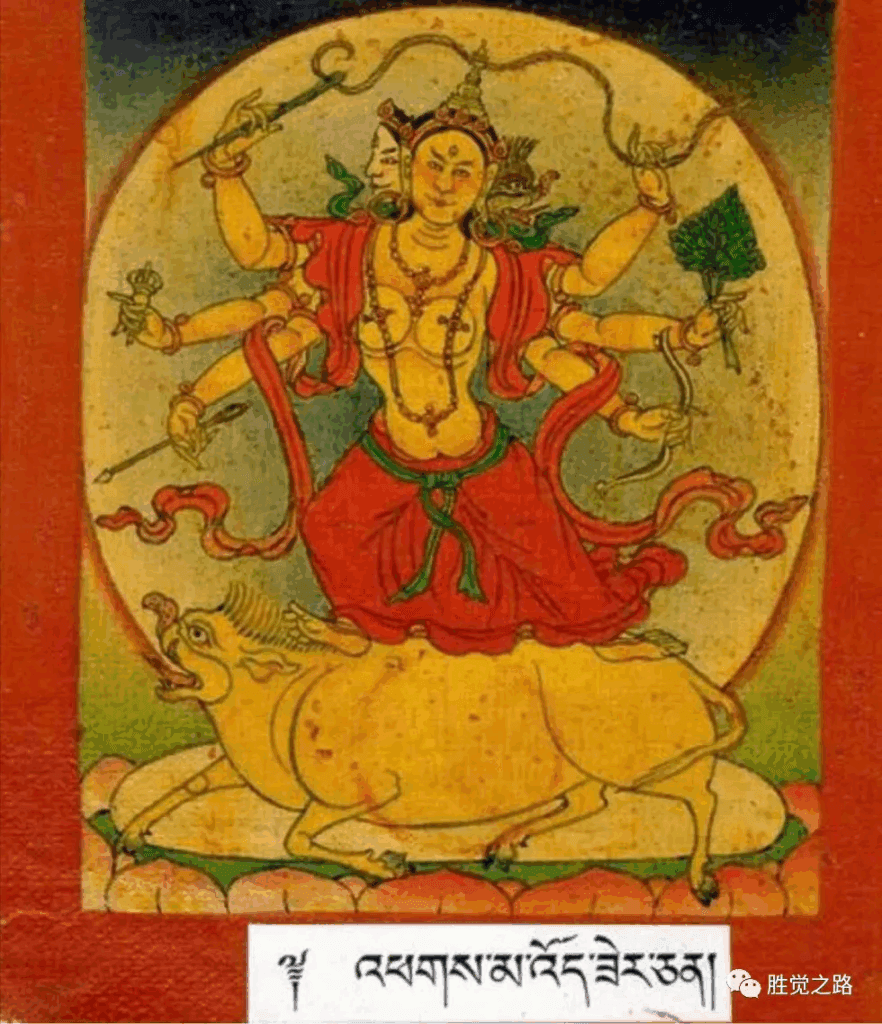
I. Lineage
The earliest transmission of Tibetan Buddhism dates back to the time of Padmasambhava, reaching Tibet in the 8th century AD. It continued to spread to Tibet in the 11th and 12th centuries. The Marici teachings were also transmitted to Tibet at different times, including over 400 years ago during the time of Taranatha and over 600 years ago.
The Marici teachings are found in the Sakya school’s Collection of Accomplishments, the Nyingma school’s Great Treasure of Terma, and the Jonang school’s Source of Accomplishments. The Marici has many forms, including one face and two arms, three faces and six arms, etc.
In the Source of Accomplishments, the Marici has four different forms. I received this empowerment under Langga Rinpoche, and others under Penor Rinpoche and Lama Madhyama Rinpoche. Therefore, there are many versions of the Marici lineage.
II. Attainments Through Practice
The Marici teachings belong to the Action Tantra, which largely focuses on achieving common accomplishments.
Common achievements refer to those shared by both non-Buddhist and Buddhist practitioners. Examples include the practices of Kurukulla (the Mother of Illumination), Marici (the Mother of Light), and the Wealth Mother. These practices aim to simultaneously attain ultimate (uncommon) Buddhahood within the framework of common achievements.
There are two types of achievements: common achievements and supreme or ultimate achievements—liberation from samsara, attainment of the Bodhisattva stage, or Buddhahood.
The Action Section—means that Buddhas and Bodhisattvas manifest as activity deities to perform common activities such as pacifying, increasing, magnetizing, and subjugating.
III. Introduction to Marici
Marici herself is an eighth-stage Bodhisattva who has escaped samsara; she is Tara and Avalokiteshvara. Even when manifesting as an activity deity, she is still a Bodhisattva.
Some Buddhas and Bodhisattvas are inherently transcendent but manifest as worldly deities; others manifest as Bodhisattvas transcending the world. Marici belongs to the latter category.
In Xuanzang’s translation, Marici means “light,” “possessing light,” or “Marici who is complete with light.”
The Sanskrit word “Derwa” is mostly translated as “heaven,” meaning a deity. Generally, deities are not yet transcending samsara (the cycle of rebirth); they are the principal deities within samsara, the guardians of samsara.
However, in Buddhism, “heaven” has two meanings: one refers to a deity not yet transcending the world, and the other refers to a deity transcending the world—possessing purity and immaculateness; some translations refer to her as the Mother of Buddhas.
The merits of Marici are mentioned in the Marici Bodhisattva Rahini Sutra, translated by Master Xuanzang: Marici protects people from harm caused by weapons, travel, getting lost, fire, water, ghosts, poison, etc., possessing numerous merits.
The Marici Bodhisattva Sutra also mentions that she can make sentient beings invisible on roads, invisible off roads, invisible among sentient beings, invisible during royal calamities, and invisible from all kinds of disasters such as water, fire, and weapons.
The “road” in “making sentient beings invisible on the road” refers to the path of spiritual practice; invisibility is a form of protection. If one’s spiritual path is fraught with harm from beings who dislike virtuous deeds, karmic creditors, or enemies, practicing the Dharma of the Radiant Mother Buddha can grant invisibility, meaning others cannot see you during your practice and cannot harm you.
IV. Brief Description of Merits
All Buddhas and Bodhisattvas perfectly possess the four activities of “pacifying, increasing, magnetizing, and subjugating.” Whether in worldly matters or the unique path to liberation, these are supreme, swift, and inconceivable methods of attainment.
A brief description of the merits of the four activities:
“Pacifying Activities”: Externally, it reduces or eliminates misfortune such as offending the Grand Duke Jupiter, encountering petty people, experiencing unfavorable years, lawsuits, legal troubles, calamities caused by the four elements (earth, water, fire, and wind), animal attacks, and war; it turns misfortune into good fortune, and frees one from all fear, delusion, and terror. Internally, it pacifies the imbalance of the four elements and the obstacles of the five poisons, swiftly attaining the merit of peace and freedom of body and mind.
“Increased Karma”: Externally, it brings growth in virtue and authority, success in fame and fortune, increased lifespan and intelligence, abundant wealth, freedom from poverty and famine, smooth career progress, and fulfillment of all desires. Internally, it swiftly perfects accumulated virtue and resources, rapidly eliminates ignorance, and quickly awakens wisdom, enabling deep understanding of scriptures and receiving blessings.
“Attracting Karma”: Externally, it brings increased popularity, fulfillment of favorable relationships, harmonious interpersonal relationships, happy and fulfilling family and marriage, swift fulfillment of desires for sons or daughters, and booming business. Internally, it prevents adverse conditions from arising, and with favorable conditions present, it easily attracts virtuous friends and guides virtuous teachers.
“Destroying Karma”: Externally, it averts harm from adverse conditions such as lawsuits, constant attacks from petty people, various infectious diseases and epidemics, curses and spells, non-human beings, the eight classes of gods and dragons, and demons and ghosts. Internally, it prevents and heals physical and mental ailments caused by attachment to self and the five poisons.
Secret obstacles and afflictions, such as the lack of concentration and wisdom in young children, and the restlessness, drowsiness, and agitation caused by age-related memory loss or dementia, can be prevented, alleviated, or eliminated. It also swiftly enables the accomplishment of various endeavors.
Regardless of the specific circumstances, the fundamental condition for practicing any Mahayana Dharma is “generating Bodhicitta.”
Even if you are practicing today to protect yourself, your aspiration must be: “I practice because I hope that others will not commit evil deeds or create negative karma for me; I practice for the sake of all sentient beings.” You cannot practice with the mindset of wanting to win yourself and others to lose; this is incorrect.
V. Characteristics of the Dharma Gate
The characteristics of the Marici Bodhisattva Dharma Gate are as described in the Great Wrathful Tantra: “Among all the Dharma Gates of Buddha Mothers, the blessings of Marici Bodhisattva are the fastest.”
Furthermore, the Buddha Speaks of the Great Marici Bodhisattva Sutra states: “She cannot see, cannot grasp, cannot bind; fire cannot burn, water cannot drown; she is free from all fear; no one dares to belittle her; no enemy can harm her.”
If one practices the Marici Bodhisattva Dharma Gate with correct faith in Buddhism, the merits are as described in the Buddha Speaks of the Great Marici Bodhisattva Sutra: “One can obtain pure and great blessings. One can increase vast auspiciousness…” “Auspicious. It can eliminate all grave sins. It can achieve the Samadhi of the principal deity. One will attain the Dharmakaya of Vairocana.”
Furthermore, through the practice of true Buddhist teachings, as recorded in the Buddha Speaks of the Great King of Yoga Sutras: “It can accomplish all things and eliminate enemies and thieves. If one upholds it according to the Dharma, one will not be able to commit any evil deeds on the road.”
As Master Yinguang said: “Marici, though appearing in celestial form, is in reality a Bodhisattva. Because of her earnest desire to save sentient beings and her deep compassion for relieving suffering, she spoke this mantra as the foundation for salvation. If one recites this mantra devoutly every day, the more the better. Even in the face of calamities such as floods, fires, and weapons, one can turn misfortune into good fortune.”