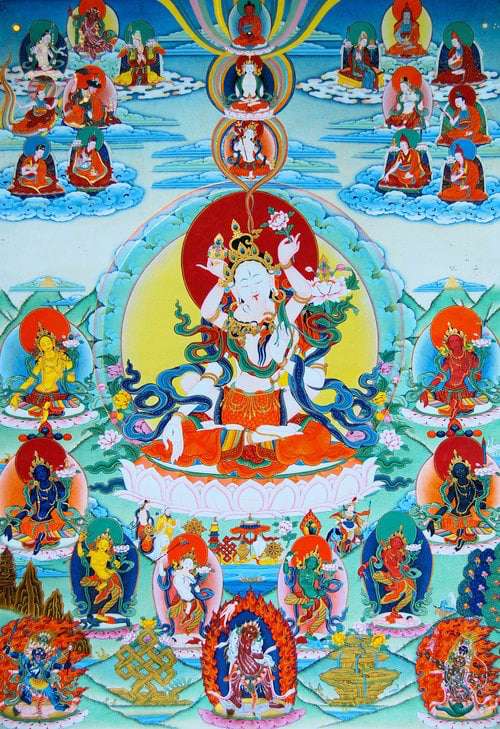
On June 14, 2019, the Longevity White Tara Empowerment Teaching at Miaocheng Dharma Garden was held
Everyone should first understand what kind of deity White Tara is. In the Vajrayana tradition, the deity is often mentioned, and the so-called deity is the recognition that all sentient beings possess Buddha-nature. The manifestation or manifestation of each being’s Buddha-nature or light depends on practicing the deity; practicing any Dharma door with this purpose is the same.
Buddha has inner Buddha and external Buddha; the blessing of the external Buddha can purify the dust of the inner Buddha; After the merits of the inner Buddha manifest, they can also purify the external Buddha’s guest dust, thus resolving internal and external aspects, ultimately becoming a Buddha and the principal deity. Therefore, we usually use the term ‘deity’ to establish it.
The deity has various male and female characteristics, as well as the tranquility and wrathful aspects. Why are there so many different aspects? Because sentient beings have immeasurable karma, countless afflictions, and countless faculties, in order to eliminate their various afflictions and habits, Buddhas and Bodhisattvas manifest in various forms—this is the immeasurable merit of all Buddhas and Bodhisattvas. If sentient beings have only one faculty, then the Buddha only needs to appear as one form. However, each sentient being’s capacities differ; greed, anger, ignorance, arrogance, and doubt vary; wisdom and compassion also differ; therefore, Buddhas and Bodhisattvas must manifest various forms. If merit is limited, the Buddha can only appear as one form.
The White Tara transmitted today can be practiced as a guru, as a deity, or as a dakini. Generally speaking, every Buddha or Bodhisattva can practice as a guru or deity, but most dakini practices focus on the work and their image. If undertaking a certain task, the guru will now practice for female sanghasa in the dakini manner.
Therefore, to understand what kind of Buddha Tara is, we must first understand the origins of the Buddhas and Bodhisattvas, and also understand why they manifest in this way.
All Buddhas and Bodhisattvas have the same merit, ability, and spiritual power, with no differences. The Buddha has no kind in the primordial realm; if the Buddha has distinctions of seeds, lands, and direction, then the Buddha has worldly discriminating minds. Anything with discrimination is not completely pure; it is a worldly Buddha, a Buddha with afflictions or defilations. A Buddha is not eternal or eternal. Because the Buddha has no distinction in the original Dharma; ultimately, it is formless. Therefore, the primordial purity, neither birth nor extinction, is an inherently pure inherent nature, a pure realm of the Dharma realm.
Later, for the benefit of sentient beings, or when sentient beings’ faith and the vows and power of Buddhas and Bodhisattvas come together, the Buddhas and Bodhisattvas will manifest as appearances. These features include the Buddha’s Sakubutakaya, the emanation body, the sentient beings, and many others. These are manifestations of the Buddha to save sentient beings, not the ultimate Buddha. What we see now are the adorned thirty-two marks and eighty kinds of virtues. Buddhas and Bodhisattvas with perfect marks are all manifestations of Buddhas manifesting in conventional truth to save sentient beings, or manifesting their merits. Therefore, they are called Buddhas with forms in conventional truth. Because worldly people can only interact with worldly Buddhas, their level too high to understand, and even a little understanding cannot reach that state.
Worldly teachings are very important, worldly appearances are important, and so are the various worldly methods. Anything with form, the realm of sentient beings, or the main roots (eyes, ears, nose, tongue, body) that manifests, is called a conventional Buddha. Secular Buddhas have the power of secular Buddhas; secular Buddhas can save sentient beings in samsara.
The Tara we teach today is the Buddha manifesting as a female assembly, also called a Bodhisattva; Tara is Guanyin Bodhisattva. Tara and Guanyin Bodhisattva do not look alike, so why is Tara called Guanyin Bodhisattva? If you don’t understand Sanskrit, you may have some doubts about this understanding.
We call Guanyin Bodhisattva the Guanyin Bodhisattva who saves suffering and distress. In Sanskrit, Tara is pronounced “Om Da Le, Du Da Le, Du Le, Suo Ha.” “Du” means suffering, “Da Li” means to deliver, to save all suffering and difficulties. To save those in distress is “Da La,” meaning Guanyin Bodhisattva who saves from suffering and distress. The origin of the word in Sanskrit is like this.
In the ‘Universal Gate Chapter of Avalokiteshvara Bodhisattva,’ Avalokiteshvara Bodhisattva has many appearances: masculine, female, general, wrathful king, rakshasa, ordinary person, and so on. Avalokiteshvara manifests various forms to save sentient beings. Why manifest these forms to save sentient beings? Because we worldly people are attached to appearances—attachments to shape, appearance, physical body, and so on. When we have these attachments, having an appearance close to ourselves makes communication easier.
It’s like humans can’t communicate with ants because you don’t understand their language. Sometimes when we communicate with dogs or cats, we need to imitate their sounds so they can approach us. Similarly, to liberate other sentient beings, one must approach the forms and sounds of sentient beings to guide them. When the sights, sounds, smells, tastes, and touches are completely different, there is fear, distance, and barrier. Just like when we see some terrifying animals in the deep sea, we feel a sense of dread. It might not harm people, but you don’t know if it is aggressive. This is what we call communication when your body, scent, taste, and touch are different.
Therefore, Buddhas and Bodhisattvas, for the sake of skillful means, manifest themselves as any form. If he is a rakshasa, then he is liberated as a rakshasa; If it is a celestial deity, then transcend them in the form of the Son of Heaven and Heavenly Maiden; If it is human, it should manifest as the image and liberation of humanity; If it is a land animal, it should manifest as a land animal to liberate them, and so on.
How does Tara manifest? The Vajra Realm is divided into five divisions. The boundaries of the five divisions are not fully defined, but 99% have a sense of belonging, just like a person’s surname. Generally, your surname is fixed, but in ancient times, emperors could bestow surnames, and if you remarried or adopted someone, your surname would change. Similarly, the five Buddhas of the five directions are manifestations of the five kinds of wisdom of Buddhas and Bodhisattvas. The five Buddhas belong to the east, south, west, north, or central regions, and sometimes their exact locations are not fixed. Just like Tara, sometimes it’s the lotus department, sometimes it’s the business department; Sometimes in the West, sometimes in the North. However, the White Tara we practice, according to the scriptures about her, mostly belongs to the land of Amitabha Buddha in the Western Pure Land, representing the manifestation of Avalokiteshvara Bodhisattva. Therefore, everyone knows that White Tara is Amitabha Buddha, Guanyin Bodhisattva, belonging to the Western Pure Land.
Sometimes, when we observe using human discriminating thoughts, Amitabha Buddha and Guanyin Bodhisattva are also different. Sometimes Guanyin Bodhisattva is Avalokiteshvara Bodhisattva, sometimes Dripping Water Guanyin. There are many images of Guanyin Bodhisattva, with more than a hundred supported and scriptural sources. Other practitioners manifest in their realms, whether accomplished or those with firm faith; in their realms, Avalokiteshvara Bodhisattva manifests countless forms, with all kinds of images.
There are many aspects, if you want to understand them. The main deity and retinue are all part of the same Dharma realm and the same kind of wisdom changes, so we call this the integration of master and companion. The master is the master, just as the Buddhas of the five directions are the masters. The eight great Bodhisattvas and the Buddha mothers under the five directions are his retinues. These may have high or low status in appearance, but in essence, they do not. Because it essentially does not, it is called master-companion fusion.
What help does practicing such a method, or what help does the principal deity or dakini mother have? The main purpose is to gain worldly and transcendental benefits. In terms of worldly interests, each Buddha or Bodhisattva’s vows and powers differ. Worldly benefits include cessation, increase, concealment, and removal; longevity, health, wealth, and removal of obstacles. Each deity’s function and vows differ, and the work they undertake is also different. In terms of transcendental aspirations, eliminating afflictions and attaining enlightenment is the same for every Buddha and Bodhisattva.