
Amitabha Buddha’s incarnation, the lineage of Kadampa Desha, the founder of the Kathok school, and the Phowa transference of consciousness practice.
admin 2025-08-09
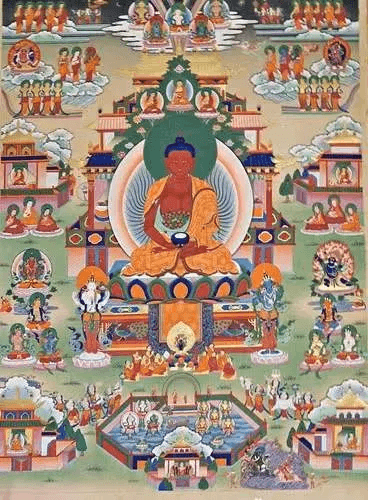
Amitabha Buddha is a familiar name to everyone, so he doesn’t require much explanation. Yesterday, I shared the teachings on Vajrakilaya, but since many are unfamiliar with it, I explained its origins.
Today, I won’t go into detail about Amitabha Buddha. The Amitabha Sutra is very popular in Han Chinese areas; wherever Mahayana Buddhism is practiced, everyone knows Amitabha Buddha and has likely read the Amitabha Sutra. The Infinite Life Sutra and the Amitabha Sutra are identical in both Tibetan and Chinese; the only difference is the language, not the content. The way Amitabha Buddha’s 48 great vows are divided and summarized is slightly different.
Everyone knows the merits of Amitabha Buddha. Reciting Amitabha Buddha’s name, believing in Amitabha Buddha, and practicing Amitabha Buddha’s teachings can all lead to rebirth in the Western Pure Land of Ultimate Bliss. Rebirth in the Pure Land is not without conditions; compared to other Dharma gates, the Amitabha Buddha’s Dharma gate is relatively easier. This is why we believe in Amitabha Buddha, recite Amitabha Buddha’s name, and are reborn in the Pure Land—that is, the Pure Land of Ultimate Bliss.
As everyone knows, Amitabha Buddha represents the Mahayana path. To practice this path, one must meet the conditions of Mahayana Buddhism. Those who practice Buddhism, regardless of the path they choose, must have faith in the Three Jewels. It is on this foundation of faith that Mahayana practice is cultivated.
The fundamental condition and basis of the Mahayana path is the generation of vast Bodhicitta (the aspiration for enlightenment). Bodhicitta has two types: relative Bodhicitta and ultimate Bodhicitta. Ultimate Bodhicitta is without discrimination, while relative Bodhicitta has many distinctions.
A more convenient way to generate Bodhicitta is to vow to practice this path and attain Bodhi in the future. Upon becoming a Buddha, one should benefit all sentient beings, placing them in a pure state of enlightenment or leading them to the Pure Land. The most fundamental basis of this Bodhicitta is first understanding one’s own suffering, and then understanding the suffering of sentient beings. Those who do not understand their own suffering cannot empathize with the suffering of others, cannot empathize with the suffering of other sentient beings, and therefore cannot empathize with the suffering of all sentient beings. Without being able to feel the suffering of all beings, it’s impossible to generate loving-kindness and compassion. Therefore, one should think, “I don’t want to suffer, so I don’t want other beings to suffer either.”
The methods for attaining happiness, disliking suffering, or abandoning suffering are all the same. All beings in this world, whether ants, cockroaches, spiders, or anything else, ultimately seek their own happiness. Of course, the levels of happiness differ; some are temporary, some are long-lasting. Temporary happiness lasts a year or two, some a lifetime. Long-lasting happiness, ultimate happiness, is liberation from the three realms and attainment of Bodhi.
In studying the Mahayana Dharma, one should learn ultimate happiness. On the path of practice, one should strive to give all beings even temporary happiness. Happiness in this life and ultimate happiness are our goals. Happiness is not for one’s own enjoyment; we hope all beings can attain ultimate happiness.
The ultimate purpose of studying and practicing the Dharma, and even the temporary purpose, is for those around us, or for all humanity. Reciting Amitabha Buddha’s name, or in the Pure Land school, reciting Amitabha Buddha’s mantra, etc., the fundamental basis and most fundamental condition is generating Bodhicitta (the aspiration for enlightenment).
Having faith in Amitabha Buddha is the first condition; the second condition is generating vast Bodhicitta.
Furthermore, practicing merit, holding repentance ceremonies, and constantly contemplating the Pure Land of Ultimate Bliss—having these four conditions guarantees rebirth in the Pure Land. When we practice and transmit the Amitabha Buddha Dharma, please do not forget these four conditions.
Now, I will begin to bless you and bestow the empowerment of Amitabha Buddha. Various schools have their own Amitabha Buddha Dharma. Today, I am transmitting the Amitabha Buddha Phowa (transference of consciousness) Dharma, passed down by the Kathok lineage master Kadampa Desha. Many people in the past practiced this Dharma and went to the Pure Land.
You should visualize the master in Amitabha Buddha’s Pure Land, looking at us with compassionate eyes and suggesting that we go to the Pure Land. Many eminent monks and virtuous masters of the past, before their passing, would tell the public that they would go to the Pure Land of Ultimate Bliss. All the patriarchs are in the Pure Land, as Bodhisattvas there. Practicing this Dharma makes it easier to reach the Pure Land.
Now, everyone should contemplate the merits of Amitabha Buddha, cultivate a strong hope and desire to go to the Pure Land, overcome your own suffering, and generate vast Bodhicitta for the sake of all sentient beings, practicing merit and repentance. Make a firm resolution to practice this Dharma, a resolve to attain Bodhi for the sake of all sentient beings. Have faith in the Guru, compassion for all sentient beings, and a pure view of all sentient beings.
Today, visualize this place of practice as the Pure Land of Ultimate Bliss; visualize the Guru as Amitabha Buddha; visualize all disciples as manifestations of Amitabha Buddha among Bodhisattvas; the Dharma being transmitted is the Amitabha Buddha Dharma, which brings liberation upon hearing; in this extremely rare and precious time, receive the Amitabha Buddha Dharma; practice the Amitabha Buddha Dharma, accepting this Dharma today with a heart that cherishes its rarity and preciousness. When this Dharma is transmitted, there will be some obstacle-removing rituals at the beginning, blessing rituals in the middle, and prayer and dedication rituals at the end. During the transmission, please turn off your cell phones and recording devices, and refrain from talking or chatting. Maintain a pure mind focused on Amitabha Buddha while listening to the Dharma.
Now we will perform the obstacle-removing ritual. Please visualize Vajrasattva or Amitabha Buddha above your heads.