
Amitabha Buddha’s incarnation, the lineage of Kadampa Desha, the founder of the Kathok school, Amitabha Buddha
admin 2025-08-09
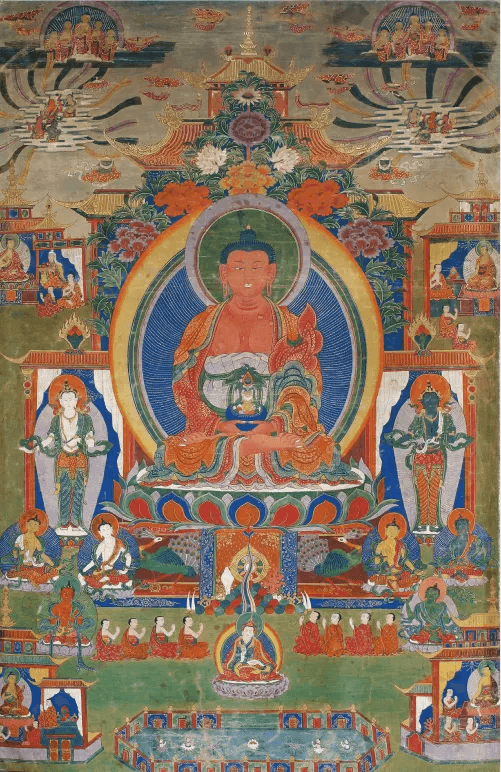
Today’s transmission is the Amitabha Buddha empowerment and the Amitabha Buddha liberation ritual. You have already seen the ritual text; please take a look at it. It contains explanations, and I believe you can understand it.
I. Origin of the Lineage
Today’s transmission is a very special Dharma, considered a unique feature within the Kathok school. It is the transmission of the Kathok patriarch Kadampa Desha, specifically the Amitabha Buddha ritual and empowerment passed down from Kadampa Desha.
I have received this empowerment from many masters, such as Penor Rinpoche. My earliest exposure to this empowerment was under the tutelage of Shichen Ongzhu Rinpoche, my great-uncle. I requested this transmission from him.
I also received it under Shazha Rinpoche. Shazha Rinpoche did not give the empowerment, but I received the oral transmission from him, which I requested myself. Because he compiled the Phowa practice of the Kathok school, specifically the Phowa method of Longsal Nyingpo, which I originally compiled with the support of Shakya Rinpoche, and the text is printed in Nepal. I reminded him to transmit this oral transmission, and he did transmit it to me. I accepted the supplication text and the Phowa practice. Therefore, his lineage is as follows.
One reason this practice is so special in the Kathok tradition is that receiving this empowerment or practicing this method guarantees rebirth in the Pure Land of Amitabha—this is the promise of the lineage masters. Because of this, this practice is very unique within the Kathok school.
II. Introduction to the Lineage Master Kadampa Desha
Many prophecies record that Kadampa Desha was an emanation of Amitabha Buddha. He himself practiced Amitabha’s teachings and personally witnessed Amitabha Buddha giving him empowerments and blessings. Of course, he would not publicly acknowledge himself as an emanation of Amitabha Buddha.
Kadampa Desha manifested as a bhikkhu (monk), appearing in monastic form. For a very long time, he practiced Amitabha Buddha as an ordinary practitioner, and finally saw Amitabha Buddha in person.
He saw many deities, including Amitabha Buddha. This is the conventional practice of Mahayoga. Mahayoga means that Tantric practice has many stages, divided into outer, inner, and secret. There are differences in rituals, visualization, stages of practice, and stages of meditation. The Dharma we are transmitting this time belongs to the practice of Mahayoga.
This Dharma was later transmitted to his two great disciples, whom we mentioned earlier. These two disciples can also be said to be his own manifestations, or they each lived in their own realm, each with their own different manifestations, stories, and histories. However, they were all in the same realm. Although they had their own stories, there was no distinction between teacher and disciple. Therefore, the teachings mentioned here are definitively established and undisputed. A wondrous great Acharya, a reincarnation of Shantideva, and an accomplished master of Chakrasamvara.
A great accomplished master from Nepal, a reincarnation of the Kadampa school, Kadampa was one of his reincarnations, named Kadampa Desha. The “Dam” in his name means “beginning.” Desha may have been his posthumous name. After death, it’s an honorific title for a king. This title is still used in many places, including Amdo. After death, “Desha” is added to the end of the name, indicating that he was a king and no longer exists in this world. It could also be his posthumous name; his original name was Sherikange—the Lion of Wisdom. He had many names, but here it’s Sherikange, or perhaps “Immeasurable Warrior,” “Brave Wisdom,” or “Unimpeded Eloquence”—there were many such names.
Initially, Kadampa Desha studied the Kagyu school; he was a Kagyu disciple. He was a lineage holder of the four great masters of the Kagyu school, specifically the four lesser and four great masters, Pangmu Zhepa. The great master Pangmu Zhepa branched into many Kagyu schools, such as the Drikung Kagyu and the Drukpa Kagyu, all of which are Pangmu Zhepa lineages. It is one of the four major lineages of the Pangmu Zhepa school. Pangmu Zhepa was the brother of Kadampa Desha. Some sources mention they shared the same father and mother, while others say they shared the same mother. They both studied under Gampopa in the Tsang region and also under Rechungpa. He was the second-generation successor of Milarepa, studying under both Rechungpa and Gampopa, thus representing a true Kagyu lineage. Because of this relationship, many Kagyu teachings are found in Kadampa Desha’s early works.
The teachings of the New Translation School include Mahamudra and Kalachakra, or Yamantaka, or Hevajra. I previously found Kadampa Desha’s extensive commentary on Hevajra in a library in Outer Mongolia, but I can’t find it now. These are some of Kadampa Desha’s New Translation School works. Later, the Kadampa school promoted the teachings of the Old Translation School, leading to the loss of many teachings and lineages of the New Translation School of Kadampa Desha.
The reason Kadampa Desha studied the Dzogchen teachings of the Old Translation School, specifically the Nyingma school, or the Guru Rinpoche lineage, is that he had studied under Sangpo Druppa. During his studies under Druppa, he realized emptiness. Although his time with Druppa was relatively short—he spent more time with Kagyu masters like Druppa and Sochungpa—his realization of Dzogchen led him to consider him his root guru. While this guru’s name is known in many lineages, he was a very great accomplished master of his time, though his biography is unavailable. His name is mentioned in many places.
Kadampa Desa, a master of many teachings, including Mahamudra and Dzogchen. The lineage of the unification of Mahamudra and Dzogchen wasn’t a later development; it was already established and transmitted during Kadampa Desa’s time.
This unified teaching of Mahamudra and Dzogchen also appears in the writings of Shakya Gyaltsen of the Kadampa school. The unified teaching of Dzogchen and Mahamudra is also found in the Palyul school today.
Kadampa Desa can be considered a non-sectarian master. He later propagated a significant portion of Padmasambhava’s teachings due to special circumstances. By practicing this method, he reconnected with the lineage, especially by cultivating faith and realizing the Dzogchen doctrine. His guru told him that if he went to a mountain for retreat and practice, he could attain the rainbow body in this lifetime; and if he propagated the Dharma, 100,000 disciples and lineage members would attain the rainbow body.
The master asked him, “Which one do you choose?” When the master asked this, he replied, “It’s no problem for me not to manifest the rainbow body. I hope my disciples, the lineage I’ve been taught, will achieve enlightenment and manifest the rainbow body.” He made this vow.
Afterwards, he began building Kathok Monastery. This is what we call the early Kathok school, which is slightly different from the later Kathok school. Historically, the earliest Kathok school was a fusion of the Kagyu and Nyingma schools. The later school primarily focused on the terma (hidden treasure teachings) of Dundul Dorje and Longsal Nyingpo. Although both are within the same lineage, the early and later periods are different.
Among the deities practiced by Kadampa Desha, he practiced many Kalachakra Tantras, as well as Hevajra, etc. After his passing, these images appeared on his skull. His skull has a special catalog, which Kadampa Desha himself said was written down by his disciples.
The Kadampa school used to have 13 treasure chests containing the relics of the lineage masters. Among these chests was the skull of Kadampa Desha, along with all of Kadampa Desha’s belongings, which included a special catalog. Kadampa Desha said that all his items were listed, specifying when, who would receive them, their names, and where they would go. He predicted this over 800 years ago. This skull is currently in my possession.
Where is Kadampa Desha’s heart? It is in the monastery of Kachen Rinpoche, the monastery of the great Kagyu master Kachen Rinpoche. He had it documented in writing because of the connection between him and his brother, Pangmu Zhepa. Therefore, the Drukpa Kagyu and Drikung Kagyu schools were often combined in the past. The two brothers founded a sect, and they were teacher and disciple to each other, entrusting each other with tokens of faith.
The heart and skull of Kadampa Desha are the most important, considered lineage treasures or family heirlooms. Because Kadampa Desha attained Buddhahood in this very life, all who see, hear, or touch his robes or skull will receive his blessings, as well as the blessings of Amitabha Buddha, he mentioned. He also mentioned that reciting the Kadampa Desha Three Deities Prayer will prevent one from falling into hell, and if recited in the presence of the deceased, it will ensure rebirth in the Pure Land of Ultimate Bliss. This is both Amitabha Buddha’s vow and Kadampa Desha’s vow.
III. The Power of the Lineage Masters’ Vows – Practicing this Method Leads to Rebirth in the Pure Land of Amitabha
When Shakya Rinpoche helped others practice the Phowa method, he often recited the Phowa teachings of Kadampa Desha. He was very happy when he transmitted this teaching, saying that our lineage masters are in the Pure Land of Amitabha, watching us with compassionate eyes. If you establish a Dharma connection with them, every lineage master is watching you from the Pure Land, and reciting this method will allow you to reach the Pure Land. He transmitted the Phowa method with such great joy.
Some masters are very happy when transmitting special teachings, and Shakya Rinpoche was also very happy when transmitting this method. It was as if all the lineage masters were watching us, and those who received the teachings would go to the Pure Land of Amitabha; they would guide us there.
Previously, when my master Ongzhu Rinpoche transmitted this method to me, he also mentioned this. Whether practicing for oneself or helping others, when he recited the Phowa method for the deceased, he also practiced this content. Ongzhu Rinpoche’s guru was Kathok Khenchen Aga, the most famous Kathok Khenpo, also known as Agwangpo. When they recite this mantra, they have faith in themselves and in this Dharma. Practicing this Dharma will bring their blessings, and the blessings of the patriarch Kadampa Desha. There is such transmission, such prophecy, and such aspiration from the guru.
Although this ritual is not very long and the recitation is simple, it is not necessary to recite the entire text. Just recite the prayer in the middle, and the prayer for the three deities at the beginning.
There was once an old man in Gansu, a hero in a tribe. He was very brave during the inter-tribal wars. His tribe was called Langdi. His descendants are still alive today. Because he committed many sins during the inter-tribal wars of Mongolia in his youth, he was able to purify himself through sincere repentance. (He practiced this Dharma method extensively in seclusion, and at the time of his death, he was freely reborn in the Pure Land of Ultimate Bliss.) Therefore, when practicing this Dharma method, one should frequently contemplate the merits of Amitabha Buddha.
IV. Conditions for Lotus Family Practice
Among all the Dharma practices in the world, the most commonly practiced are those of the Lotus Family among the Five Dhyani Buddhas: Avalokiteshvara, Amitabha Buddha, Padmasambhava, and Tara. These kinds of practices all belong to the Lotus Family.
The Lotus Family corresponds to the Western Dhyani Buddhas. The Lotus Family is particularly effective in remedying the desires of beings in the Desire Realm. Beings in the Desire Realm have strong desires, and the Bodhisattvas who counteract these strong desires are from the Lotus Family. Therefore, whether it is Avalokiteshvara, Padmasambhava, Amitabha Buddha, or other Bodhisattvas of the Lotus Family, their essence is the same, but their manifestations differ because they appear in various forms according to the needs of sentient beings to guide and liberate them.
The practices of the Lotus Family are relatively easy for beings in the Desire Realm to cultivate and resonate with. Whether it’s Guru Rinpoche, Tara, or Amitabha Buddha, it’s relatively easy to connect with them. This is related to Amitabha Buddha’s vows and the karmic connections with beings in the Desire Realm.
Regarding the conditions for practice, the conditions for practicing Amitabha Buddha’s methods are the lowest. Having faith in Amitabha Buddha, generating vast Bodhicitta, practicing merit and repentance, and daily remembering Amitabha Buddha’s virtues—these are all sufficient to reach the Pure Land. The conditions are quite low.
While the conditions for the Lotus Family practices are generally low, it’s not entirely accurate to say they are the lowest. Maintaining unwavering faith is not easy. Generating correct Bodhicitta is also not easy. Although it sounds simple, it’s actually very difficult in practice. Because these two are not easy to do—generating Bodhicitta is difficult, and people are easily angered—one must cultivate compassion within one’s heart.
Although there are only five conditions, they are simple yet extremely difficult. Maintaining unwavering faith and a vast aspiration is not easy, but we have faith, even if it’s not entirely firm.
Firm faith means not wavering when faced with trials. Whether it’s faith in the guru or the deity, not wavering when faced with trials constitutes firm faith. Even when sick or encountering adversity, if you have faith in the guru, and when the guru scolds you or points out your faults, you shouldn’t say, “I have no faults, it’s the guru’s misunderstanding.” If you think like this, you’re wrong, and your faith is insufficient. We’re not discussing that today; the main point is to maintain firm faith.
Furthermore, a firm aspiration isn’t just about cultivating compassion for those around you, but also about cultivating bodhicitta (the aspiration for enlightenment) even towards those you dislike the most. Therefore, it’s not easy.
When cultivating bodhicitta, why visualize the enemy first? Because you dislike them the most, because they have many problems, and seeing them makes you angry and troubled. Therefore, cultivating compassion and a vast bodhicitta towards them is not easy. The conditions for reaching Amitabha Buddha’s Pure Land are simple, but two conditions are difficult: unwavering faith and the arising of Bodhicitta (the aspiration for enlightenment). These two are extremely difficult to achieve.
All Mahayana practices require the arising of Bodhicitta, not just Amitabha Buddha’s teachings. If these can be achieved, reaching the Pure Land is not so difficult; it’s quite easy.
Regarding the conditions for reaching the Pure Land, you should examine yourself: Do I possess the necessary conditions to go to the Pure Land? Do I have the necessary conditions to learn Mahayana Buddhism? At the beginning of learning, everyone lacks these conditions, but one can strive and perfect them.
If everyone possessed all the necessary conditions when starting to learn Buddhism, then there would be no need for practice; one would quickly attain Buddhahood. It is because the conditions are not met that practice is necessary. When seeing the merits of a Dharma practice, one may feel joy, but seeing the conditions can lead to a loss of faith, and most importantly, self-deprecation. One might think: “I can’t do it, I have no way,” or “I lack the ability.” Many times we look down on ourselves, but in reality, every sentient being possesses Buddha-nature and has many potential conditions.
Many accomplished beings in the past were just like us—ordinary people. Ordinary people practiced, ordinary people studied, and ultimately, ordinary people achieved enlightenment, just like us. Sometimes they progressed, sometimes they regressed, advancing and retreating—that’s how they cultivated.
When we see the merits of Buddhas and Bodhisattvas, we feel that their merits seem to have been suddenly obtained, and we think they are extraordinary. But they weren’t suddenly obtained, nor are they extraordinary. They are the result of unwavering faith cultivated for three great eons. This perseverance is extraordinary, truly extraordinary. Sometimes good fortune comes suddenly, but that’s nothing extraordinary. The key is perseverance; perseverance is truly remarkable.
On the path of cultivation, perseverance is needed. When cultivating Amitabha Buddha, I just mentioned two stories I know—two people with heavy sins who ultimately went to the Pure Land. I’ve told this story many times; it’s one I know, and many people around them know it. They were also people of perseverance, and very loyal in their worldly affairs. Although they had killed many beings and accumulated heavy karma, they were two very brave and righteous people in the world. They never broke their promises, and their repentance wasn’t something that could be accomplished in a day or two.
Later, when asked how they cultivated themselves, they said they had worked diligently for over ten years, practicing without interruption. The first person I just mentioned, Langdi, walked from Gansu to Lhasa, repenting and practicing along the way. He was in a state of complete silence, not speaking at all. He had committed many sins, including the sin of killing, but when he finally arrived in Lhasa for pilgrimage, he didn’t speak for three years, only chanting Amitabha Buddha.
The Kadampa Desha Phowa we just mentioned also went on pilgrimage to Lhasa. Many people disliked him because of his widespread killing, and because of this dislike, he left. Then, for over ten years, he persevered, striving to achieve great accomplishments. For over a decade, they have consistently recited the Amitabha mantra daily, practicing this ritual and the Phowa method. Their attainment wasn’t sudden; it took a long time—some say around 15 years, others around 12—to diligently repent and ultimately achieve this result.
Therefore, when we talk about merit, those who encounter this Dharma are very fortunate; they will not fall into hell and will attain enlightenment. Thinking about merit may seem difficult, but if everyone makes a firm resolution, a steadfast heart, and perseverance, you can do it; you definitely can, there’s no problem.
The key is to make a resolution. Once you’ve made that resolution, no matter how difficult the path of practice, you cannot regress, not even in death. Even if you’ve died many times, you cannot regress on the path of practice in this life. You must have this kind of mindset; if you study and practice with this kind of mindset, you will definitely achieve enlightenment.
Therefore, in practicing Amitabha Buddha, you must have faith in Amitabha Buddha, compassion for all sentient beings, and practice repentance and merit-dedication. To reach the Pure Land of Ultimate Bliss, one must generally possess these conditions. If all of these are met, reaching the Pure Land is not very difficult.
Of these conditions, the most difficult are faith and the generation of Bodhicitta. I’ve repeatedly told you this, so please don’t forget. Every time I speak to those who are learning, I mention that practicing Dharma, reciting rituals, or chanting mantras a certain number of times is not difficult for many because many are willing to do it. However, we often neglect the most fundamental Dharma. We focus heavily on the secondary, though important, aspects that are not fundamental, and everyone pays great attention to them.
I often tell you that if someone gets angry today and abandons Bodhicitta, they don’t take it seriously. They think it’s normal to be angry about something. That’s perfectly normal. But if someone accidentally kills a sentient being, they feel very sad and pained. That’s not wrong; other people’s lives are important, the lives of other sentient beings are very important, and it’s understandable that they feel sad. However, killing out of hatred or intentional intent is not a very serious sin, because your motive was not to kill that being. Stepping on a cockroach or an ant is like being blessed by a mouse you were catching; you might then have nightmares every day.
While having faith in cause and effect is a good thing, if the killing wasn’t intentional, you should dedicate the merit and repent deeply. Don’t let repentance keep you up at night. Don’t let this become a form of harm. Your intention was to catch something, but you killed it accidentally. The sin isn’t very heavy, but the karma of hatred is very heavy, especially the karma of holding grudges. Therefore, everyone should be mindful of the karma of hatred and cultivate Bodhicitta (the aspiration for enlightenment). That’s what I’ve shared with you today.
Don’t forget what I just said about practicing the Pure Land Dharma. We don’t have much time today, so we’ll stop here.