Iron Ox Year End – Dorje Drolma (Wrathful Guru Rinpoche) Removes Obstacles
噶陀仁珍千宝仁波切 2025-08-05
Every year at the end of the year, we hold a series of Dharma assemblies, most of which are for removing obstacles. Therefore, they are commonly called year-end obstacle-removal ceremonies. This is a necessary annual event in Tibetan Buddhist monasteries; some monasteries perform it more often, some less, and some perform it for the entire month.
I. Introduction: Dorje Drolma (Wrathful Guru Rinpoche)
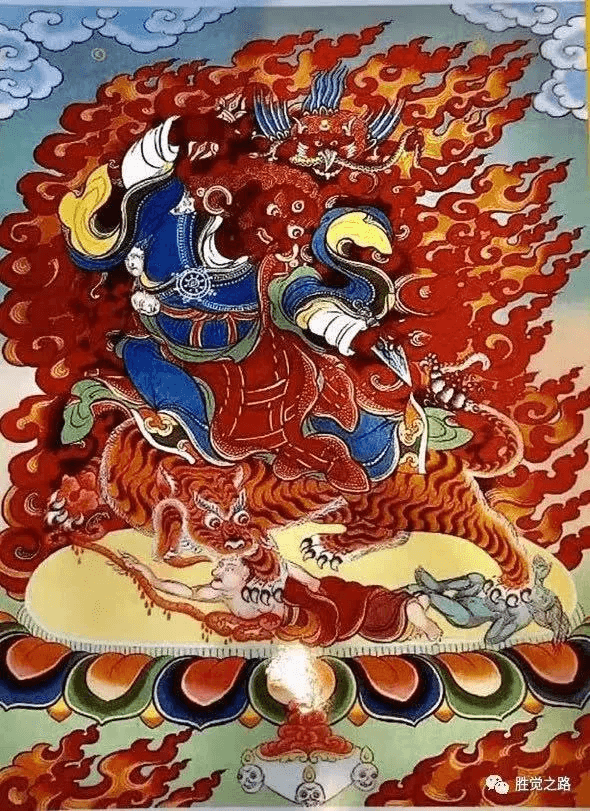
Today we are practicing the Wrathful Guru Rinpoche here. There are many forms of this deity; two of the eight manifestations of Guru Rinpoche are Wrathful Guru Rinpoche. In Dorje Drolma, “Dorje” means Vajra, and “Drolma” means transcendent. There are several translations of this, referring to the transcendent holy deity, the Wrathful Guru Rinpoche.
In Sanskrit, Drolma or Lokadala means transcendent. The Wrathful Guru Rinpoche manifested in this form within the eight great charnel grounds of India to subdue demons and heretics in various places. The time and place of his manifestations vary. Currently, the ritual texts show Guru Rinpoche manifesting in various places in the fearsome Vajra form of the Wrathful Guru Rinpoche to liberate sentient beings.
In particular, the “Nijin Zhongji Deze” (尼锦中吉得策) signifies Guru Rinpoche manifesting as a wrathful form in the Yaksha Palace and charnel ground to subdue demons and heretics in India and other regions.
II. Guru Rinpoche’s Thirteen Tiger Caves
Furthermore, before the construction of Samye Monastery in Tibet, Guru Rinpoche manifested as Dorje Drolma to subdue various Tibetan gods, earth gods, and the eight classes of celestial beings and dragons. Simultaneously, Guru Rinpoche manifested as Vajrapani in thirteen places to liberate sentient beings.
These thirteen places are commonly called “Tiger Caves,” characterized by tiger paw prints. The wrathful Guru Rinpoche rides a tiger, the meaning of which varies. Sometimes it represents Yeshe Tsogyal, or Shakya Deva, Tashi Chödrön, or other dakinis manifesting as tigers to subdue all demons, etc.
Sometimes the tiger represents a local deity, manifesting as a tiger as Guru Rinpoche’s mount out of respect. Sometimes it represents a rakshasa subdued by Guru Rinpoche, trampled underfoot after subjugation. In each place, Guru Rinpoche manifests in various forms, each with a different hidden meaning.
Regardless, Guru Rinpoche manifests as the wrathful form of Guru Rinpoche in the thirteen tiger caves of Tibet to liberate sentient beings.
Among the tiger caves, the one most familiar to everyone is the one in Bhutan. Others are the one in Wenpu Tsang in Tibet, next to Samye Monastery, which can also be called the tiger cave of Samye Qingpu. These two are the two most important tiger caves where Guru Rinpoche manifested as the wrathful form.
Previously, a Rinpoche asked where the thirteen tiger caves were. From what I remember, I only briefly mentioned them. But besides these thirteen tiger caves, there are others in other places as well. Guru Rinpoche’s activities pervade all worlds, therefore, there will be tiger caves wherever he is. Thus, there are not only thirteen; these are places with verifiable records from past great masters, places where hidden treasures have been unearthed.
III. The Merits and Benefits of Practicing Dorje Drolma (Wrathful Guru Rinpoche)
Today’s practice of the Wrathful Guru Rinpoche Vajra Terror addresses the various obstacles encountered in this degenerate age, both human and non-human. Human obstacles include mutual criticism, conflict, war, and betrayal. Non-human obstacles include unseen demons, beings in the intermediate state (bardo), beings in the Asura realm, and beings in the animal realm, all manifesting in various forms to harm sentient beings.
Currently, various inauspicious phenomena arise, such as imbalances in the four elements, inverted seasons, and the spread of plagues. These phenomena occur in both the human body and nature.
Especially, we are constantly experiencing afflictions. Ordinary people have the most afflictions; their minds are not at ease or free. They find fault with everything and everything. These arise from the demons within their hearts. This occurs when compassion is insufficient; therefore, we have the most demons within us.
Disrespect for the Guru and the Three Jewels, and a lack of compassion for sentient beings, constitute wrong views. When cause and effect are reversed, it is called wrong view. Wrong views are a form of delusion. When wrong views are strong, one cannot reach the Pure Land of Ultimate Bliss. One often commits the sin of abandoning the Dharma, giving up the Dharma, and harboring wrong views such as thinking this is good and that is bad, thus slandering the Three Jewels. Such slander of the Dharma, the Sangha, and the Buddha ultimately prevents one from reaching the Pure Land.
IV. Faith is the Foundation of Attainment
Among the practices, the easiest are the Great Perfection (Dzogchen) for those of superior capacity and the Pure Land practice for those of lesser capacity. Those of lesser capacity refer to those with unwavering faith.
In Mahayana Buddhism, the most supreme and ultimate practice is the Prajnaparamita (wisdom) practice. Those who study Prajnaparamita and the emptiness practice are those of superior capacity.
Those who rely on faith and the Buddhas and Bodhisattvas do not need to study many teachings; they can achieve enlightenment through faith alone. This is for those of lesser capacity. This doesn’t mean they are incapable of enlightenment or inferior, but rather that their wisdom in listening, contemplating, and meditating is not as great as that of those of superior capacity.
The easiest path to attainment requires faith. Without unwavering faith, no practice will yield results. Therefore, to strengthen one’s faith, it is crucial to frequently contemplate the merits of the Three Jewels. When practicing the Guru Rinpoche teachings or many wrathful deity teachings, with the intention of eliminating all obstacles, both outer and inner, the path of practice is relatively smooth.
Sentient beings in this degenerate age are easily prone to afflictions and easily lose faith. Our power of faith, compassion, and purity are all very weak and easily shattered like bubbles.
This requires strengthening one’s faith through the wisdom gained from listening, contemplating, and meditating, eliminating obstacles and increasing wisdom through the power of Buddhas and Bodhisattvas, thus strengthening one’s faith and firming one’s resolve on the path. We practice this method to solidify our resolve.
V. Eliminating Obstacles Requires Pure View
It’s not that we don’t understand the Dharma, nor that there are no solutions; there are many. However, people don’t practice them, or they can’t concentrate. Practicing two different methods in one time is difficult, a seven-day retreat is difficult. We vow to recite Vajrasattva’s mantra, vow to practice many other methods, but two, three, or four years have passed, and we still haven’t practiced! There are various excuses for not practicing.
The main problem is a lack of emphasis on the Dharma. If one values the Dharma, practice will be prioritized, leading to a brighter path of spiritual cultivation. Since vows made before the Three Jewels and the Guru have not been fulfilled, it’s normal to encounter obstacles on the path.
Therefore, to remove these obstacles, I often have those who have taken refuge recite the Guru Rinpoche mantra 100,000 times. Firstly, I hope for a smoother path of spiritual practice in the future. Secondly, I hope they receive the blessings of the lineage masters, being guided by Guru Rinpoche life after life and becoming his disciples.
If one recites with focus, sincerity, and dedication, corresponding signs will appear. However, if one practices merely as a formality, the effect will be less pronounced. This is not because the Dharma is not sublime, but because the person lacks focus; this also creates obstacles for oneself.
Originally, obstacles are destined to be removed through personal wisdom and the three wisdoms of study, contemplation, and meditation. If any one of these three wisdoms is lacking, removing obstacles is difficult. Hope alone is insufficient; to practice the sublime Dharma, one must become a suitable candidate for practice and possess the necessary qualifications.
It’s normal to encounter obstacles if one’s qualifications are not yet perfect. Therefore, before practicing, one must not forget the Three Jewels, nor sentient beings, and must observe one’s own mind, visualizing one’s mind as a pure mandala. Now, practicing the extremely sublime Dorje Drolma method, especially during the mantra recitation phase, visualize all objects as pure, the place as the Buddha’s pure land, oneself and others as the deity, and the sound heard as the mantra of Guru Rinpoche. Practice with this mindset.
Generally, our Five Perfections visualization involves visualizing all pure things as a pure land, the guru as pure, oneself as pure, and thoughts as pure—this is what is said in all tantras.
Especially, time and Dharma should be pure. The mind that cherishes the Dharma and cherishes time should not only cherish them but also achieve a state of equality across the three times, completely eliminating any discriminating thoughts about time.
If one cannot achieve this, thinking that time is precious, and wondering if there will be more time like this to practice with the guru, time to practice with virtuous intentions, then one cannot know. Therefore, one must cherish this rare and precious time.
Cherishing the Dharma—the Dharma is pure and wondrous—cultivates a heart that cherishes the Dharma, which in turn fosters a heart that cherishes the Guru; and when a heart cherishes the Guru, a heart that cherishes the Dharma naturally arises—they are the same. Lacking either one, neither is present.
Today’s practice is the most supreme method for removing obstacles among the various manifestations of Guru Rinpoche: the Dorje Drolma and Vajrapani Vajra practice. We practice with a heart of cherishing and joy.
Reciting his mantras can also remove obstacles to the body, family, and career, especially obstacles on our spiritual path. Everyone should practice sincerely.
While reciting the mantras, we offer torma, but the primary purpose is to dedicate the merit and offer blessings.
VI. Key Points of Visualization
The visualization of all objects is the pure land of lotus light. The visualization of the opposite being is the wrathful Vajrapani Guru Rinpoche Vajra of the Eight Manifestations of Guru Rinpoche, with a red lotus king on its crown, surrounded by a wrathful mandala of five dakinis, ten wrathful deities, and four guardian goddesses. Visualize the red syllable “Hum” on the vajra, which instantly transforms into the wrathful form of Guru Rinpoche, surrounded by the Ten Great Wisdom Kings and other deities, just like the one before him. Visualize yourself and others simultaneously.
Focus your mind on the seed syllable “Hum” and recite the mantra.
VII. Torma Offering
Due to various unfavorable conditions, only torma is offered to the wrathful deity. This is a very important offering to each protector deity. Therefore, practitioners of Tibetan Vajrayana Buddhism often make increasingly large and elaborate torma offerings. The purpose is to remove obstacles and grant accomplishments through torma offerings. Torma offerings bring the benefits of accomplishing worldly and spiritual goals and eliminating obstacles on the path. Therefore, torma (food) offerings are a very important and fundamental ritual in all schools of Tibetan Buddhism.
We offered over a thousand torma, rice, and other offerings, and recited the mantra a thousand times. Including those in online group practice, the total number of recitations should exceed ten thousand.
Offering ten thousand or a thousand offerings is mostly calculated in terms of the number of torma (Buddhist offerings) or the number of mantras recited, counted in two ways. Now we mainly calculate it by the number of mantras recited. By practicing together in this way, everyone receives the merit of offering ten thousand or a thousand offerings. I wish everyone good health. Amitabha!
VIII. Conclusion
Don’t forget the Three Don’ts: Don’t forget the Three Jewels, don’t forget all sentient beings, and don’t forget to constantly examine your own mind. Do you have greed, hatred, or pride? Observe, reflect, and correct yourself repeatedly! Amitabha!